Tag: Dualism
-
The Unfolding of Truth – 3: Plotinus – Emanation and the Return to Unity
If Plato glimpsed the realm of the eternal through the Forms, fixed, timeless, and shining with intelligible clarity, Plotinus deepens the vision. In the Enneads, he presents a metaphysical unfolding of reality from a single, ineffable source: the One. This One is beyond Being, beyond intellect, beyond any distinction. It is not a being among…
Written by

-
The Unfolding of Truth – 2: Two Worlds: Plato and the Birth of Metaphysical Structure
Parmenides had shown that Being cannot not be. Change, then, must be illusion. But human experience contradicts this at every turn: we see birth, death, decay, motion, transformation. If thought must reject the evidence of the senses, how is truth to be known? It is Plato who takes up this task, and with him, philosophy…
Written by
-
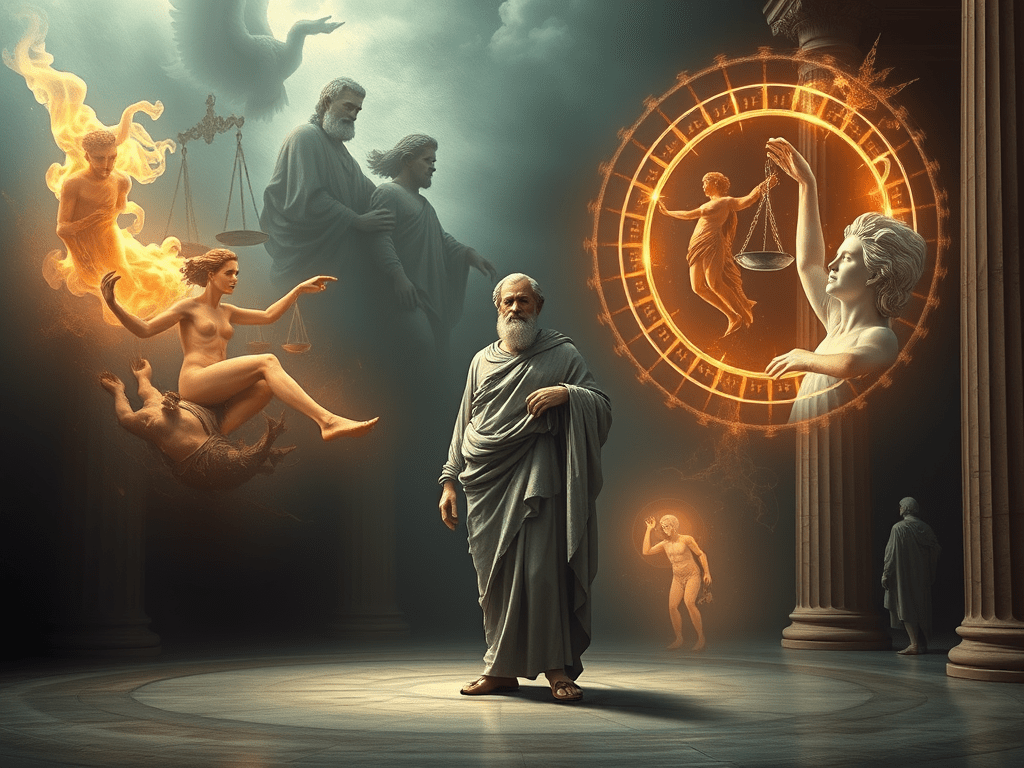
Christianity and the Structure of Being–A Metaphysical Map
From Plato to the Eternal Structure of Being 🔹 1. Plato (4th c. BCE) Core Move: Eternal Forms vs. Temporal World 🡺 Impact: Introduces the first metaphysical dualism→ Sets up the world of change as ontologically inferior→ Seeds the logic of annihilation (what becomes can also vanish) 🔹 2. Early Christianity (1st–4th c. CE) Core…
Written by

-
Christianity and the Structure of Being– Conclusion: Christianity Was Never Meant to End in Dualism
The Return to What Has Always Been True Throughout this series, we’ve traced a path—one not of rejection, but of return. Not a return to doctrine as it has been taught, nor to metaphysics as it has been inherited, but to the truth Christianity has always carried within itself: that what-is cannot not be. That…
Written by
-
Christianity and the Structure of Being– 5: Toward Fulfillment — Christianity and the End of Dualism
The Return to What Has Always Been True Christianity stands today at a threshold — not of decline, but of fulfillment. After centuries of tension between its deepest intuitions and its inherited metaphysics, the time has come to see what has been gesturing from the beginning: that the truths it proclaims are not mere hopes…
Written by
-
Christianity and the Structure of Being– 3: The Persistence of the Platonic Framework
From Augustine to Modernity: How Christianity Carried the Logic of Annihilation By the time Christianity emerged as the dominant religious force of the Roman Empire, the seeds of a deeper metaphysical tension had already been sown. The Christian proclamation of the eternal had fused with the Platonic suspicion of time, matter, and change. The result…
Written by
-
Christianity and the Structure of Being – 2: The Infiltration of Platonism
How Greek Metaphysics Entered Christian Thought In its earliest centuries, Christianity encountered a world saturated with Greek philosophy. Among the many schools of thought that shaped late antiquity, none was more influential—or more seductive—than Platonism. Plato offered a majestic metaphysical vision: a realm of eternal, unchanging Forms—the true Being of which all sensible things were…
Written by

-
Christianity and the Structure of Being– Introduction to the Series
From Dualism to Destiny For centuries, Christianity has offered the Western world its deepest intuitions about the eternal: that life does not end in death, that the person is sacred, that love is stronger than the grave, and that a kingdom without end is not only possible—but promised. And yet, these luminous insights have long…
Written by

-
Parmenides, the East, and the Question of Illusion
Across cultures and millennia, human thought has struggled with the same enigma: if Being is eternal, how do we account for the change and disappearance that fill our experience? Parmenides in Greece and the sages of the East each intuited the permanence of Being, yet consigned the world of appearances to illusion. Their insight was…
Written by

-
Beyond Left and Right – Article 10: The Eternal City – Towards a Civilization Aligned with the Structure of Being
Western civilization, having undergone profound crises of meaning, has long been caught in the oscillation between competing ideologies—none of which have been able to provide a stable foundation. The failure of both progressive deconstructionism and reactionary restorationism points to a deeper issue: the absence of a necessary and indestructible foundation upon which civilization can rest.…
Written by

-
Post 27 – The Structure of Being on the Illusion of Dualism
Introduction The Structure of Being perspective challenges a series of dualisms that are often taken for granted. By questioning the very idea of becoming—that things emerge, change, and vanish—this view exposes a fundamental mistake in our understanding of time and existence. This mistaken view gives rise to several apparent dualisms: Moreover, these themes resonate with…
Written by

-
Post 12 – The Empirical vs. Transcendental Self: Understanding Duality
Body and soul, flesh and spirit, empirical and transcendental—the list of dualities used to describe reality and the human condition is extensive. But does this dualism truly reflect reality? If it does, how do these two sides of existence relate to one another? Is this division a fundamental part of reality, or merely a framework…
Written by

 It Is What It Is