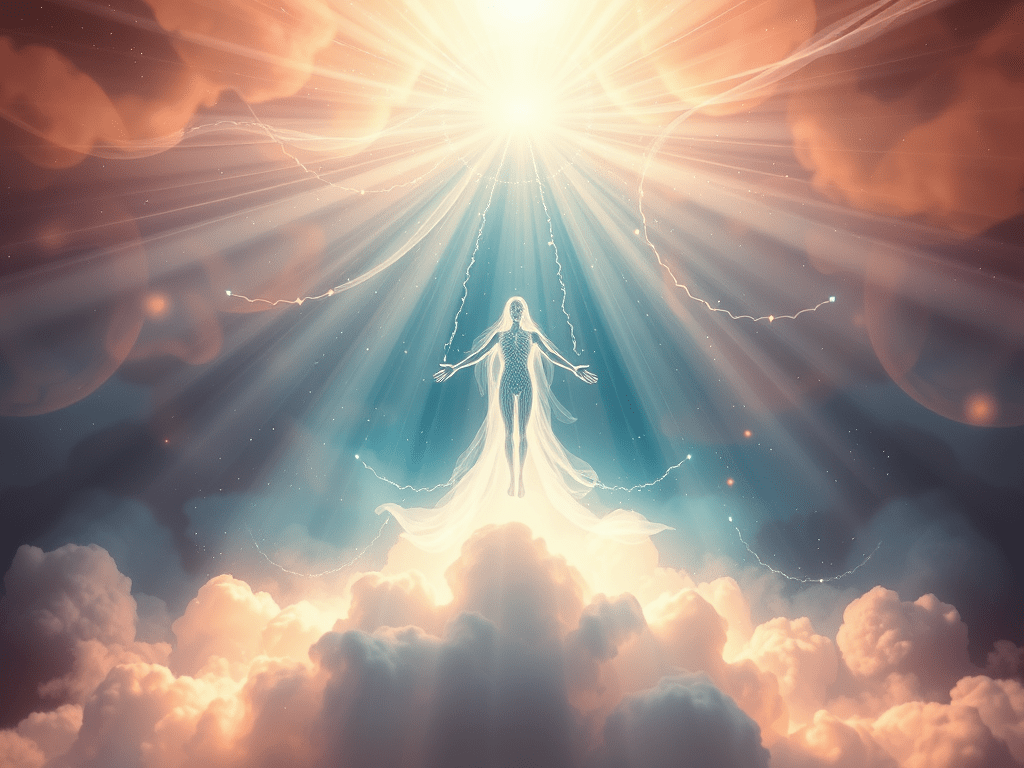
Near-Death Experiences (NDEs) have been recorded across cultures and historical periods, with strikingly similar elements recurring in diverse traditions. Reports of luminous beings, out-of-body perceptions, overwhelming peace, and encounters with deceased loved ones transcend specific religious or philosophical frameworks. Yet, the interpretations of these experiences are deeply shaped by the conceptual structures available within each culture. From the ancient Egyptian belief in the journey to the afterlife to contemporary accounts framed through neuroscience or spiritual transcendence, the phenomenon of NDEs remains profoundly enigmatic.
The Challenge of Interpretation
Despite the apparent consistency of many NDE elements, their meaning is not self-evident. Common narratives often impose assumptions of movement, transition, or personal transformation—suggesting that the experiencer has “left” one state of existence and entered another, only to “return.” This framing presupposes becoming: the idea that one passes from life to death and then back to life. Such an interpretation, however, is already conditioned by the belief in time as a linear process rather than recognizing that all that is, necessarily is.
When viewed through the lens of the eternal Structure of Being, the conventional ways of interpreting NDEs dissolve. What is experienced in an NDE is not a movement through different states of existence but the appearing of what is already and eternally true—albeit mediated through historical, linguistic, and cognitive limitations.
Beyond Scientific and Materialist Reductions
Modern materialist explanations attempt to reduce NDEs to biochemical and neurological phenomena—hallucinations triggered by oxygen deprivation, endorphin release, or brain activity patterns during states of trauma. While such accounts may describe certain physiological correlates, they fail to address the fundamental issue: the necessity of the appearing of these experiences within Being itself. The Structure of Being is not something that can be “caused” by a material process, nor can it be reduced to the contingent functions of a biological organism.
The inadequacy of scientific reductionism mirrors the limitations of religious or metaphysical interpretations that see NDEs as evidence of a sequential “afterlife.” Both perspectives remain trapped in the assumption of becoming—whether in the form of material emergence or spiritual transition—rather than recognizing the necessity of Being as eternally itself.
Toward a More Foundational Perspective
If NDEs are not journeys through different existential states, what are they? They are manifestations of the eternal appearing within the conditions of the finite. The elements perceived—light, encounters, peace, or fear—are not signs of a transition but rather the necessary unfolding of what is. The experience does not “reveal” a previously unknown domain but makes explicit what has always been.
Recognizing this allows for a shift in how NDEs are approached. Instead of seeking validation for particular religious or materialist doctrines, the focus turns to understanding how these experiences emerge within the unfolding of truth. They do not prove an afterlife, nor do they reduce to mere hallucinations. They express the necessity of Being in the way it must appear within human consciousness.
This series will explore these themes in depth, addressing the fundamental misconceptions surrounding NDEs and demonstrating how their true significance lies not in what they “suggest” about an afterlife, but in what they affirm about the eternal.
 It Is What It Is
Leave a comment