Category: Uncategorized – All Posts
-
Beyond Mortal Life 4: The Eternal Resolution: Justice, Memory, and the Reappearance of All Things
Introduction: From Reflection to Recognition The movement of thought we explored in the previous article brings us to the threshold of a deeper unveiling. What appears in moments of profound insight, whether in Near Death Experiences or in sudden awakenings of the heart, is not simply a review of past events, but the dawning recognition…
Written by
-
Beyond Mortal Life 3: The Burden of Guilt and the Search for Redemption
Introduction – A Wound in Our Seeing Guilt is one of the heaviest burdens carried by human beings. It does not simply wound our emotions; it distorts the very way we see ourselves, others, and the world. In guilt, we do not merely regret an action, we become convinced of our separation from what is…
Written by

-
Beyond Mortal Life 2: The Eternal Structure and the Unfolding of the Fragment
The Unity That Was Always There At the heart of the illusion of death lies another illusion: the belief that the being we are is only what we seemed to be in time. A series of acts, moments, feelings, memories, all of which fragmentary, vulnerable, often incoherent, and strung together by the thin thread of…
Written by

-
Beyond Mortal Life 1: The Mortal Illusion and the Eternal Foundation
The End That Never Was From the beginning of human thought, death has stood as the ultimate horizon. It has been seen as that final act in which everything we are is either lost or transfigured, depending on our beliefs, yet always with the underlying presumption that something ends. That presumption, deeply rooted in language…
Written by

-
The God Who Dies—and Does Not Die
Death, myth, and the veil between the Infinite and the finite Look at anything closely enough, and you will see its edges. This tree ends where the air begins. This hand is not that table. This person is not another. This moment is not the next. We live among distinct things, each occupying its own…
Written by
-
Truth Will Set You Free… But First It May Unsettle Everything
We often speak of truth as though it were necessarily comforting. “Truth will set you free” sounds like a promise. Behind it is an image of liberation in which something false is removed, clarity arrives, and we are finally able to live without the burdens that kept us confined. There is something deeply true in…
Written by
-
When Psychology Becomes the Last Religion
Psychology has become one of the principal languages through which we understand ourselves. We speak of trauma, attachment, personality, boundaries, self-esteem, conditioning, repression, coping mechanisms and emotional needs. We describe our relationships in psychological terms, interpret our childhoods through psychological categories, and increasingly turn to psychological explanations not only when something is wrong, but whenever…
Written by
-
Empathy and the Eclipse of Truth
Empathy has become one of the great moral virtues of our time. To empathize is generally understood as something almost unquestionably good: to put ourselves in another person’s place, to feel what they feel, to understand their experience from within rather than judging it from outside. There is much that is valuable in this. The…
Written by

-
The Problem of Paradigms: When the Map Becomes the Territory
We are surrounded by explanations. Physics tells us what matter is doing, biology tells us how organisms function, psychology tells us how the mind behaves, economics tells us how people respond to incentives, and religion offers its own language for questions of meaning and purpose. Each of these ways of looking at reality can be…
Written by

-
The Infinite Unveiling: Death, Contradiction, and the Eternal Horizon
Death has often been imagined as the ultimate threshold. It is the point at which life ends, the moment when we supposedly pass into nothingness, or, in religious traditions, the gateway through which the veil of this world is finally lifted and eternity is revealed. There is something deeply understandable in this intuition. As long…
Written by

-
Consciousness and the Origin of Appearing: Beyond the Search for a Foundation
It seems almost impossible to imagine an appearing without someone to whom something appears. If I see a tree, there is the tree and there is me seeing it. If I hear music, there is the sound and there is the consciousness in which the sound is heard. From this apparently simple experience, a much…
Written by

-
Origins, Causation, and Eternity: What Does a Beginning Really Mean?
We tend to speak of reality as though everything must have a beginning. The universe began. Life began. Each of us began. And behind these statements there seems to be an obvious picture: before something existed, there was nothing, and then, somehow, that something appeared. Three very different accounts of reality are often brought into…
Written by
-
War and Peace: In the Light of Being – 12
The Peace That Contains All Looking Back We began with a simple question. What do we mean when we speak of war and peace? At first the answer seemed almost self-evident. War appeared as conflict, peace as its absence. Yet the more carefully we looked, the less sufficient those familiar definitions became. History showed us…
Written by
-
War and Peace: In the Light of Being – 11
The Original War The Horizon We Never Stop Crossing Throughout history, humanity has rarely been content simply to inhabit the world it finds. Every age has sought to cross the horizon that seemed to define it. A sailor reaches the edge of the known sea and wonders what lies beyond. An explorer crosses a mountain…
Written by

-
War and Peace: In the Light of Being – 10
History in Another Light The History We Usually Tell History is often told as the story of what human beings accomplish. History presents us with empires, nations, wars, discoveries, and civilizations, each appearing within the changing landscape of human life. Every generation receives the achievements and failures of those who came before it, while hoping…
Written by
-
War and Peace: In the Light of Being – 9
It Was There All Along The Strange Nature of Recognition Some experiences leave us with the curious feeling that nothing new has happened, even though everything seems different. An old melody begins to play, and within a few notes we know it immediately. Walking through a familiar town after many years away, we suddenly recognise…
Written by

-
War and Peace: In the Light of Being – 8
What Action Presupposes Every Action Begins Somewhere Human life is inseparable from action. From the moment we wake until we fall asleep, we are continually doing something. We care for those entrusted to us, make plans, solve problems, repair what has broken, protect what we value, and prepare for what may come. Whether our actions…
Written by

-
War and Peace: In the Light of Being – 7
The Measure of Reality How We Measure the World Much of ordinary life depends upon measuring reality according to what can be done. We ask whether something can be achieved, protected, improved, repaired, preserved, or lost. Parents care for their children, physicians treat their patients, builders construct homes, and governments make decisions with the future…
Written by

-
War and Peace: In the Light of Being – 6
What Cannot Fall Into Nothing The Horizon of Loss In the previous article we considered the possibility that peace does not simply arise whenever conflict comes to an end. Historical peace remains precious, yet history itself seems unable either to establish it permanently or to preserve it indefinitely. This raises another question. If peace does…
Written by

-
War and Peace: In the Light of Being – 5
The Peace History Cannot Give What Do We Mean by Peace? Peace is one of the most cherished words in every language. Nations pursue it through diplomacy, families long for it after conflict, and individuals seek it in the midst of restless lives. We celebrate when wars come to an end, when violence subsides, and…
Written by

-
War and Peace: In the Light of Being – 4
What Lies Beyond Our Power? The Expanding Horizon of Action Throughout history, humanity has continually extended its ability to shape the world. We cultivate the land, build cities, harness rivers, cross oceans, cure diseases, explore space, and communicate across continents in an instant. Each generation inherits the achievements of those before it and adds something…
Written by

-
War and Peace: In the Light of Being – 3
The Measure of Our Power Shaping the World Human life is inseparable from action. From the moment we are born, we find ourselves in a world that calls for a response. We learn, build, cultivate, protect, heal, repair, invent, and organize. We do not simply inhabit the world. We continually seek to shape it. This…
Written by

-
War and Peace: In the Light of Being – 2
The World We Shape Acting in the World Whether we build or destroy, protect or attack, reconcile or separate, we are always acting. From the smallest decisions of daily life to the greatest events of history, human existence unfolds through countless acts of willing. We choose, plan, defend, organize, create, preserve, and sometimes destroy. Whether…
Written by
-
War and Peace: In the Light of Being – 1
What Do We Mean by War and Peace? Words We Rarely Question Few words seem more familiar than war and peace. From childhood onward, we learn to think of them as opposites: war is violence and peace its absence. One begins where the other ends, and history itself often appears to move back and forth…
Written by

-
War and Peace: In the Light of Being – Introduction
War and peace are among the oldest words in the human story. They belong to every civilisation, every culture, and every generation. They shape our understanding of history, influence our hopes for the future, and often determine how we judge both ourselves and others. We usually think we know what these words mean: war is…
Written by

-
Eternity in Everyday Life 3: Beyond Division
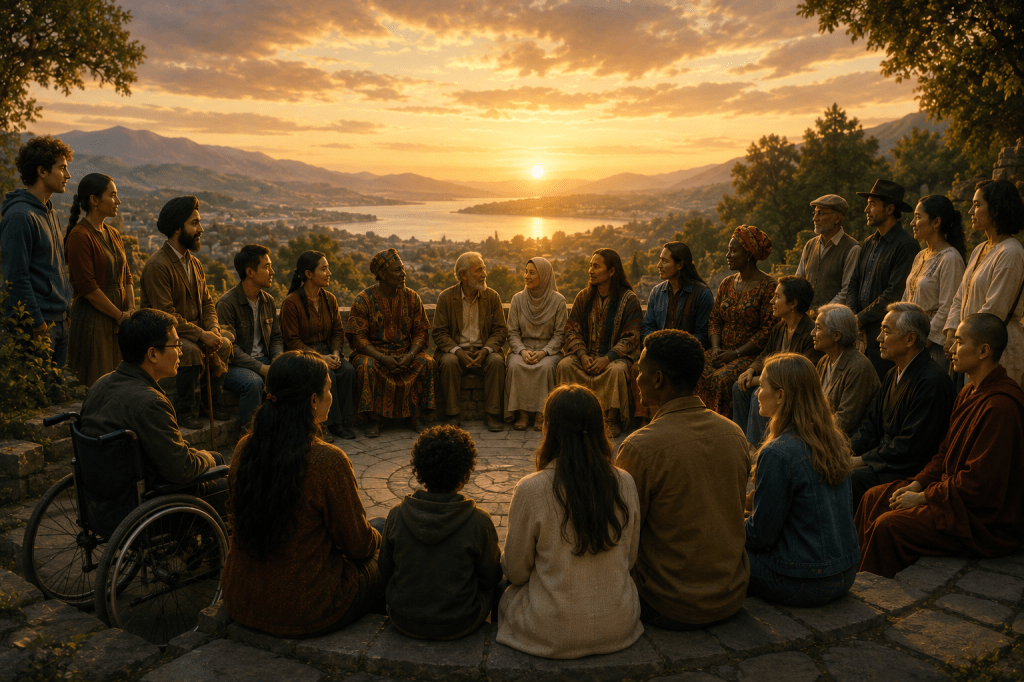
The Persistent Shadow of Hierarchy Humanity has long measured itself through distinctions. Kingdoms and empires separated the civilized from the barbarian. Colonial systems ranked peoples according to origin, appearance, or customs. Even where such structures have been challenged, the impulse behind them persists in more subtle forms. National pride, inherited prejudice, and unspoken assumptions continue…
Written by
-
Eternity in Everyday Life 2: The Eternal Person
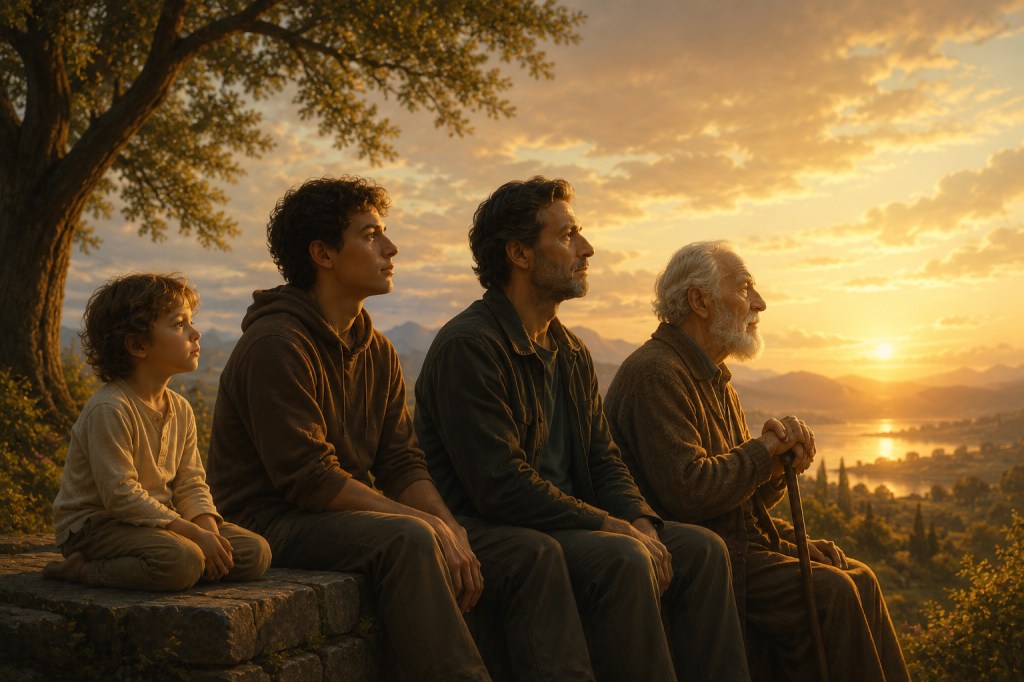
Age and the Illusion of Hierarchy In our world, time is not merely a measure of duration. It becomes a scale of value. Age, like wealth or beauty, is arranged into a hierarchy. The child is regarded as incomplete and in need of formation. Youth is celebrated as vigor, promise, and possibility. Adulthood is valued…
Written by
-
Eternity in Everyday Life 1: Beyond Comparison
Introduction – A World of Comparisons We live in a world addicted to comparison. Every aspect of human life is placed on a scale: beauty, intelligence, wealth, morality, success. We measure ourselves and others constantly. Am I better? Am I worse? Am I improving? Declining? Even in matters of virtue and spirituality, hierarchies persist between…
Written by
-
The Things We Cannot Stop Seeking
Beauty, Truth, and Love in an Age of Disenchantment A Time of Disenchantment Our age inherited extraordinary possibilities together with unprecedented skepticism. Generations learned to distrust every claim to truth, while beauty itself increasingly came to be identified with preference, provocation, or even deliberate ugliness. The promise of limitless freedom seemed to liberate humanity from…
Written by

-
The Eternal Horizon of Man and Woman
The turmoil surrounding masculinity and femininity often appears as a conflict between nature and culture, tradition and progress, biology and self-definition. Yet these oppositions, important as they may be, do not reach the deepest level of the question. Beneath every social form, every ideology, and every historical arrangement lies something more fundamental: the enduring distinction…
Written by


