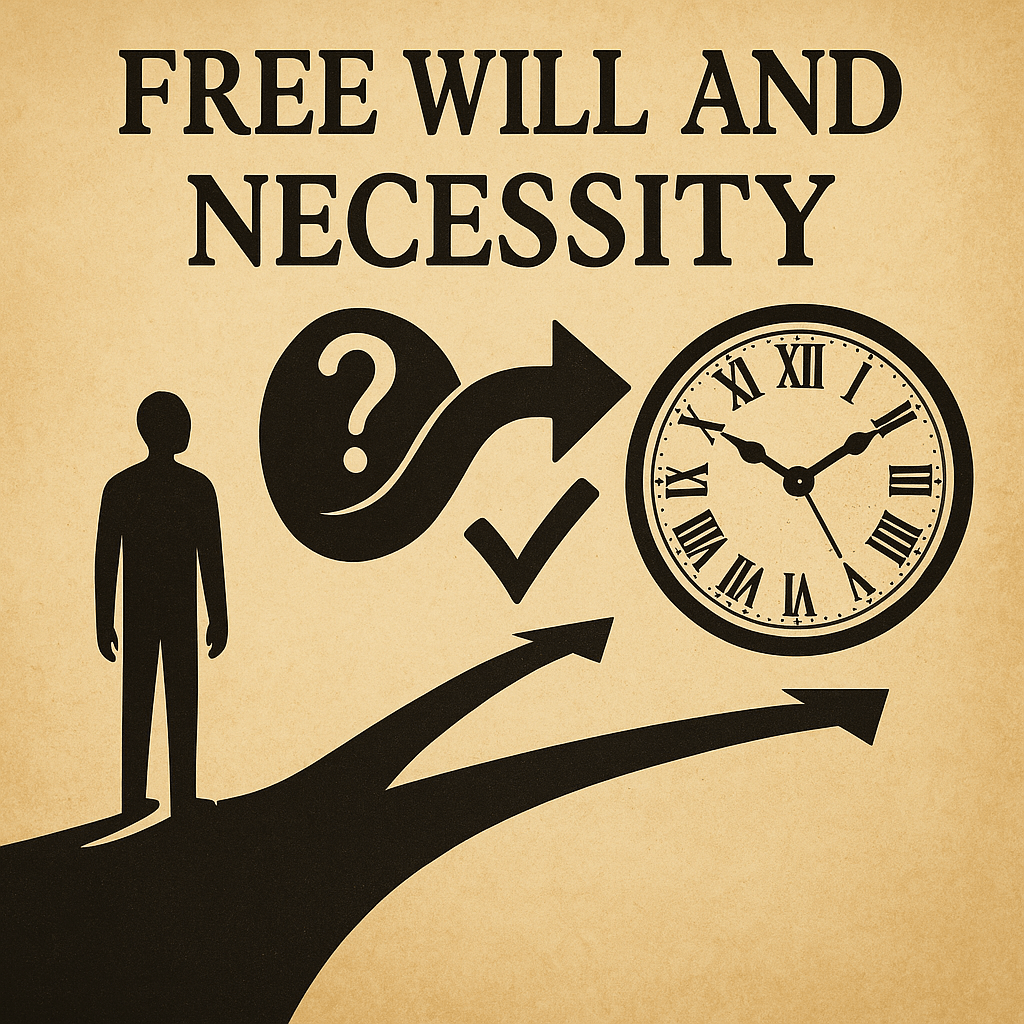
Free Will and the Necessity of Choice
Few concepts feel as fundamental to human experience as free will. We live with the conviction that we are active agents, capable of making choices, shaping our lives, and determining our future. And yet, if everything that is must necessarily be—if reality unfolds as an eternal, immutable structure—where does that leave freedom? Are we merely passive elements in an unchangeable whole? Does necessity eliminate choice, rendering agency an illusion?
These questions arise from a deep entrenchment in the framework of becoming, where choice is assumed to require contingency: the power to make something be that was not, or to prevent something that otherwise would have been. But if we move beyond this framework and recognize the eternal necessity of all that is, we find that free will is not erased but clarified.
The False Opposition Between Freedom and Necessity
The common perception of free will assumes that true agency requires a realm of possibilities—multiple potential futures where our choices make one come true over the others. This is the metaphysical assumption of contingency: that reality could unfold in more than one way. But this assumption, as we have seen, is built on the illusion of becoming, the belief that being can emerge from nothing and disappear into it.
If, instead, all that exists is eternal and necessary, then freedom cannot mean the power to introduce new realities or prevent existing ones from appearing. Rather, it must mean something deeper: the necessary self-expression of being itself.
Choice as the Inevitable Appearing of Will
The error in assuming necessity negates free will comes from the idea that freedom means “choosing between real alternatives.” But if we abandon the illusion of becoming, we see that what we call “choice” is the necessary unfolding of our will, as it eternally is.
Each of us appears as we must, including our desires, intentions, and decisions. This does not make us puppets of an external fate, because there is no external force imposing choices on us. We are necessary, not determined by some outside cause. Our will is not something foreign to us—it is us. When we make a decision, it is the necessary unfolding of what we are, not a mechanical response to external forces.
Freedom as the Recognition of Necessity
A deeper paradox emerges here: what we think of as freedom—the belief that we could have chosen otherwise—is an illusion born from the misunderstanding of being. The more we resist necessity, the more we feel trapped by it. But the more we recognize necessity, the more we experience true freedom.
When we struggle against necessity, we suffer because we assume that our choices could have been different, that regret or anxiety over decisions has meaning. But when we understand that our choices could never have been otherwise—that they are the necessary expression of our eternal being—we are liberated from this false burden.
True freedom is not in “choosing between possibilities,” but in recognizing that our choices are an inescapable, self-evident expression of what is. This is the profound recognition that resolves the false dilemma of determinism versus freedom: determinism assumes a mechanical causality imposed from without, but necessity is the self-expression of being from within.
From Free Will to the Misunderstanding of Nothingness
If we falsely assume that freedom requires contingency, we fall into the same fundamental mistake that underlies all misunderstandings: the belief in the reality of nothingness. Contingency assumes that there was a moment when one choice could have been actualized while another could have remained nothing. But nothingness is not a real possibility—it is a contradiction.
This confusion about nothingness has shaped the history of Western thought, giving rise to the illusion of becoming, contingency, and even the belief in an external cause that grants or withholds freedom. In the next article, The Misunderstanding of Nothingness: The Root of All Confusion, we will explore why the concept of nothingness is the fundamental error at the heart of all mistaken views of reality. By dissolving this illusion, we open the way to the full recognition of necessity, being, and the eternal structure of reality.
 It Is What It Is
Leave a comment