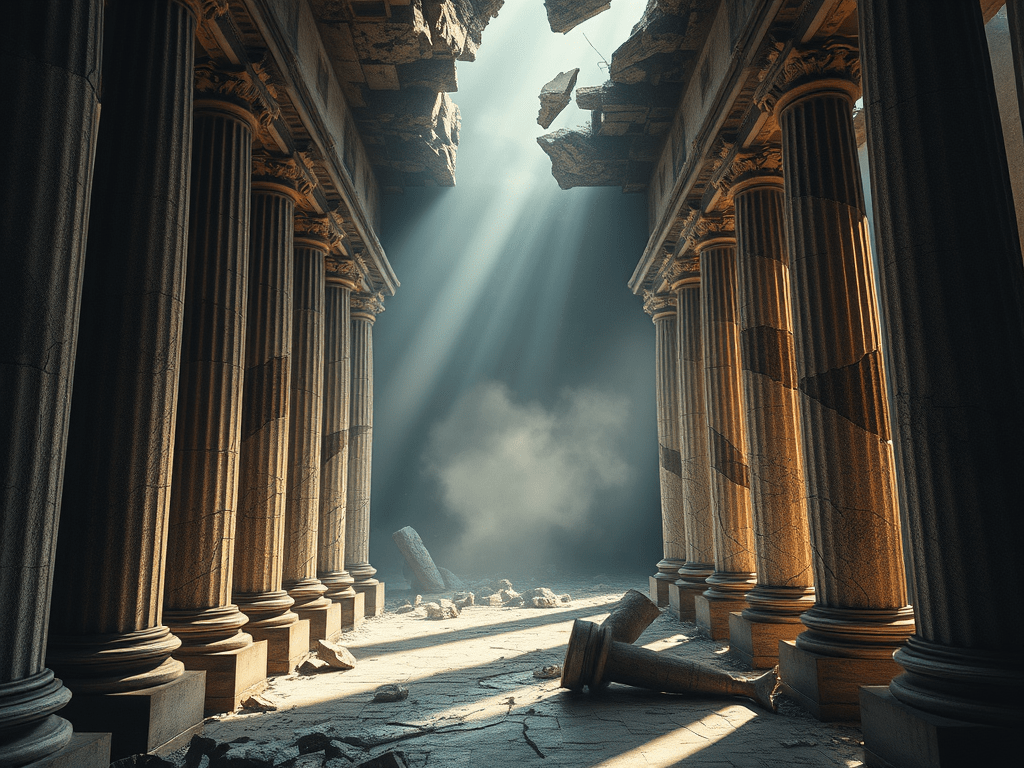
The Crisis of the West
In our time, there is an overwhelming sense of loss. The grand ideas that once shaped Western civilization—truth, beauty, wisdom—now seem fractured, overshadowed by relativism, nihilism, and despair. What was once a culture of towering philosophical and artistic achievements now appears disoriented, struggling to maintain its foundations. The arts, once infused with the sublime, increasingly reflect disorder and fragmentation. Thought, once anchored in the pursuit of ultimate meaning, often succumbs to skepticism or empty formalism. Society itself, disillusioned by the collapse of once-unshakable values, drifts toward a state of uncertainty, where meaning is no longer given but questioned at every turn.
How did we arrive at this point? The root of this crisis lies in the very trajectory of Western thought. The great metaphysical structures that once upheld truth were gradually eroded, giving way to an ever-deepening nihilism. The West’s intellectual legacy, which had sought the eternal, was undone by its own internal contradictions—contradictions that, in time, made their collapse inevitable. The belief in absolute meaning gave way to doubt; doubt gave way to rejection; rejection led to the conviction that meaning itself is an illusion. The result is the world we see today: a world where beauty is dismissed as subjective, truth is denied, and meaning is fractured beyond recognition.
The Pessimism That Follows
Faced with this collapse, it is natural to feel a profound sense of despair. Many lament the loss of values, seeing only decadence where once there was greatness. The decline of philosophical depth, the degeneration of artistic expression, the breakdown of cultural cohesion—all seem to signal an irreversible fall. The present appears as a shadow of the past, and the future as an abyss of uncertainty. In this state of pessimism, people are left grasping either for a return to a past that can no longer be restored or for new constructs that often feel hollow and artificial.
This despair is not merely intellectual but deeply emotional. It manifests in anxiety, in a pervasive sense of alienation, in the rise of mental suffering as people struggle to find meaning in a world where meaning itself is denied. The conclusion seems inescapable: civilization is in decline, and there is no way forward. Yet this conclusion is based on an assumption—that the fragmentation of meaning signals its destruction. But is this truly the case?
The Necessity of This Collapse
Emanuele Severino, among others, reveals that what we perceive as the downfall of the West is not the annihilation of meaning but the necessary process through which truth emerges. The great systems of the past, though magnificent, contained within them contradictions that had to be exposed. Their collapse is not the destruction of truth but the clearing away of errors that obscured it. The fading of previous worldviews is not the loss of meaning but the inevitable path toward its deeper recognition.
The West’s journey was destined to pass through nihilism—not as a final state, but as a necessary phase in the unveiling of being. The loss of certainty, the crisis of values, the rise of despair—all of these were unavoidable steps in the path of thought itself. If the structures of meaning built by past civilizations were truly eternal, they would not have crumbled. Their disintegration proves that they were incomplete, built upon assumptions that could not ultimately hold. Their collapse, then, is not an end but a transition toward the unveiling of a more necessary, more unshakable truth.
The Resolution: The Appearing of Truth
If we recognize that nihilism is not the destruction of meaning but its prelude, the despair surrounding our time gives way to clarity. The fragmentation of today’s world is not the victory of nothingness, but the necessary unfolding of thought towards a truth that can no longer be concealed. What is emerging is not another temporary system that will one day fall, but the recognition of the eternal structure of being itself.
Truth, beauty, and meaning are not lost; they are in the process of revealing themselves in their most unshakable form. The suffering caused by cultural collapse is real, but it is the pain of transition, not destruction. What appears as loss is, in truth, the inevitable movement of thought toward its ultimate necessity.
The conclusion, then, is not one of despair, but of profound certainty: what appears to be the decline of civilization is the unfolding of the eternal. The darkness of our time is not the death of meaning, but the moment before its most radiant illumination. To see this is to move beyond fear, beyond nostalgia, and beyond nihilism itself—to recognize that all things are eternally held within the appearing of truth.
 It Is What It Is
Leave a comment