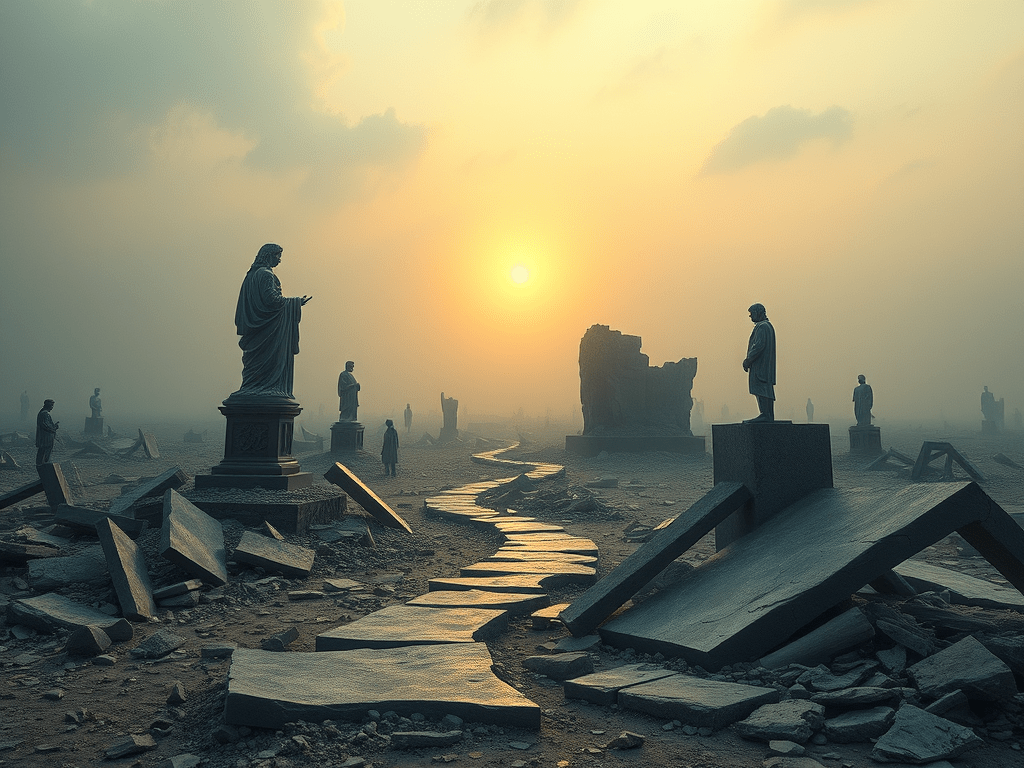
The Shadow of Nihilism
Western thought, having severed itself from the eternal structure of being, finds itself adrift in a sea of nihilism. The belief that existence is contingent, that truth is malleable, and that meaning must be constructed rather than recognized, has led to an age of fragmentation, despair, and cultural decay. This nihilism manifests in many forms, pervading philosophy, art, morality, psychology, and even politics, leaving in its wake a civilization increasingly disconnected from the necessity of being.
Philosophical Nihilism: The Collapse of Truth
The most fundamental expression of nihilism is the rejection of absolute truth. Relativism proclaims that all perspectives are equally valid, negating any foundation upon which reality can be understood. Skepticism and deconstructionism further this collapse, dismantling meaning without offering anything in return. The West, having lost faith in metaphysical necessity, assumes that being itself is unstable—a belief that gives rise to the existential void.
Cultural and Artistic Nihilism: The Loss of Beauty
Art and culture, once the highest expressions of truth, have become dominated by irony, absurdity, and fragmentation. The idea that beauty is subjective, that order is oppressive, and that meaning must be deconstructed has resulted in cultural forms that mirror the chaos of nihilistic thought. Where once art sought to unveil the eternal, now it revels in dissonance and ephemerality, reflecting the mistaken belief that nothing truly endures.
Social and Ethical Nihilism: The Disintegration of Values
The erosion of shared moral principles follows inevitably from the denial of being’s eternity. Moral relativism reduces ethics to preference, and the loss of a transcendent grounding for human dignity leaves individuals without a guiding principle. As a result, society is plagued by aimlessness, hedonism, and the pursuit of distractions to fill the void left by a rejection of necessity.
Psychological Nihilism: The Burden of Meaninglessness
Without an eternal foundation, the human psyche struggles under the weight of perceived emptiness. Depression, anxiety, and existential despair are the natural consequences of believing that life is fleeting and arbitrary. Suicide rates increase as individuals see no intrinsic reason to persist, and addiction flourishes as an escape from the unbearable awareness of purposelessness.
Political and Institutional Nihilism: The Crisis of Authority
Governments, religious institutions, and societal structures are viewed with growing cynicism, no longer seen as reflections of a higher order but as artificial constructs of power. Political discourse is reduced to manipulation and ideology, as competing forces attempt to impose order upon a world presumed to be without inherent meaning.
The Unraveling of Nihilism: The Return to the Eternal
However, nihilism contains within itself the seeds of its own destruction. The very despair it generates forces the realization that something essential has been overlooked: the eternity of being. The more the West spirals into meaninglessness, the clearer it becomes that the belief in contingency is unsustainable. The truth that nihilism obscures—that all things are eternal—eventually reasserts itself, dissolving nihilism at its root.
Philosophy Restored: The Recognition of Necessity
Once it is understood that being does not arise from nor fall into nothingness, the relativistic and skeptical worldview collapses. Truth is not constructed; it is recognized. Reality is not in flux; it is necessarily what it is. The paradox of nothingness, which has haunted Western thought, dissolves as the false dichotomy between being and non-being is abandoned. Nihilism fades, and with it, the illusion of an unstable world.
The Renaissance of Beauty and Meaning
Art, having been severed from truth, inevitably seeks its return. Once it is grasped that beauty is not a fleeting human construct but an expression of the eternal, artistic creation ceases to be an exercise in negation. Irony gives way to sincerity, and absurdity is replaced with the unveiling of necessity. The cultural wasteland of nihilism transforms into a flourishing landscape where beauty once again reveals being’s necessity.
The Restoration of Ethical Clarity
When being is seen as eternal, morality is no longer arbitrary. Ethics is not a social invention but a necessary aspect of reality’s structure. The confusion of moral relativism dissolves, and individuals recognize that they are not imposing meaning upon the world but aligning themselves with the necessary order of things. True justice emerges, not as an imposition, but as an unavoidable recognition.
The Healing of the Human Psyche
The existential despair of nihilism is rooted in the fear of loss, the belief that meaning is impermanent. But once the eternity of all that is becomes evident, this fear vanishes. Depression and anxiety lose their grip as individuals realize that they are not lost in an arbitrary world but are necessarily part of the eternal appearing of truth. The desperate need for escapism fades when reality itself is seen as inexhaustibly meaningful.
The Transcendence of Political and Institutional Cynicism
Authority is no longer seen as an oppressive construct when it is understood that truth is not imposed but appears according to necessity. The struggle for control that characterizes political nihilism becomes meaningless when it is seen that no human power can alter the structure of being. Institutions, if they are to endure, must align with truth rather than attempt to manufacture it.
The Inevitable Triumph of Truth
The nihilistic age is not an accident but a necessary stage in the unfolding of understanding. The West has undergone the experience of losing truth, not because truth is absent, but so that its necessity can be more profoundly recognized. Nihilism is the shadow cast by the forgetting of being’s eternity, and like all shadows, it disappears when light is recognized. The culmination of this process is not the triumph of despair but the inevitable reappearance of truth in its fullness.
The world, in its current state, appears fragmented and lost, but this is only the necessary unfolding of what must be recognized. The eternity of all things, once obscured, is now emerging into the clarity of recognition. And as it does, nihilism dissolves, revealing a world that was never truly lost—only waiting to be seen.
 It Is What It Is
Leave a comment