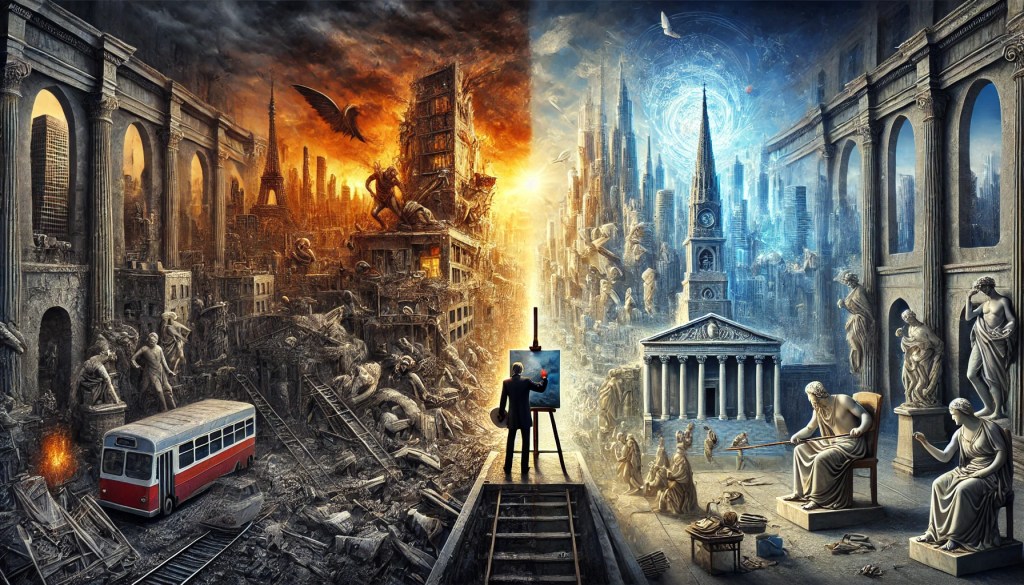
The decline of Western civilization has not only manifested in politics and ethics but has deeply affected art and culture. The modern world is flooded with cultural expressions that reflect fragmentation, disintegration, and a lack of meaning. Traditional artistic and cultural forms once expressed a sense of order, beauty, and connection to the eternal, but in a world that denies any foundational truth, art has become unmoored, drifting into relativism, nihilism, and self-indulgent subjectivity.
Yet art and culture are not arbitrary human inventions; they are necessary expressions of Being itself. Every civilization, whether it acknowledges it or not, reflects in its art a vision of reality. Thus, the crisis of contemporary art is not merely a crisis of aesthetics but a crisis of meaning. If a new foundation is to be found for humanity, it must manifest in cultural expression as well.
The Role of Art in Revealing Being
Art is not merely decoration or entertainment; it is a mode of revelation. Throughout history, the greatest works of art have served as windows into the eternal, pointing beyond the transient and revealing something of the necessity and structure of Being. Whether through the iconography of religious art, the symmetry of classical architecture, or the depth of literary masterpieces, art has always sought to manifest the underlying order of existence.
Modernity, however, has abandoned this role. When the foundation of Being was rejected, art lost its function as a conduit of truth and instead became a vehicle for arbitrary expression, personal opinion, or social critique. The result has been a culture that reflects not the eternal, but the fractured, unstable, and self-referential nature of nihilistic thought.
If art is to be restored to its proper role, it must once again be rooted in an indestructible foundation. This does not mean a return to old artistic forms for nostalgia’s sake, but rather a rediscovery of art’s true purpose: to make manifest the necessity of Being and reveal the eternal structure underlying existence.
The Fragmentation of Modern Culture
Cultural nihilism has not only affected art but has also fragmented the very notion of what culture itself is. Once, culture was understood as an organic whole, shaped by a civilization’s shared understanding of the world. Today, however, culture has been reduced to entertainment, consumerism, and shallow ideological battles. Without a unifying foundation, culture has disintegrated into a collection of isolated trends, disconnected from any deeper reality.
This is evident in the way modern societies treat tradition. Rather than seeing traditional art and cultural expressions as manifestations of eternal truths, they are often dismissed as outdated, oppressive, or irrelevant. But tradition, when properly understood, is not a set of arbitrary rules from the past—it is the necessary unfolding of Being in time. To reject it entirely is to sever oneself from the very structure that makes meaning possible.
Toward a Culture of Being
If civilization is to move beyond the failures of both left and right, it must rediscover a cultural foundation that is not merely an arbitrary construct but a reflection of necessity. This means fostering an artistic and cultural environment that does not glorify chaos, relativism, or ideological agendas but instead seeks to reveal the eternal structure of Being.
This does not imply a rigid imposition of particular styles or themes but rather a shift in orientation. True art will always take different forms in different epochs, but its essence must be the same: the manifestation of truth. A culture that recognizes the necessity of Being will produce art that is beautiful, ordered, and profound—not because of external rules but because truth itself is necessarily beautiful and ordered.
Conclusion: A New Renaissance?
The restoration of culture and art is not a secondary concern in the search for a new foundation—it is essential. If truth is to once again shape human civilization, it must appear not only in philosophy and ethics but in every expression of human creativity.
The question we must ask is: can there be a new Renaissance, one that does not simply imitate the past but instead arises from a true recognition of the eternal foundation of Being? If so, what would such a cultural transformation look like? In the next article, we will explore how this recognition of necessity can reshape education and knowledge, providing future generations with a worldview that is coherent, meaningful, and indestructible.
 It Is What It Is
Leave a comment