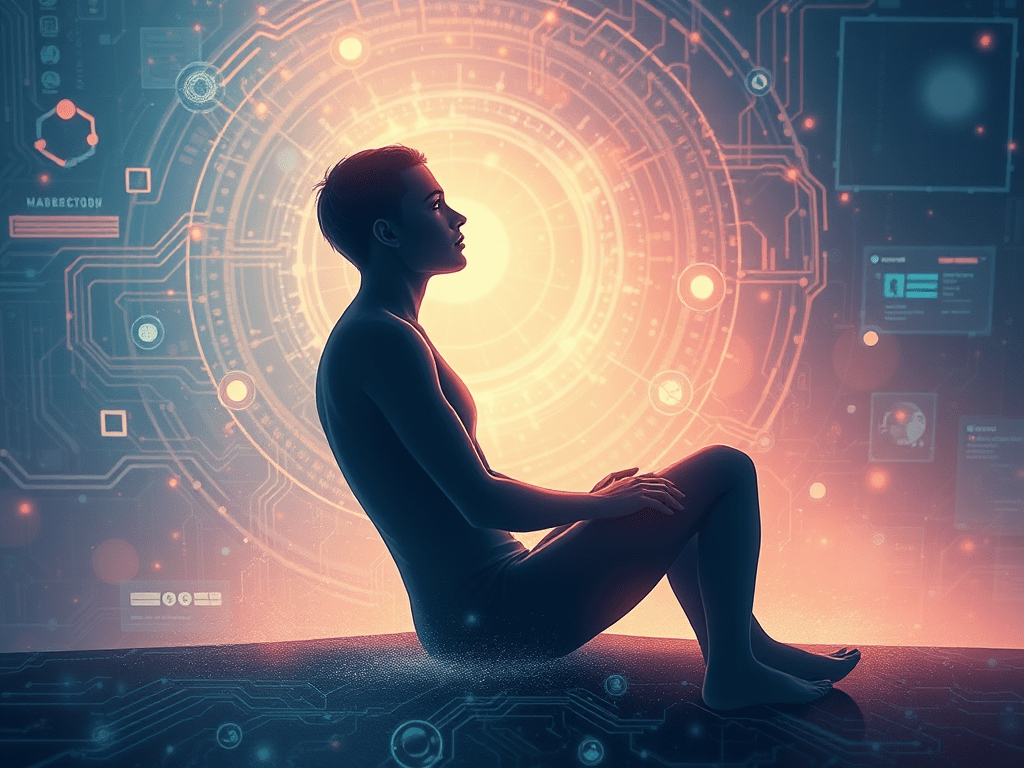
The modern world is increasingly shaped by artificial intelligence, automation, and digital technologies that promise to revolutionize human existence. Some believe that AI and advanced computation will eventually match or even surpass human intelligence, fundamentally altering our understanding of consciousness, creativity, and thought. This belief rests on the assumption that intelligence is merely an advanced form of data processing—an assumption that collapses when examined through the eternal structure of Being. If thought is reducible to material processes, then it remains contingent, subject to change and dissolution. However, true thought—the recognition of necessity—cannot be generated by something contingent. The rise of AI, rather than proving the triumph of materialism, only further reveals the limits of artificial thought and the irreducibility of consciousness.
The Illusion of Machine Consciousness
A central claim of AI research is that consciousness itself is an emergent property of complex computation. However, no matter how advanced an AI system becomes, it remains fundamentally bound to the contingencies of its programming, inputs, and the constraints of physical hardware. AI can simulate language, predict patterns, and mimic human responses, but it does not possess awareness. Awareness—the experience of being—is not a mere computation; it is the appearing of truth. Machines, lacking the necessity of Being, do not and cannot experience this appearing.
The belief that AI can eventually become self-aware assumes that consciousness is merely an advanced function of physical processes, reducible to neural activity or computational states. Yet, if consciousness were purely physical, it would be entirely subject to contingency—coming in and out of existence, bound by causality and the limits of materiality. This view contradicts the eternal Structure of Being, in which nothing that appears can be reduced to mere contingency. Consciousness is not something that ‘emerges’ but is a fundamental aspect of Being itself.
The Limits of Artificial Thought
AI and machine learning algorithms operate by detecting patterns, optimizing responses, and refining models based on statistical probabilities. Yet, no matter how sophisticated these models become, they remain within the realm of contingency. They can predict, process, and calculate, but they cannot know in the true sense. Knowledge is not a mere accumulation of data but the recognition of necessity—an awareness that cannot be produced through mechanical repetition.
The belief that AI can ‘think’ in a meaningful way stems from a misunderstanding of what thought is. If thought were simply a process of organizing and retrieving information, then indeed, AI might eventually surpass human beings in speed and efficiency. But thought, in its truest sense, is not computation—it is the recognition of that which is beyond contingency. This is why no matter how powerful AI becomes, it remains incapable of true understanding, insight, or self-awareness.
The Failure of Technological Utopianism
The idea that AI and technology will solve humanity’s fundamental problems is a modern form of utopianism, one that assumes the future holds the key to a perfected existence. Transhumanists and techno-optimists believe that human consciousness can eventually be uploaded, enhanced, or merged with artificial systems. This vision assumes that thought is merely an advanced biological computation—an assumption that disregards the necessity of Being.
Such technological aspirations fail because they remain trapped within the logic of contingency. If human thought were reducible to digital information, then it would be just as unstable and impermanent as any data stream—subject to corruption, alteration, and decay. The persistence of this view reflects an implicit nihilism: the belief that everything is ultimately malleable, that nothing is truly necessary, and that even human identity can be modified at will. This nihilism collapses when confronted with the immutable nature of Being.
The Role of Technology in Revealing Being
This does not mean that technology has no role in the unfolding of truth. In fact, the very development of AI and digital computation serves to highlight the distinction between true thought and mere mechanical processing. As AI reaches new levels of sophistication, it will only further demonstrate the irreplaceability of human awareness. The more AI is refined, the clearer it becomes that intelligence is not synonymous with Being, and that the deepest truths of existence cannot be reduced to algorithms.
The pursuit of artificial thought inadvertently reveals the necessity of true thought—the recognition of what is eternal. Technology, rather than replacing human consciousness, serves as a mirror reflecting the limits of materialism and the inescapable reality of Being. In this sense, the rise of AI does not mark the triumph of artificial intelligence but the inevitable recognition of the indestructibility of thought itself.
Conclusion: AI and the Unavoidable Truth of Being
The rise of AI does not affirm the sufficiency of materialism—it exposes its fundamental inadequacy. Intelligence is not computation, and consciousness is not an emergent property of material complexity. Machines, no matter how advanced, remain bound to contingency, while true thought is not something produced, learned, or engineered—it is the recognition of necessity.
Rather than proving that artificial systems can replicate or surpass human intelligence, AI serves as a mirror reflecting the misunderstanding at the heart of technological utopianism. The very attempt to synthesize thought only reaffirms that Being cannot be simulated, reduced, or manufactured. In the end, technology itself becomes yet another sign pointing toward the eternal structure of reality, confirming that the foundation of thought and existence is beyond all contingency.
 It Is What It Is
Leave a comment