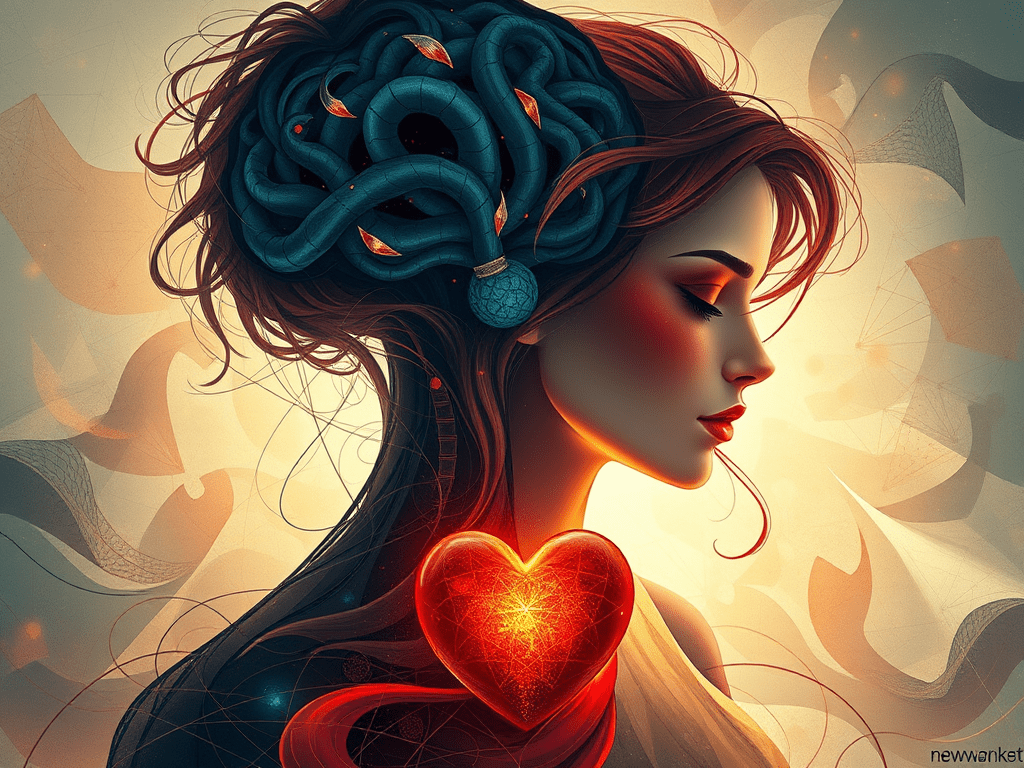
The Modern Fragmentation of Mind and Heart
In contemporary discourse, reason and emotion are often seen as opposing forces—one cold and calculating, the other passionate and irrational. This division runs deep in philosophy, psychology, and daily life, leading individuals to either suppress emotions in favor of logic or reject reason in pursuit of authenticity. But this fragmentation is rooted in an underlying misconception: the belief that thought and feeling belong to different, even conflicting, realms rather than being two aspects of the same recognition of Being.
When both intellect and emotion remain trapped in the paradigm of becoming, they operate in a state of contradiction. Rationalism, when severed from deeper recognition, leads to abstraction—an endless search for certainty through concepts that never fully satisfy. Emotion, when seen as mere fluctuation, becomes unstable, constantly shifting between attachment and loss. Both are caught in the same illusion: that fulfillment is something to be attained rather than something already eternally present.
The Contradiction of Rationalism and Emotional Instability
Rationalism, as it is commonly understood, assumes that the mind can arrive at ultimate truth through analysis, categorization, and logical inference. But when divorced from the recognition of necessity, this process becomes an endless deferral—one premise leading to another, one theory revising the last, never arriving at what simply is. The intellect, trapped in becoming, searches for stability in an unstable framework, mistaking its own movement for progress rather than seeing that true understanding is not constructed but recognized.
Emotion, on the other hand, is often reduced to reaction—a temporary response to external conditions, subject to change and loss. The modern view of emotion oscillates between indulgence and control: either one surrenders to every passing feeling or attempts to master emotions through discipline. But both approaches stem from the same mistaken premise—that emotions are transient, contingent, and ultimately unreliable.
In this paradigm, thought becomes an endless chase, and feeling becomes a wave that rises and falls without direction. Both are imprisoned in the contradiction of seeking what is already necessarily true: the fullness of Being.
The Path Beyond Fragmentation
The resolution of this conflict does not lie in suppressing one side or in finding a balance between the two, but in recognizing their shared foundation. Thought, when severed from necessity, becomes an abstraction; emotion, when detached from the eternal, becomes instability. But when both are rooted in Being, they cease to be in conflict. The intellect no longer seeks endlessly, and the heart no longer fears loss.
This transformation is not about changing how one thinks or feels but about seeing through the illusion that fulfillment is something that must be attained. The resolution does not come through effort but through recognition—the recognition that what is, already is, and that both thought and feeling, in their truest forms, are the direct experience of this necessity.
 It Is What It Is
Leave a comment