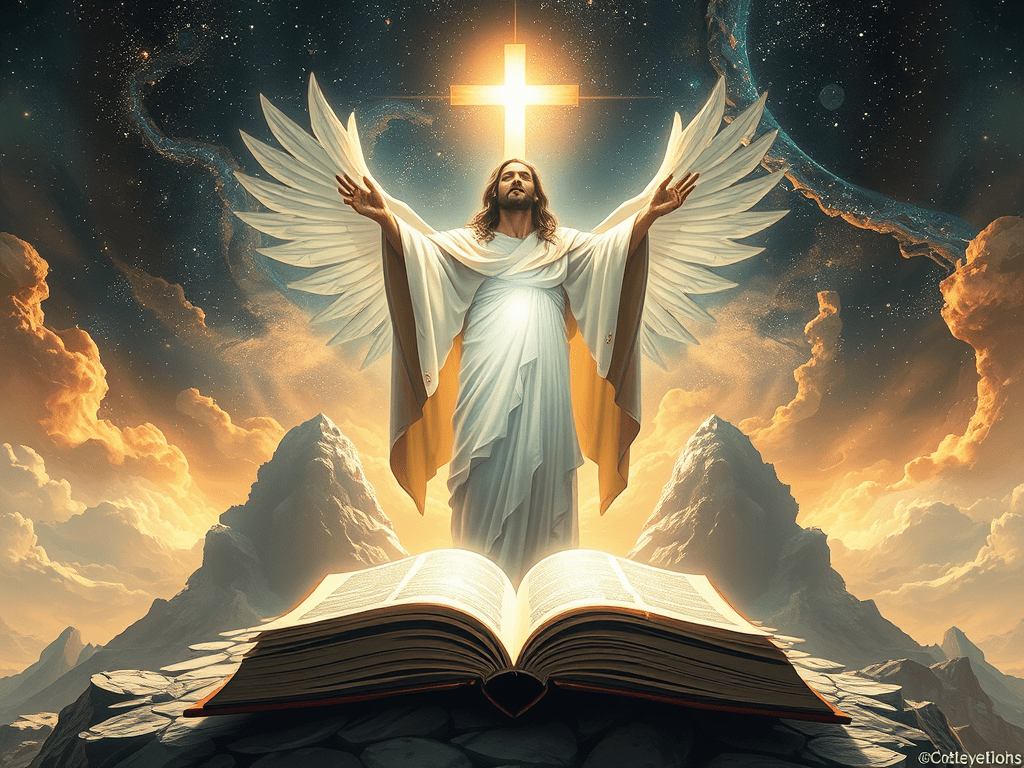
The Seeds of Truth in the Christian Vision
From its very beginning, Christianity has spoken of eternity. Not merely as a distant realm beyond this life, but as something that enters into history—something that breaks into time through incarnation, resurrection, and the promise of a kingdom that shall have no end.
In this, Christianity reveals one of the most radical and enduring intuitions ever to arise in human thought: that the temporal is not meaningless, that the body is not disposable, and that the person is not a shadow but a being of infinite worth. These are not minor ethical claims; they are metaphysical affirmations—glimpses of an eternal structure of Being that transcends both religious and philosophical traditions.
We see this intuition shining at key moments:
- In the affirmation that God became flesh—not to escape it, but to fulfill it.
- In the belief that death is not the end, and that life is not swallowed by the void.
- In the hope that the body itself will be raised in glory, not discarded like a worn-out garment.
- In the faith that history matters—that each act, each word, each life is not a passing illusion, but part of a cosmic and eternal unfolding.
These are not just teachings; they are metaphysical positions. They assert that what is most real is not beyond us, but among us—and that what appears, appears within an order that is not contingent, but destined.
This is what Christianity, in its most luminous expression, dares to declare: that the eternal is not elsewhere, but is present—already and always—in the world, in the body, in the face of the other.
And yet, this intuition has never been easy to hold.
Almost from the beginning, Christianity was confronted with the intellectual force of Greek metaphysics—especially the Platonic view that the world of change and appearance is secondary to the world of eternal, unchanging Forms. While early Christians rejected many aspects of pagan thought, they could not help but absorb this dualistic framework. And over time, it shaped the way they spoke of God, the soul, salvation, and the world.
The result was a metaphysical tension that Christianity has never fully resolved: on the one hand, it proclaims the eternity of love, the resurrection of the body, and the triumph of life; on the other, it speaks of a world created from nothing, destined for judgment, and ultimately passing away.
This tension is not merely theological—it is ontological. It is the contradiction between the intuition of eternity and the assumption of contingency. Between a world that is necessary, and a world that could have not been. Between Being that is eternal, and becoming that leads to nothing.
But what if this contradiction is not essential to Christianity? What if the deepest truth of Christian faith is not this tension, but its resolution?
What if Christianity, at its core, is not the rejection of the world, but the revelation of its eternal structure?
In this series, we will explore how Christianity’s most powerful affirmations—of love, life, personhood, and resurrection—point toward a truth it has not yet fully seen: that what-is cannot not be. That the world, the self, and the body are not fleeting stages on the way to something higher, but eternal presences in the unfolding of Being.
This is not a call to abandon the Christian tradition. It is a call to fulfill it.
To recognize in its own language and longing the shape of what has always been true: that the eternal does not stand against the temporal, but appears within it. That salvation is not escape, but recognition. And that what Christianity has sought in faith, the structure of Being affirms in necessity.
In this light, Christianity does not dissolve. It deepens. Its truths are not diminished, but grounded—no longer suspended over the abyss of nothingness, but rooted in the eternal ground of all that appears.
We begin, then, not by pointing out Christianity’s failures, but by honoring its most luminous intuition: that what-is is not lost, not doomed, not accidental—but eternal.
 It Is What It Is
Leave a comment