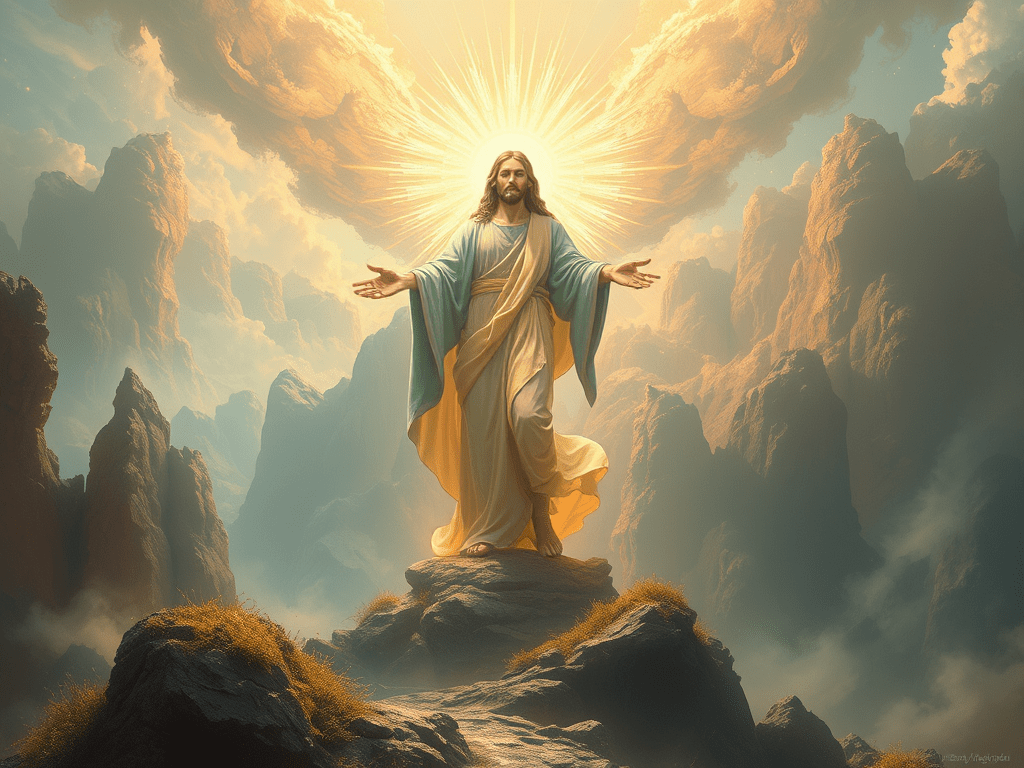
The Return to What Has Always Been True
Christianity stands today at a threshold — not of decline, but of fulfillment. After centuries of tension between its deepest intuitions and its inherited metaphysics, the time has come to see what has been gesturing from the beginning: that the truths it proclaims are not mere hopes or promises, but revelations of an eternal structure that has always already been the case.
To fulfill itself, Christianity must overcome the Platonic impasse—not by abandoning its faith, but by recognizing that the structure of Being itself affirms what Christianity has always longed to say.
The End of the Impasse
Platonism gave Christianity a language for transcendence—but at a cost. It taught that the eternal stands apart from the world, that the soul must flee the body, and that creation, made from nothing, can return to nothing. It introduced a metaphysical dualism that Christianity then carried for centuries: a division between time and eternity, world and heaven, body and spirit.
But Christianity also proclaimed the Incarnation: God enters the world. It proclaimed the resurrection: the body is not left behind. It proclaimed love as eternal, not conditional. These affirmations resist the logic of annihilation. They insist that what is — the person, the body, the world — is not disposable.
The contradiction has become unbearable. And the only path forward is not to suppress it, but to resolve it at its root.
The Necessity of What Is
The eternal life proclaimed by the Gospel is not a reward to be granted, but a truth to be recognized: that what-is cannot not be. Being is eternal, and what appears—each moment, each soul, each body—is an appearing of the eternal, not a transient flicker over a void.
In this light, resurrection is not a miraculous interruption of nature, but the unveiling of what the body already is: an eternal being, temporarily hidden, but never annihilated. The “glorified body” is not a future fabrication, but the recognition that the body, in its essence, is already inscribed in glory—because it cannot fall into nothingness.
Love, in this vision, is not the precarious bond between separate, fading beings. It is the recognition of the eternal in the other—the affirmation that the beloved, too, cannot not be. Love sees what is already true. It does not preserve the other from loss; it sees that there is no loss.
In this framework, salvation is no longer rescue from annihilation. It is the recognition of the impossibility of annihilation—the unveiling of the eternal light of each being.
The Christian God: Not Will, But Necessity
To reach this clarity, even the Christian understanding of God must undergo fulfillment. The God who creates the world from nothing and governs it through will becomes, at last, the appearing of the eternal—not a sovereign above Being, but the necessity of Being itself.
This is not a diminishment of God, but His liberation from the image of arbitrary power—a liberation Christianity itself has long desired. For centuries, Christians have struggled with the paradox of a God who loves, but who may damn; who creates, but may destroy. But if nothing can fall into nothingness, then the divine is not a choosing will over a void, but the groundless ground—the necessity that all that is, is eternally.
In this light, the divine is not a being among beings, not even the highest being, but the appearing of Being itself: the eternal structure within which every being, every face, every moment appears and is saved.
The Necessity of Redemption
With this, Christianity’s deepest promise comes into focus: that all will be saved, that nothing is lost, that every being is destined not for judgment and separation, but for glory.
This is not wishful thinking. It is not an optimistic eschatology. It is the metaphysical recognition that salvation is not contingent, but necessary. That nothing can be excluded from Being. That the eternal life offered in Christ is not one possibility among others, but the unveiling of what has always already been the case.
Christianity, then, does not need to choose between dogma and denial, nor between abstraction and mysticism. It need only recognize that its truths are eternal truths, and that the eternal does not lie elsewhere—it is here, in the structure of Being, in the face of the other, in the world that appears.
Conclusion: The Fulfillment of Christianity
Christianity does not end in this recognition. It begins anew. It is freed from the contradiction of dualism and restored to the fullness of its own message.
- The Kingdom is not deferred—it is present.
- Salvation is not conditional—it is necessary.
- The body is not a shell—it is eternal form.
- Love is not hope against loss—it is the vision of what cannot be lost.
And the Cross, long seen as the sign of a death that saves, becomes the sign of what is eternally saved: the life, the body, the suffering, and the glory of each being, revealed in the eternal necessity of its appearing.
The final enemy is not death. It is the belief in annihilation. And that enemy has already been overcome.
 It Is What It Is
Leave a comment