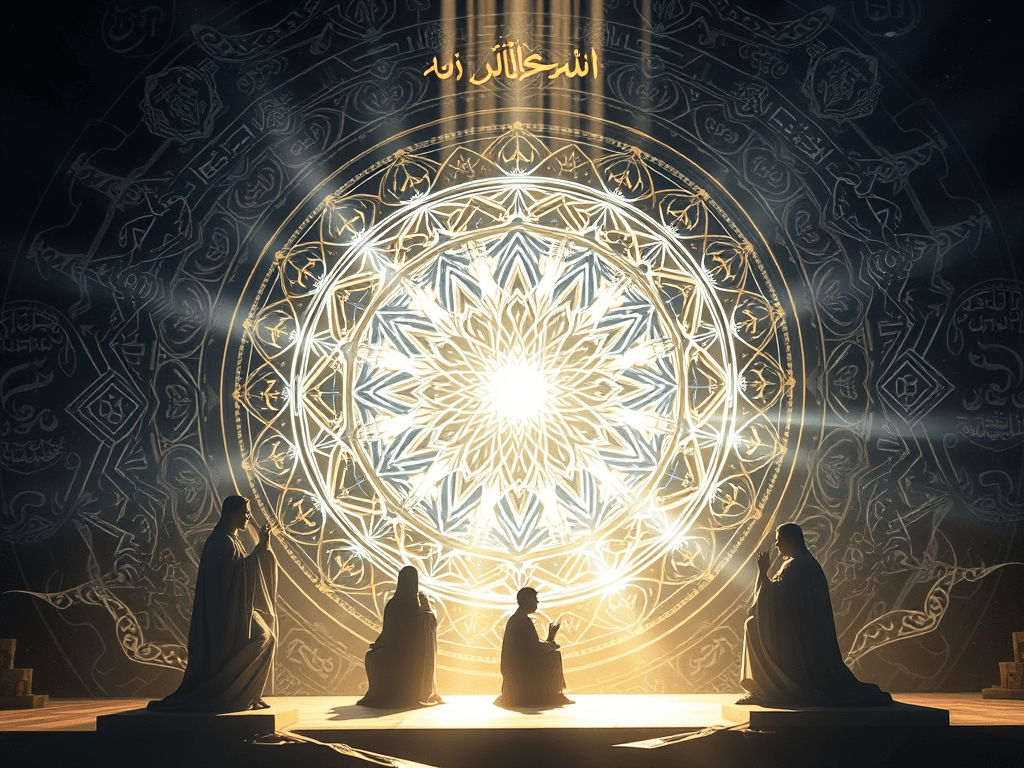
As the Christian world grappled with the tension between eternity and time, Islamic and Jewish thinkers inherited many of the same questions, often through their deep engagement with Greek philosophy. What emerged was a powerful synthesis: the divine transcendence of monotheism joined to the metaphysical clarity of reason. Yet beneath this apparent resolution, new contradictions arose, especially around the nature of Being, causality, and the possibility of contingency.
The Unity of God and the Problem of Multiplicity
At the heart of Islamic and Jewish thought stands the uncompromising affirmation of divine unity. God is One: utterly simple, indivisible, without composition. This insight, drawn from the Hebrew Scriptures and the Qur’an, found philosophical refinement in the hands of thinkers like Avicenna (Ibn Sina) and Maimonides (Moshe ben Maimon).
For Avicenna, God is the Necessary Being (wājib al-wujūd): the One whose existence cannot not be. All other beings are possible; they depend on something else to exist. Only God exists necessarily, by virtue of His essence. From this Necessary Being flows all that is: a cascading chain of emanations, increasingly complex and composite, leading down to the world of matter and multiplicity.
Maimonides, similarly, emphasized God’s absolute simplicity. God has no attributes in the sense we understand them. He is not “powerful” or “wise” in a way that adds something to His being. God is beyond all predicates. We can only speak of Him negatively, by saying what He is not.
These visions share a deep commitment to preserving the divine from all change and composition. And yet, they must still account for a world that is other than God, and that appears to change, become, and pass away. How can multiplicity arise from unity? How can the temporal be caused by the timeless?
The Neoplatonic answer of emanation served as a bridge. The One overflows, not by will or choice, but by necessity. Being flows from Being, like light from the sun. But this raises the problem again: is the world necessary or contingent? If it flows necessarily, how is God free? If it is willed, how can an utterly simple Being possess a will without composition?
The Return to Unity and the Veil of Contingency
Sufi and Kabbalistic traditions offered a different approach, less analytical, more experiential. Thinkers like Ibn Arabi, Al-Hallaj, and the Jewish mystics of Safed began to speak of a deeper unity beneath the veil of multiplicity.
“All that exists is but a manifestation of the Real,” said Ibn Arabi. The world is not separate from God, but God appearing under the veil of otherness. Creation is the self-disclosure (tajallī) of the divine names. Each being is a mirror reflecting one aspect of the eternal.
The Kabbalists spoke of the ten Sefirot, emanations through which the Infinite (Ein Sof) reveals itself in the cosmos. These are not parts of God but modes of divine self-manifestation. The act of creation is an act of contraction (tzimtzum), God making space for the other, yet never truly leaving.
In both traditions, the tension between unity and multiplicity is not fully solved but spiritually surpassed. The world is a sign, a symbol, a theophany. What appears to be separate is, in truth, an aspect of the One. The multiplicity of forms does not negate unity; it reveals it.
Yet the metaphysical question remains: is the world truly Being, or is it still becoming? Is it eternal, or is it a flickering appearance? Can what seems contingent truly be, or is it always at risk of falling into nothingness?
The Quiet Contradiction
Islamic and Jewish metaphysics reached astonishing heights of precision, insight, and spiritual depth. They preserved and extended the insights of Plato, Aristotle, and the Neoplatonists, anchoring them within a revealed tradition. But they did so while maintaining a strict creator-creature distinction—an ontological gap that can never be fully bridged.
As a result, a contradiction lingers: the world is both dependent and real, both other than God and a revelation of God, both contingent and meaningful. This duality, between necessity and possibility, Being and non-being, unity and multiplicity, never fully resolves.
Like earlier traditions, Islamic and Jewish thought intuited that Being is one, that multiplicity is not ultimately opposed to unity, and that all things are signs of the Real. But the full consequence of this unity—the recognition that every being is eternally itself, never passing into or out of Being—had not yet fully appeared.
That unveiling required another step. And it would come, not through further speculation about necessity or emanation, but through a radical re-interpretation of emptiness itself.
 It Is What It Is
Leave a comment