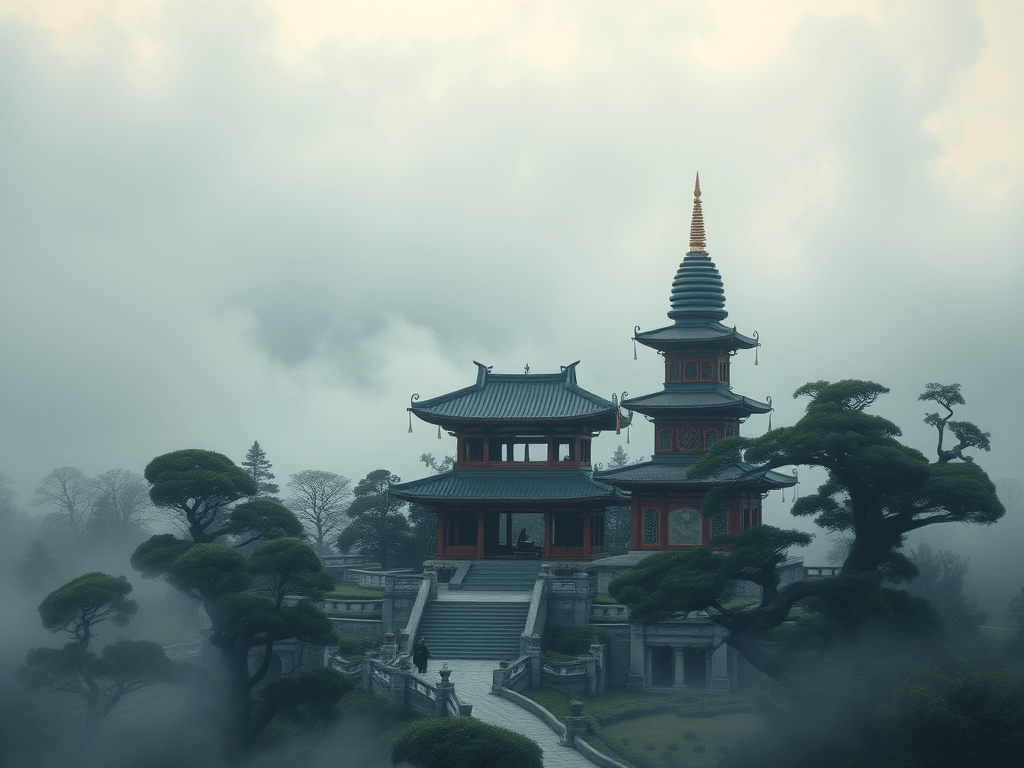
Of all the great spiritual traditions, Buddhism stands as perhaps the most radical in its deconstruction of substance, self, and separateness. Where Western and Islamic metaphysics sought to secure a necessary foundation, Buddhism uncovered the groundlessness of all things. But is this negation a form of nihilism, or does it open toward a different kind of affirmation—one that precedes the categories of being and non-being?
Śūnyatā – Emptiness as Freedom
Central to Buddhist insight is the concept of śūnyatā, or emptiness. Developed most powerfully by Nāgārjuna and the Madhyamaka school, emptiness is not a substance or entity, but a recognition: that all things are empty of self-nature (svabhāva). Nothing exists independently, nothing arises from itself, and nothing endures by its own power.
This is not a denial of appearance. Rather, it is the denial of inherent existence. A chariot, Nāgārjuna famously argued, is not identical to its parts, nor something apart from them—it is a designation, a dependent phenomenon. All things are like this: composite, relational, contingent.
To realize emptiness is to break the spell of grasping—the illusion that there is a separate “I” standing over and against a world of things. Liberation (nirvāṇa) lies not in escaping the world, but in seeing it truly: interdependent, transient, and free of self.
Yogācāra and the Nature of Consciousness
While Madhyamaka emphasized the emptiness of all phenomena, the Yogācāra school turned its attention to consciousness. Everything we experience, it claimed, arises in and through mind (citta). The duality between subject and object is itself a construction of consciousness.
This led to the famous doctrine of “mind-only” (cittamātra), but it was not idealism in the Western sense. Yogācāra did not claim that only mind exists, but that all appearances are dependent on cognitive construction. What we take to be external, separate things are projections of habitual patterns (vāsanās) stored in the deep layers of mind (ālaya-vijñāna).
Even consciousness itself is empty—not a fixed substance, but a stream of dependently arising events. The goal is to awaken to the non-duality of subject and object, self and other. In this awakening, the world is not denied, but transfigured: it appears as luminous, interpenetrating, free.
Huayan and the Interpenetration of All Things
In East Asia, these insights took on new expression through the Huayan school of Chinese Buddhism. Drawing on Madhyamaka and Yogācāra, Huayan offered a vision of reality in which all things interpenetrate all other things. Every phenomenon is both itself and the whole—a reflection of the totality.
This was expressed in the metaphor of Indra’s Net: an infinite web of jewels, each reflecting all the others. There is no center, no edge, no fixed hierarchy. Reality is a dynamic, shimmering unity, where every point contains every other. Form and emptiness are not opposed but mutually arising: form is precisely emptiness, and emptiness is form.
This culminated in a profoundly non-dual vision. There is no absolute beyond the world, and no world apart from the absolute. Samsara is nirvana. Appearance is the display of suchness (tathatā).
From Emptiness to Eternal Appearance?
But even in these luminous visions, a silent ambiguity remains. If all things are empty of self-being, then what truly is? If everything arises dependently, is there anything that does not pass away?
Buddhism avoids the extremes of eternalism and nihilism. Yet the rejection of substance and permanence leaves unresolved the question: what is the ontological status of appearance itself? Is it real? Or is it a flow of illusions without foundation?
Some later traditions, like Zen or certain readings of Dzogchen, seem to affirm a kind of eternal presence beyond concepts. The “suchness” of things is not a thing, but it never ceases to be. It is not born, and therefore it does not die. But this is more hinted at than argued. The contradiction between being and non-being remains implicit.
The Threshold of Affirmation
Buddhism brought the insight of impermanence and interdependence to its highest clarity. It unmasked the illusion of self, the grasping at fixed entities, and the futile attempt to hold what cannot be held. Its gaze was merciless and liberating.
But in turning away from all affirmations of self-being, it also risked leaving appearance without ground. Emptiness, without resolution, can become its own kind of negation. The formless form of things remains unexplained.
The step beyond this paradox lies not in rejecting emptiness, but in asking anew: Is what appears truly nothing? Or is every appearance, precisely because it cannot become nothing, an eternal, necessary reality?
This is where the metaphysical unveiling reaches its turning point. The negation of self-being can no longer stand alone. It must either resolve into nothingness, or give way to a more radical affirmation: the eternal identity of each being, as it appears, unrepeatable and indestructible.
The question now passes to those who would claim to see Being itself, not as a hidden essence behind the world, but as the eternal showing of all things.
 It Is What It Is
Leave a comment