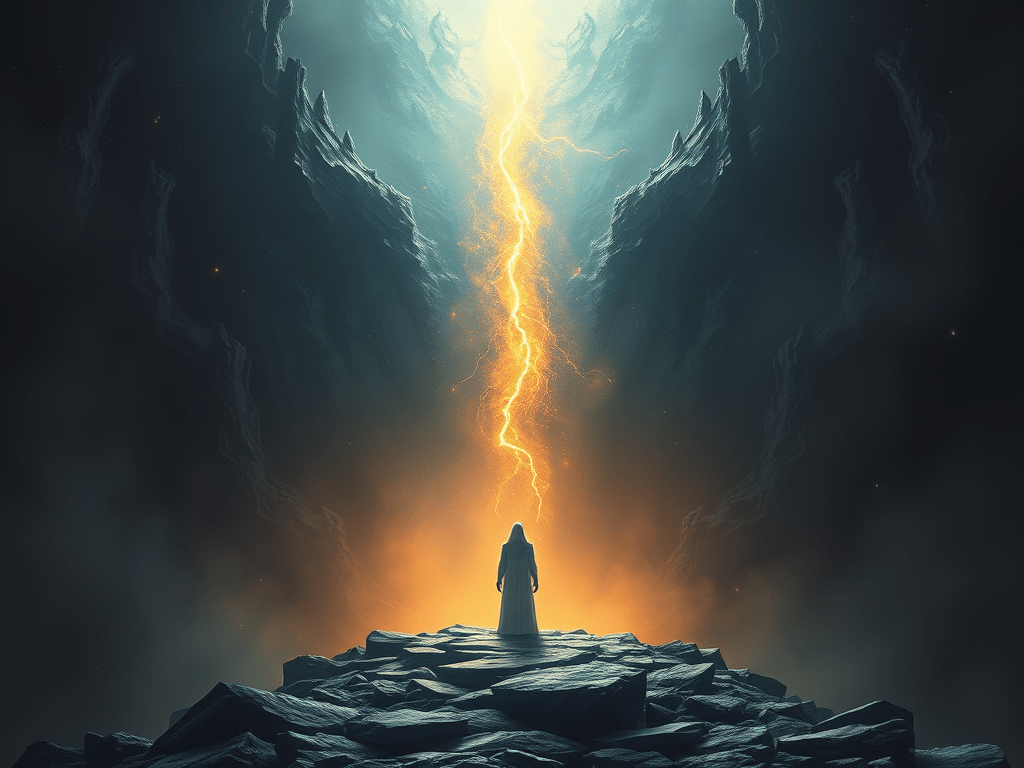
“You will not die.” – The Eternal speaks, overturning the oldest lie.
If there is a single belief that governs modern anxiety, it is this: You will end.
Death is no longer a mystery or passage, as it was for many ancient cultures; it is now regarded as the absolute cessation of the self. A biological failure. A vanishing.
But this belief, that the self is annihilated in death, is not just tragic. It is metaphysically false.
This article confronts the final and most terrifying illusion of the becoming-world: the belief that the self can cease to be.
It reveals how this belief emerges from the logic of becoming, and how it is necessarily overturned by the eternal Structure of Being.
The Fear of Non-Being
From a young age, we are taught to fear death as the unknown — but deeper still, we fear it as non-being.
Not change. Not transformation. Not movement from one state to another.
But nothingness.
We do not fear pain so much as we fear vanishing.
We do not fear the end of the body, but the end of the I.
And yet, here lies the contradiction:
The very self that fears non-being is itself the witness of Being.
How can that which is grounded in Being fear its own absence, except by already presupposing that absence is possible?
But absence is not possible. Not truly.
For if anything can fall into non-being, then Being would be contingent, unstable, dissolvable, and so would truth itself.
But truth is not dissolvable. It is necessary.
And so is the self, as it appears in its eternal structure.
Death in the Metaphysics of Becoming
Within the metaphysics of becoming, all things are contingent.
All things are born from nothing, and all things return to it.
In this view, the self is an emergent function, a byproduct of brain processes, social conditioning, and random chance.
And so death is the collapse of this fragile system.
The extinguishing of the self, swallowed back into the void.
But this view contains a fatal contradiction: it affirms the existence of something that is, while simultaneously denying that it must be.
It treats existence as a temporary anomaly, surrounded by nothingness.
But nothingness is not a space in which something can appear.
It is not a ground.
It is impossible.
What becomes clear, then, is that the metaphysics of becoming is not a neutral description of change; it is a nihilistic vision.
It defines reality as a flicker in the dark.
And the self, under this vision, is doomed to extinction.
The Eternal Self and the Falsehood of Death
But if Being is necessary, and what appears in Being cannot vanish, then death cannot be what we think it is.
The self does not fall into nothingness.
The body may cease to function, the biological processes may halt, but the self, in its eternal structure, remains.
Death is not the end of the self.
It is the transition between modes of appearance.
The one who has “died” has not ceased to be.
They are no longer appearing in a certain temporal modality; that is, to us, here, but they have not been annihilated.
They cannot be.
To cease to be is not an option.
This is not wishful thinking. It is not based in religious faith or emotional hope.
It is the direct consequence of the principle of identity:
What is, is. What is not, is not.
And what is cannot become what is not.
Therefore, you cannot die.
Why the Illusion Persists
And yet, why does death feel so real, so final?
Because the lens through which we interpret it (the cultural, scientific, emotional framework) is still grounded in the logic of becoming.
We are conditioned to associate absence of appearance with non-being.
But this is a category mistake.
Just because something does not appear here, or now, does not mean it does not exist.
The moon remains even when hidden by clouds.
How much more does the eternal remain, even when unseen?
In truth, death is the mirror of birth; not its opposite.
What we call “being born” is not the coming-into-being of the self, but the self appearing in a new form.
Likewise, death is not vanishing, but appearing otherwise.
The self passes through appearance, not into non-being.
The Consolation of the True Self
When this truth is recognized, not merely understood, but seen, the fear of death begins to dissolve.
The self is no longer a fragile construction hovering on the edge of a void.
It is the eternal appearing of Being, momentarily manifest in this visible form.
To know this is not to eliminate sorrow, but to purify it.
We may still grieve those who have passed, but not as if they have ceased to exist.
We grieve the change in appearance, not the loss of Being.
And in this purified sorrow, there is a deeper joy: the recognition that what we love cannot be taken from us.
Nothing true can vanish.
Not the beloved.
Not the self.
Not the face of Being.
Living in Light of Eternity
To recognize that death is not the end is to begin to live differently.
No longer motivated by fear, nor paralyzed by the illusion of urgency, we live in the reverence of eternal things.
We see others not as fleeting accidents, but as necessary appearances of Being.
And we see ourselves, not as passing shadows, but as bearers of eternal light.
You cannot die.
You cannot cease to be.
And all that you love is with you, now and always.
Looking Ahead
If death does not annihilate the self, then the problem is not death itself, but the mistaken understanding of life that fears it.
Our culture, its technologies, its psychologies, and its politics, all remain bound by a false image of the self.
How can we live, think, and build anew, if the self is eternal?
Next: Article 7 — The Culture of Self-Making and the Tyranny of Becoming
 It Is What It Is
Leave a comment