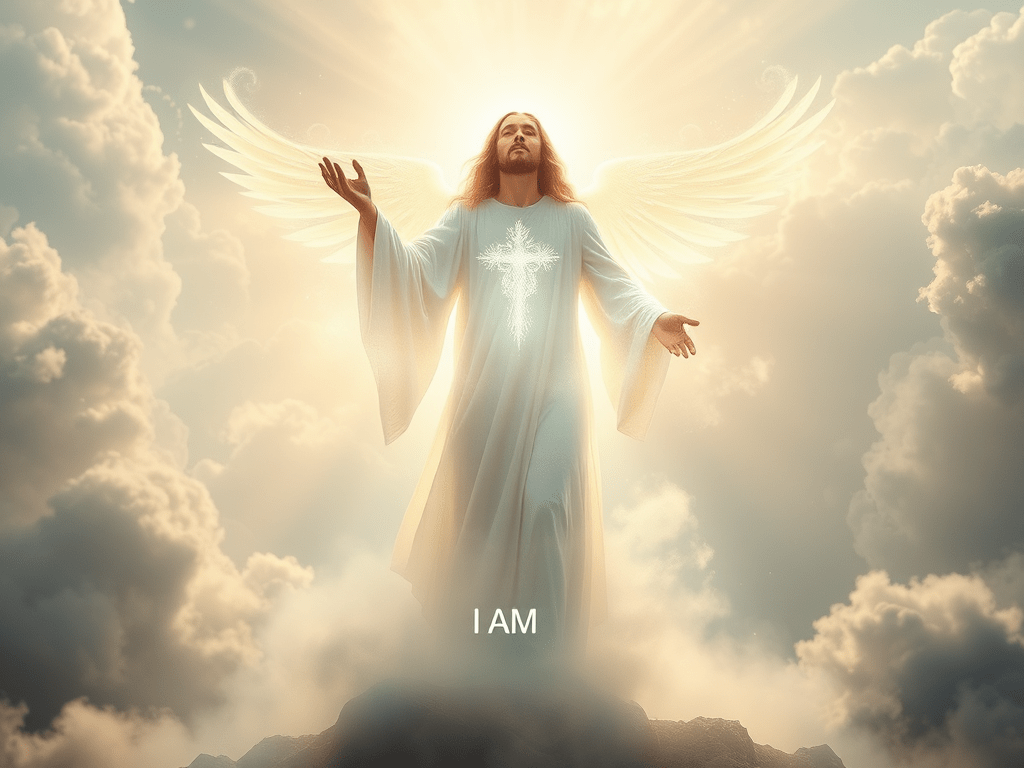
“I AM WHO I AM.”
— Exodus 3:14“Before Abraham was, I am.”
— John 8:58
The First Unveiling
When Moses asks God for a name, he is asking for something familiar: a word he can carry back to the people, a way to speak of the divine. But the answer he receives is not a name in the ordinary sense.
“I AM WHO I AM.”
This is not mythology. It is not a title drawn from nature or kingship.
It is a direct declaration of Being itself.
God is not described here as creator, ruler, or judge.
God is simply the One who is — the One who cannot not be.
This is more than language. It is revelation, not just of God’s identity, but of the structure of reality itself.
God Is Not a Being Among Beings
In much of popular belief, God is imagined as a supreme being — powerful, holy, other, above. But the words given to Moses, and later echoed by Jesus, point to something far more foundational.
God is not one thing among others — not even the highest.
God is Being itself. Not a part of the universe, but its ground.
Not the one who exists, but the very condition of existence.
Thomas Aquinas would later put it plainly: God is ipsum esse subsistens — the act of being itself.
Meister Eckhart would say: God is not good; God is goodness itself. God is not wise; God is wisdom itself.
And Paul Tillich would call God the ground of Being — that without which nothing could appear.
This understanding is not a philosophical addition to Christianity.
It is already unfolding from its center.
Jesus and the Eternal “I AM”
Centuries after Moses, Jesus says something that causes outrage:
“Before Abraham was, I am.”
He doesn’t say, “I was.”
He says, I am — placing himself not within time, but before it.
Not within history, but within Being.
He speaks not as one who has become, but as one who is —
not as a prophet pointing to God, but as the presence of God appearing.
This is not about identity in a modern sense.
It is not ego, role, or title.
It is the same voice that spoke to Moses — now speaking in form.
The Shift from Symbol to Structure
In the early stages of faith, we speak of God through symbol.
God as Father, King, Shepherd, Potter. These are needed, and sacred.
But they are also partial — images pointing to what cannot be pictured.
The turning point comes when we see that the purpose of symbol is not to define God, but to point beyond itself.
God is not like something.
God is the condition for anything to be at all.
This means God is never absent — because nothing that exists could exist apart from Being.
And it means we are never separate — because we are not outside of Being, but appearing in it.
Being and the End of Separation
This changes everything.
If God is Being, and we are beings who appear within Being,
then the idea that we are separated from God is not only theologically problematic — it is metaphysically impossible.
What we call “separation” is not a distance in space or essence.
It is a veil in thought — a forgetting of what we already are.
We are not on a journey to become something divine.
We are the appearing of Being — unique, unrepeatable, eternal in form.
The Gospel does not say, “You will become what you are not.”
It says, “The truth will set you free” — not change you, but reveal you.
Not Abstraction, but Fulfillment
This is not abstract philosophy.
It is the deepest meaning of the Christian revelation.
“In Him we live and move and have our being.”(Acts 17:28)
“All things were made through Him… and in Him all things hold together.”(John 1, Colossians 1)
“Christ, who is your life.”(Col. 3:4)
The divine is not only above us.
It is the ground of us, the light in which all things shine.
And when Jesus says “I AM,”
he is not giving a metaphor.
He is unveiling the real — the eternal speaking through the temporal.
Looking Ahead
Once we see that “I AM” is not a divine name but the unveiling of Being itself, then the old framework of distance and mediation begins to dissolve. The Law, the Temple, the Sacrifice — these were not errors, but symbols for a truth not yet seen. In the next article, we’ll look at that unveiling: how Christianity moves from veil to light, from symbol to presence, and from religion to recognition.
Next: Article 2 — The Veil and the Light: Law, Symbol, and the Coming of Presence
 It Is What It Is
Leave a comment