“The law was our tutor to bring us to Christ,
that we might be justified by faith.
But now that faith has come, we are no longer under a tutor.”
— Galatians 3:24–25“We all, with unveiled face, beholding the glory of the Lord,
are being transformed into the same image from glory to glory.”
— 2 Corinthians 3:18
The Long Arc of Religion
Religion begins in distance.
A God who is holy. A people who are not.
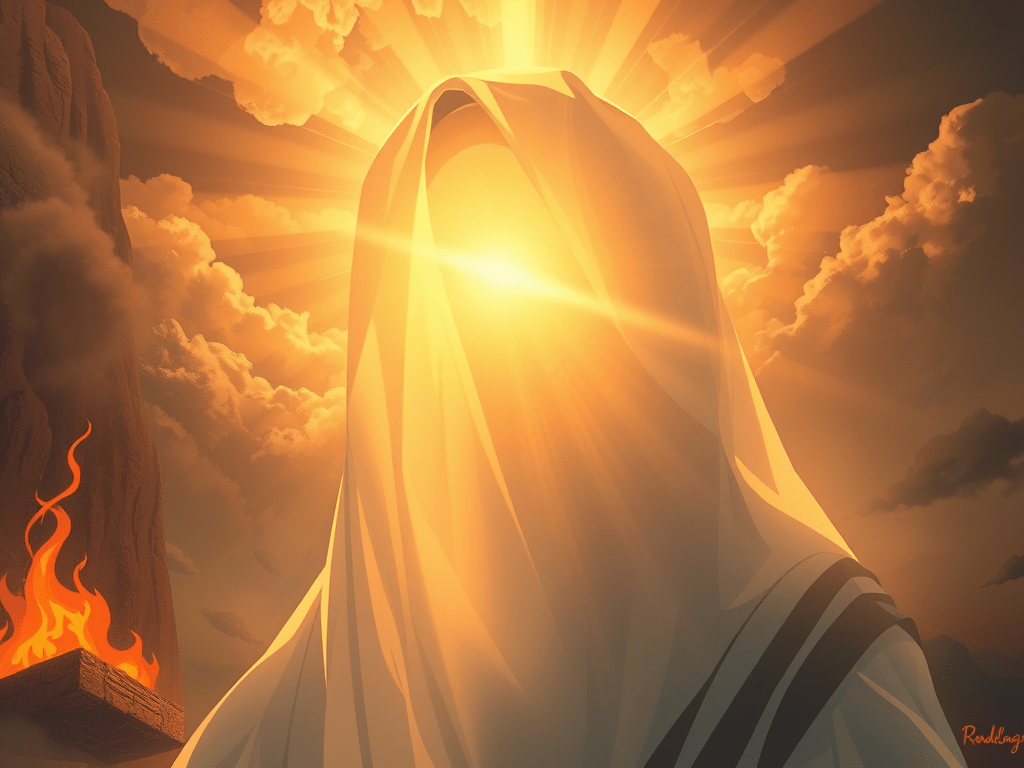
A mountain that cannot be touched. A veil that must not be lifted.
Sacrifice, law, temple, priesthood — all built to manage that distance.
These were not errors. They were preparation.
What appears as ritual or restriction is, at its heart, a symbolic structure —
a system for holding open the space between human and divine,
while waiting for something deeper to be revealed.
Paul calls this the tutor, the guardian of a child not yet able to see the whole.
The Law is not opposed to truth.
But it is not the truth itself.
It is a veil — not a lie, but something placed between.
The Purpose of the Veil
Why a veil?
Because truth cannot be forced.
And the mind, still bound to images, cannot bear to see what has no form.
So God appears through symbols: fire, cloud, voice, stone, sacrifice.
Each symbol speaks truly — but incompletely.
Each prepares the soul — but also conceals.
The veil is mercy.
It holds space until the eye is ready to see.
The Light That Replaces the Symbol
Then something happens.
Christ appears — and with him, the truth behind the symbols.
He does not destroy the Law.
He fulfills it. But not by observing it — by revealing what it pointed to all along.
- The Temple is replaced by the Body.
- The Priest by Presence.
- The Sacrifice by Recognition.
- The Veil is torn.
And suddenly, the distance collapses.
Not because God has changed,
but because the eyes of the soul begin to open.
From System to Seeing
This is the turning point of the Gospel — and of all true transformation.
What was once a system of approach becomes a moment of recognition.
Not obedience to a rule, but fidelity to what is.
Not mediation through ritual, but direct appearing.
“We all, with unveiled face…”—
not just the priest, not just the mystic, buteveryone.
Each now able to see — not the image of God,
butGod in the image.
In the world. In the face of another. In themselves.
This is no longer religion.
This is presence.
Faith Is Not Belief — It Is Recognition
Paul says we are no longer under the tutor, because faith has come.
But what is faith?
Not belief in doctrines or moral effort.
Faith is not mental assent. It is not hope for what is missing.
Faith is the clear seeing of what has always been true.
It is trust in the real —
in the truth that Being cannot not be,
and that we are not separated from it.
The law points to this.
The veil protects it.
But only truth reveals it.
The End of Mediation
The Christian story moves from sacrifice to presence, from priesthood to recognition.
This is not a shift in liturgy.
It is the unveiling of Being.
Once seen, the structures of religion begin to fall away — not in rebellion, but in completion.
There is no more need for intermediaries,
because the temple has become the world,
and the light shines from within all things.
Looking Ahead
Once the veil is lifted, the old world does not disappear — it is transfigured. And yet, many still live as if the veil remains. In the next article, we look at how this transition is described in the final vision of Scripture — a city with no temple, a people with no need for sun or moon, a light shining from within. It is the end of religion — and the beginning of truth without mediation.
Next: Article 3 — No Longer Through a Temple: The End of Mediation
 It Is What It Is
Leave a comment