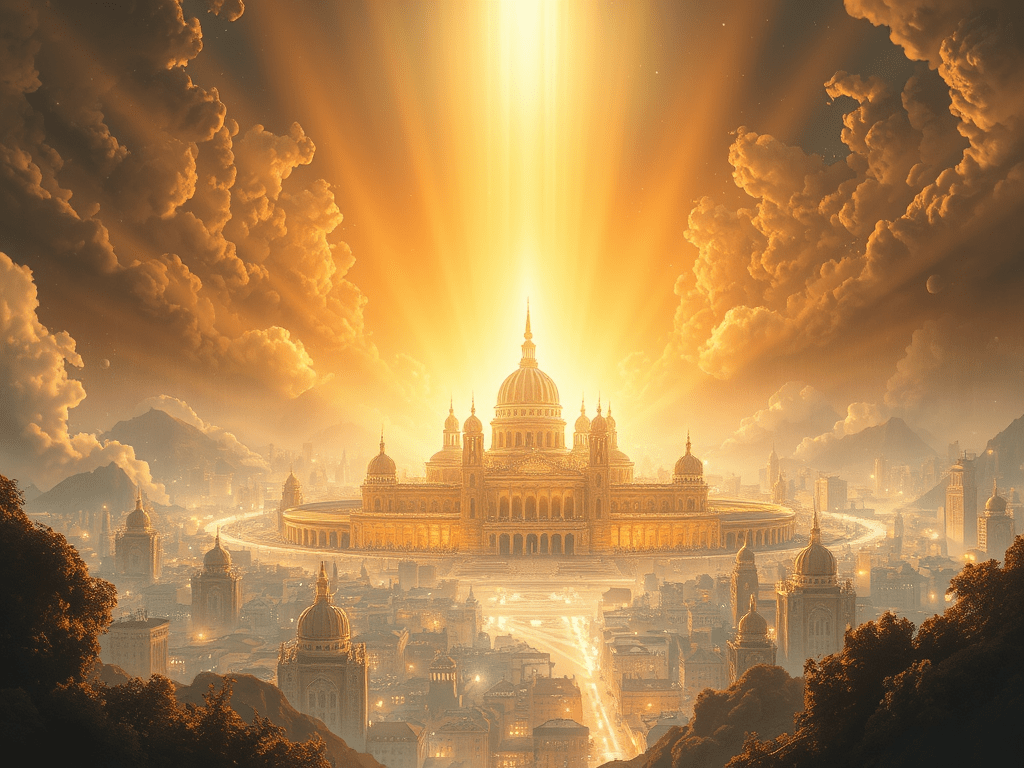
“I saw no temple in the city, for its temple is the Lord God the Almighty and the Lamb.
And the city has no need of sun or moon to shine on it,
for the glory of God gives it light, and its lamp is the Lamb.”
— Revelation 21:22–23
The Final Image
The Book of Revelation closes not with destruction, but with a vision —
a city, radiant with light, descending from above.
It is the culmination of history, the healing of all things.
And at its center is a striking absence:
“I saw no temple in the city.”
For a people formed by temple, sacrifice, and priesthood,
this is not a minor detail — it is the end of an entire order.
The place once reserved for God is now everywhere.
There is no longer a need for mediation, because what was once distant has become immediate.
This is not the destruction of the sacred.
It is the unveiling of its fullness.
From Center to Wholeness
In ancient religion, the temple was the center —
the place where heaven touched earth,
where God could be approached,
where the holy was contained.
It was sacred space in a profane world.
But in the vision of Revelation, this separation no longer exists.
There is no more center — because the whole is filled.
No more priest — because all are present.
No more sun or moon — because light now shines from within.
This is the end of the symbolic order.
Not its rejection, but its fulfillment.
The Lamb as Light
“The Lamb is its lamp.”
Not a figure on a throne,
but the light through which everything is seen.
This is no longer theology. It is ontological transformation.
The Lamb — Christ — is not the object of worship in this final vision.
He is the light by which all is recognized,
the radiance of Being itself appearing in clarity.
Where once people worshipped from afar,
now they live in the immediacy of the Real.
The End of Sacred Distance
Revelation is not just about the future.
It is the symbolic closure of the entire structure of mediation.
- From temple to transparency
- From symbol to light
- From religion to recognition
The New Jerusalem has no church, no altar, no rite —
because the whole has become holy.
This is not spiritual abstraction.
It is the very promise of the Gospel, seen through to its conclusion.
“On that day you will know that I am in the Father, and you in me, and I in you.”
— John 14:20
God in All, and All in God
The temple was a shadow.
The Law, a tutor.
The cross, a tearing of the veil.
Now, what was hidden appears.
What was distant draws near.
What was worshipped through symbol
is seen in the real.
This does not mean the end of God.
It means the end of separation from God.
God is no longer above or apart.
God is Being itself —
the light of every face,
the breath of every form.
And so: no more temple.
Not because God is gone —
but because God is everywhere.
Looking Ahead
When the temple disappears, worship changes. Not in posture, but in essence. It becomes recognition, not ritual. The voice of Christ — once the mediator — is now the light itself. In the next article, we explore what it means to speak of God not as a person above, but as Being itself — the ground of all that is, the One in whom nothing is missing.
Next: Article 4 — God as Being: The Ground of All, the Form of All
 It Is What It Is
Leave a comment