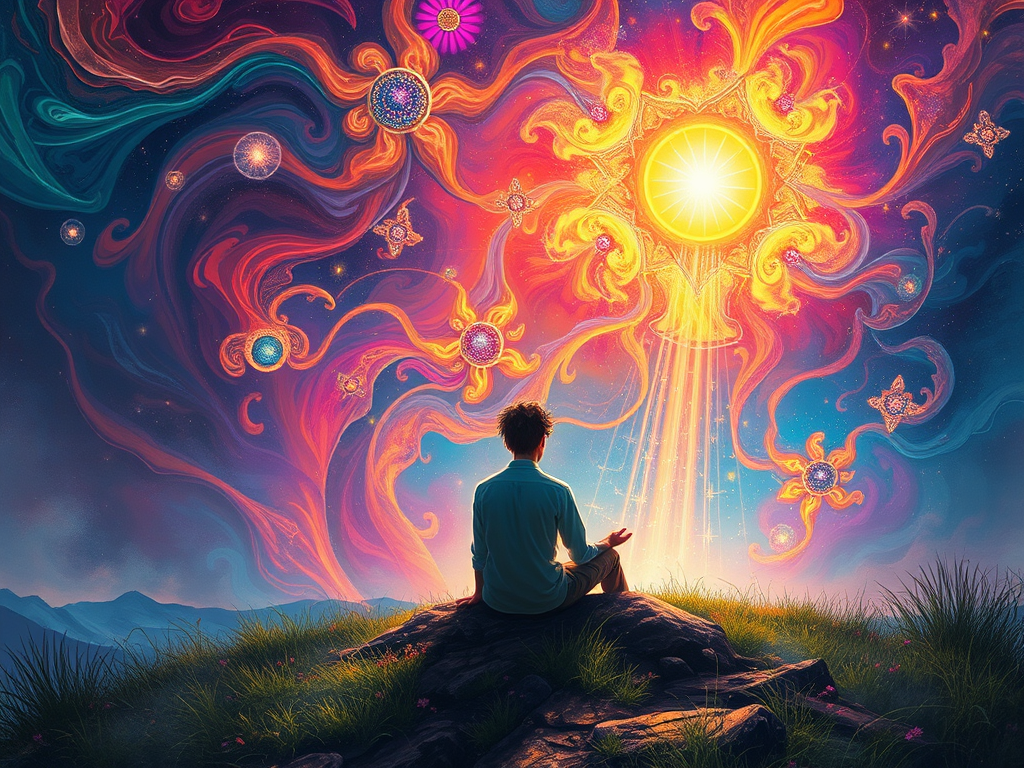
We live in an age of deep disillusionment. The great narratives of modernity—progress, science, material comfort—no longer hold the authority they once did. For many, the promise that rational knowledge or economic prosperity could satisfy the human spirit has been exposed as a fragile illusion. Beneath the surface of technological advancement and social change, a deeper crisis persists: a crisis of meaning, of self, and of the structure of reality itself.
In this landscape of confusion and collapse, the return of psychedelics is no accident.
Once relegated to the fringes of counterculture, psychedelics are now entering mainstream discourse. Universities research them, therapists administer them, spiritual seekers revere them. Whether through psilocybin retreats, ayahuasca ceremonies, or microdosing trends, countless individuals are turning to altered states of consciousness in search of healing, insight, and ultimately—truth.
The New Prometheus?
This so-called psychedelic renaissance is often framed as a kind of Promethean recovery—mankind reclaiming a lost fire of wisdom and self-knowledge. Figures like Timothy Leary envisioned psychedelics as catalysts for a new society, while contemporary proponents point to their power to resolve trauma, treat depression, or induce mystical insight. Beneath all of this is the intuition—often unspoken—that ordinary consciousness is not the whole story. That the default experience of time, identity, and separation may be a kind of veil.
And yet, what is it that these substances actually reveal?
For many, psychedelics dissolve the barriers of the self and offer a sense of unity with all things. Time seems to vanish. Death loses its sting. The ego collapses. Some describe merging with “pure light,” “universal love,” or “infinite intelligence.” Others fall into terror and fragmentation. Still, most agree on this: reality is not as it seemed before.
But is this shift in perception a revelation of truth—or simply a novel illusion?
The Hunger Behind the Experience
The psychedelic movement did not arise in a vacuum. It is a response to something—a hunger that modern life cannot satisfy. The disintegration of religious frameworks, the rise of nihilism, and the failure of consumer society to answer existential questions have all created a void. Psychedelics step into that void as substitutes for revelation, as chemical prophets in a world that has forgotten how to listen.
This is not to say that these experiences are false. On the contrary: what makes them powerful is that they resonate with something deeply true—a sense that we are more than passing bodies, more than neurons firing in darkness, more than creatures born to die. These glimpses often point toward a reality beyond becoming, even if they do not name it as such.
But without grounding, these glimpses remain ambiguous. They may be interpreted through the lens of past trauma, spiritual ideology, cultural expectation, or personal desire. The same experience might lead one person to the belief in cosmic unity, another to ancestral visions, and yet another to chaotic dissolution. The problem is not the experience itself—it is the absence of a framework that distinguishes necessity from illusion.
The Crisis of Experience
The age of psychedelics is, at its core, an age of experience. That is, a time when truth is sought not in thought, not in philosophy, not in the eternal, but in the immediate, the felt, the overwhelming. And while this move away from abstract rationalism has value, it runs the risk of confusing the intensity of experience with the depth of truth.
Experience can be revelatory. But revelation is not the same as recognition. To recognize truth is to see what cannot not be—what is necessarily so, what holds across all appearances. Psychedelic visions, no matter how profound, are still appearances. They are part of becoming, of time, of change. They point toward something greater, but they are not that greater thing.
This is why the psychedelic renaissance, for all its promise, must be met with caution and clarity. It is not enough to escape the illusion of ordinary life if we fall into new illusions cloaked in light. The hunger that drives people to these substances is real—but it will not be satisfied by altered states alone.
Toward a Deeper Ground
What the psychedelic movement reveals is not just the power of these substances—but the poverty of our current metaphysical framework. It shows how many long for something beyond the fleeting, the contingent, the meaningless. It also shows how easily that longing can be misdirected.
This series will not reject psychedelic experience. Nor will it glorify it. Instead, we will treat it as a sign of the times—an expression of the necessary contradiction within the dominant worldview, and a call to go further. We will explore how these experiences intersect with the eternal, but also why they cannot replace the philosophical work of unveiling the Structure of Being—the necessary, eternal, and unchangeable truth that underlies all appearances.
Only by grounding our search for truth in what cannot pass away can we find the clarity that so many psychedelic travelers glimpse—but cannot hold.
 It Is What It Is
Leave a comment