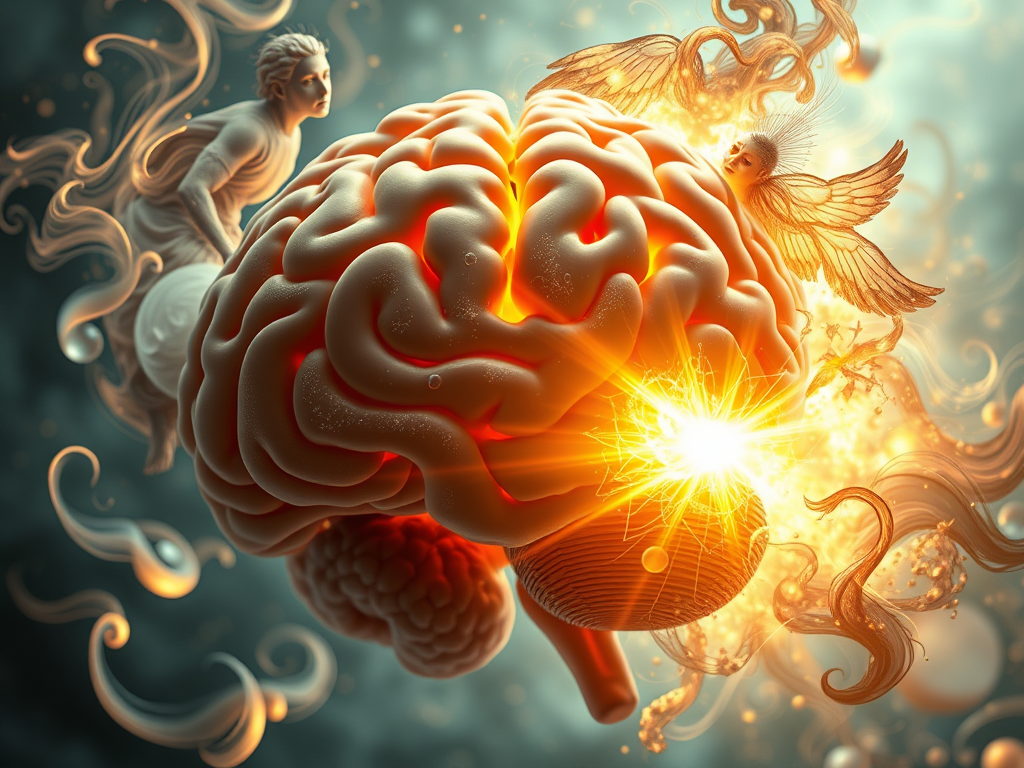
One of the most widely accepted metaphors in contemporary psychedelic discourse is that the brain is not a generator of consciousness, but a filter—a narrowing device that reduces the full spectrum of reality into a manageable stream of experience. This idea, which traces back to thinkers like Henri Bergson and Aldous Huxley, proposes that the brain’s function is not to produce awareness, but to limit it, keeping us tuned to only what is necessary for biological survival.
When this filter is disrupted—by psychedelics, trauma, or spiritual practice—the range of perception is said to expand. Users speak of seeing “more,” of sensing realities that were always present but hidden. Some even claim to encounter “ultimate truths,” spiritual beings, or other dimensions of existence. The appeal of this model is obvious: it offers a scientific-sounding explanation for mystical experience without fully abandoning the language of neuroscience.
But beneath its surface lies a deeper question: If the brain filters reality, then what is the nature of that reality which it conceals? And how can we distinguish between mere alteration of perception and an authentic recognition of truth?
The Filter Model: A Brief Overview
The basic premise of the filter model is this: consciousness is fundamental, and the brain acts as a reducing valve. As Aldous Huxley wrote in The Doors of Perception, the human mind at large is “a kind of reducing valve,” whose function is to allow through only a tiny trickle of the broader “Mind at Large.” Psychedelics, meditation, and certain near-death experiences are said to widen that valve, giving access to what is normally suppressed.
This notion resonates with those who have touched profound states of being. It affirms the sense that our ordinary awareness is narrow, conditioned, partial—and that there is more.
Yet despite its allure, the filter model raises a series of unresolved problems. If the brain filters consciousness, where is this “greater consciousness” located? Is it a metaphysical field? A higher dimension? Is it eternal? Does it contain contradictions? Most critically: how do we know that what is revealed when the filter is lifted is true?
Seeing More is Not Seeing Truly
This is the central issue: more does not mean clearer, and intensity does not equal truth. A kaleidoscope of images, entities, or insights may be dazzling, but if these are merely appearances within becoming—if they change, contradict, or vanish—then they cannot constitute what is necessary, eternal, or indubitable.
The filter model suggests that something has been “opened.” But unless that opening leads to the recognition of that which cannot not be, then the experience, however significant, remains within the cycle of appearances—within becoming, not Being.
There is a difference between altering the structure of perception and seeing what is necessarily true. A distorted lens can produce captivating images, but it cannot reveal the structure of the lens itself. Psychedelics may affect the brain’s filtering function, but they do not in themselves unveil the eternal.
Being is Not Hidden
This leads to a crucial turning point. The idea that the brain conceals a higher truth assumes that Being—Truth—is somehow hidden, and must be uncovered by special means. But the recognition of Being, of the eternal structure of reality, does not depend on altered states or special access. Being is not hidden behind the veil of ordinary consciousness; it is what appears necessarily in every moment, in every thought, in every being.
The problem is not access. The problem is interpretation.
We interpret the world through the lens of becoming—through the belief that things come into being and pass away. This belief leads to the assumption that truth is elsewhere, beyond, hidden. Psychedelics may seem to confirm this by offering unfamiliar experiences, but in truth, they only reveal the instability of our interpretations, not the eternal ground that supports all appearance.
The unveiling of Being does not require the expansion of consciousness—it requires the recognition of what already appears, stripped of the illusion of coming-to-be and passing-away.
Toward the Recognition of the Eternal
If the brain is a filter, then what it “filters out” is not a storehouse of dazzling imagery or mystical data. What it obscures is the recognition of necessity—that each being is eternal, unchangeable, and never emerges from or returns to nothingness. The veil is not perceptual; it is interpretive. The illusion is not the world; it is the belief that the world is made of fleeting nothings.
In this light, psychedelics may disrupt the filter, but they cannot in themselves replace the interpretive structures that bind us to nihilism. In fact, without a clear foundation, they may simply replace one illusion with another.
And yet—they can point. They can shake the belief in materialism. They can unsettle the conviction that we are isolated, accidental, and doomed to vanish. In this way, they may serve as preparatory signs, symptoms of the breakdown of a false metaphysics and the hunger for the recognition of truth.
But that recognition does not come in flashes. It comes through the unveiling of the Structure of Being—a structure that does not change, does not flicker, and does not depend on brain states.
In the next article, we examine more closely the limits of experience itself. What happens when the extraordinary becomes a substitute for truth? How do cultural expectations and personal longing shape what we see and feel? We will explore why, despite the intensity of altered states, experience alone cannot secure what is eternal—and how the failure to recognize this has profound implications for our understanding of healing, insight, and Being.
 It Is What It Is
Leave a comment