Category: Uncategorized – All Posts
-
Know Thyself – 9: The Community of Eternal Selves
Beyond Contract and Contingency: Toward a People of Being Modern society is built upon the belief that individuals are autonomous agents who form relationships: personal, social, or political; through choice, negotiation, and mutual benefit. From this standpoint, community becomes a fragile contract, always subject to revision, dependent on will, agreement, and utility. But this vision…
Written by

-
Know Thyself – 8: The Rediscovery of Personhood: From Psychological Construct to Eternal Reality
Know Thyself: The Crisis of Identity and the Return to Being “Man is not merely a part of the world, but the place where the world begins to appear.”– Emanuele Severino The Disappearance of the Person In an age obsessed with identity, the person has all but disappeared. We speak endlessly of roles, traits, preferences,…
Written by

-
Know Thyself – 7: The Culture of Self-Making and the Tyranny of Becoming
You can be whatever you want to be.” But what if that is the root of our confusion? Modern culture does not ask us to know ourselves; it demands that we make ourselves.This shift, often hailed as liberation, has become a new tyranny. We are no longer born with a destiny to recognize, but with…
Written by
-
Know Thyself – 6: Death and the False End of the Self
“You will not die.” – The Eternal speaks, overturning the oldest lie. If there is a single belief that governs modern anxiety, it is this: You will end. Death is no longer a mystery or passage, as it was for many ancient cultures; it is now regarded as the absolute cessation of the self. A…
Written by

-
Know Thyself – 5: Memory, Loss, and the Illusion of the Vanishing Self
“All that is yours shall return to you, not as you remember it, but as it is.” In the experience of memory, we encounter both presence and absence.The beloved face, the longed-for moment, the words once spoken, they appear again, but only as images, pale echoes of what once was. We say things like, “She’s…
Written by

-
Know Thyself – 4: Relational Beings: Love, Recognition, and the Eternal Other
“Where two or three are gathered in my name…”– not merely a number, but a revelation of Being-in-relation. If the modern self is imagined as a solitary project, the eternal self is not.We do not exist alone. We never have. The idea of relation is not an optional feature of human life, nor a later…
Written by

-
Know Thyself – 3: The Myth of the Fluid Self: Desire, Gender, and the Collapse of Form
“I feel like I’m becoming who I really am.”– A common expression, but beneath it, a profound contradiction. In a world where identity has been severed from Being, where presence has dissolved into process, fluidity emerges as an ideal. To be fluid is to be free, unconstrained, endlessly open to becoming. This modern myth is…
Written by

-
Know Thyself – 2: The Fragmented Self: Psychology, Power, and the Loss of Presence
“I used to think I was one person. Now I’m not so sure.” The modern self is not only in crisis; it is shattered. Fragmented across roles, performances, diagnoses, and projections, the self has become a mosaic of shifting parts. Where once we spoke of character or soul, we now speak of personality types, trauma…
Written by
-
Know Thyself – 1: The Crisis of Identity: Becoming, Nothingness, and the Modern Self
“Modern man believes he can be anything — because he no longer believes there is anything he truly is.” We begin in the midst of crisis. Not just political or cultural, but ontological. We no longer know who we are, and worse, we have come to believe that this unknowing is freedom. For centuries, the…
Written by
-
Know Thyself – Introduction
The Crisis of Identity and the Return to Being We live in an age where identity is everything, and nothing. It is affirmed, debated, deconstructed, weaponized, and endlessly remade. To belong or to be excluded, to find one’s “true self” or to reject the very idea of a fixed self; these now lie at the…
Written by
-
The Unfolding of Truth – Appendix B
The Veil and the Real: Islam, Mysticism, and the Eternal Structure “He is the First and the Last, the Apparent and the Hidden.”— Qur’an, Surah 57:3 Islam and the Ontological Unity of Being At the heart of Islam is the affirmation: “There is no god but God.” This statement, while theological on the surface, also…
Written by

-
The Unfolding of Truth – Appendix A
Christ and the Eternal: Beyond Time, Beyond Creation “Before Abraham was, I am.”— John 8:58 The Hidden Contradiction in the Christian Narrative Christianity, in its dominant historical form, presents a synthesis between the eternal and the temporal: God, who is eternal, enters time to redeem creation, which is seen as fallen, finite, and subject to…
Written by
-
The Unfolding of Truth – 10: Conclusion – The Fulfillment of the Journey
A Journey Through Thought This has been a journey through the history of thought; not as a museum of ideas, but as the necessary unfolding of a single drama: the contradiction between Being and becoming. From Parmenides, who first glimpsed the immovable truth, to Plato, who gave structure to its reflection in the world of…
Written by
-
The Unfolding of Truth – 9: Emanuele Severino – The Inevitable Resolution of the Contradiction
The Final Contradiction The journey of philosophy, from Parmenides to postmodernity, is marked by one recurring drama: the tension between Being and becoming. Parmenides declared: Being is; non-being is not. And yet, all of history, Platonic dualism, Christian creation, Buddhist emptiness, modern subjectivity, has wrestled with the appearance of change: How can what is seem…
Written by

-
The Unfolding of Truth – 8: Modernity – From Substance to Subject and the Collapse of Metaphysics
The Turning Point: From the World to the Self With the collapse of the medieval synthesis, the philosophical gaze shifted dramatically. No longer anchored in substance metaphysics or a transcendent order, modernity turned inward, to the thinking subject as the new foundation. This was not merely a shift in emphasis. It marked the beginning of…
Written by

-
The Unfolding of Truth – 7: Scholasticism and the Domestication of Metaphysics – The Final Attempt Before the Fall
The Afterglow of Revelation and the Return of Aristotle As the Middle Ages matured, a remarkable convergence took place: the truths of revelation were increasingly systematized through the lens of Greek metaphysics, particularly that of Aristotle. The fusion promised much: clarity, coherence, and the ability to defend faith through reason. Yet behind this synthesis lay…
Written by
-
The Unfolding of Truth – 6: Buddhism – Emptiness, Interdependence, and the Question of Appearance
Of all the great spiritual traditions, Buddhism stands as perhaps the most radical in its deconstruction of substance, self, and separateness. Where Western and Islamic metaphysics sought to secure a necessary foundation, Buddhism uncovered the groundlessness of all things. But is this negation a form of nihilism, or does it open toward a different kind…
Written by

-
The Unfolding of Truth – 5: Islamic and Jewish Thought – Divine Simplicity, Emanation, and the Hidden Unity
As the Christian world grappled with the tension between eternity and time, Islamic and Jewish thinkers inherited many of the same questions, often through their deep engagement with Greek philosophy. What emerged was a powerful synthesis: the divine transcendence of monotheism joined to the metaphysical clarity of reason. Yet beneath this apparent resolution, new contradictions…
Written by
-
The Unfolding of Truth – 4: Christian Revelation – Creation, Logos, and the Problem of Time
With the advent of Christianity, a new voice enters the unfolding of thought, one that speaks not only of the eternal, but of a personal God who creates out of love, enters into history, and redeems. The metaphysical speculation of the Greeks meets the narrative structure of Scripture. Logos becomes flesh. Eternity touches time. At…
Written by

-
The Unfolding of Truth – 3: Plotinus – Emanation and the Return to Unity
If Plato glimpsed the realm of the eternal through the Forms, fixed, timeless, and shining with intelligible clarity, Plotinus deepens the vision. In the Enneads, he presents a metaphysical unfolding of reality from a single, ineffable source: the One. This One is beyond Being, beyond intellect, beyond any distinction. It is not a being among…
Written by
-
The Unfolding of Truth – 2: Two Worlds: Plato and the Birth of Metaphysical Structure
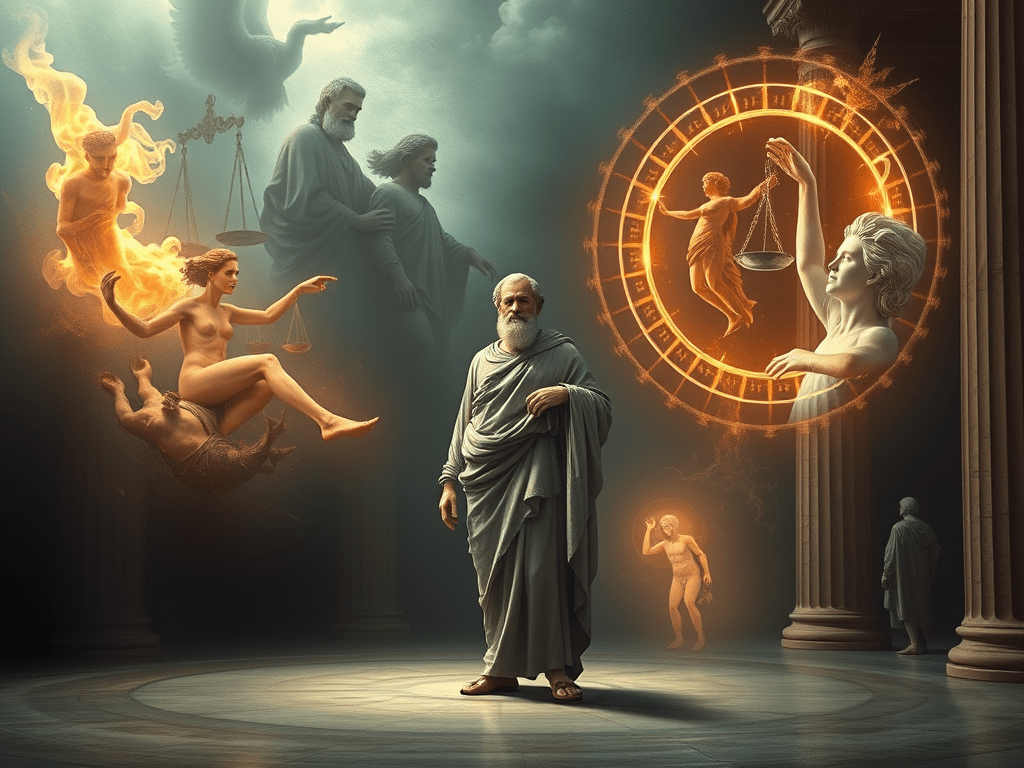
Parmenides had shown that Being cannot not be. Change, then, must be illusion. But human experience contradicts this at every turn: we see birth, death, decay, motion, transformation. If thought must reject the evidence of the senses, how is truth to be known? It is Plato who takes up this task, and with him, philosophy…
Written by
-
The Unfolding of Truth – 1: The First Light: Parmenides and the Emergence of Being
Before there were systems, there was wonder. In the earliest days of philosophy, Greek thinkers turned from mythos to logos; not to dismiss the sacred, but to seek its structure. Beneath the shifting appearances of the world, they began to ask: what abides? What is the principle that does not pass away? What is real?…
Written by

-
The Unfolding of Truth Through the History of Thought – Introduction
Throughout the history of human thought, there has been a persistent intuition, often obscured, often contradicted, yet never entirely extinguished, that reality is not what it seems. From the first metaphysical inquiries in ancient Greece to the contemplative insights of Eastern sages, from the mystical speculation of late antiquity to the rational rigor of modern…
Written by
-
Christianity and the Structure of Being–A Metaphysical Map
From Plato to the Eternal Structure of Being 🔹 1. Plato (4th c. BCE) Core Move: Eternal Forms vs. Temporal World Reality = unchanging, timeless Ideas (Forms) The world of becoming = shadow, illusion, imperfection Being belongs only to the eternal; the sensible is suspended over non-being 🡺 Impact: Introduces the first metaphysical dualism→ Sets…
Written by

-
Christianity and the Structure of Being– Conclusion: Christianity Was Never Meant to End in Dualism
The Return to What Has Always Been True Throughout this series, we’ve traced a path—one not of rejection, but of return. Not a return to doctrine as it has been taught, nor to metaphysics as it has been inherited, but to the truth Christianity has always carried within itself: that what-is cannot not be. That…
Written by
-
Christianity and the Structure of Being– 5: Toward Fulfillment — Christianity and the End of Dualism
The Return to What Has Always Been True Christianity stands today at a threshold — not of decline, but of fulfillment. After centuries of tension between its deepest intuitions and its inherited metaphysics, the time has come to see what has been gesturing from the beginning: that the truths it proclaims are not mere hopes…
Written by
-
Christianity and the Structure of Being– 4: The Intimations of Destiny Within the Christian Tradition
How the Eternal Structure Continues to Emerge Despite centuries of metaphysical dualism, Christianity has never fully surrendered to nihilism. Even while shaped by a Platonic framework that casts the world as impermanent and the body as perishable, the Christian tradition has continued to bear witness to something more: the silent but insistent truth that what…
Written by

-
Christianity and the Structure of Being– 3: The Persistence of the Platonic Framework
From Augustine to Modernity: How Christianity Carried the Logic of Annihilation By the time Christianity emerged as the dominant religious force of the Roman Empire, the seeds of a deeper metaphysical tension had already been sown. The Christian proclamation of the eternal had fused with the Platonic suspicion of time, matter, and change. The result…
Written by
-
Christianity and the Structure of Being – 2: The Infiltration of Platonism
How Greek Metaphysics Entered Christian Thought In its earliest centuries, Christianity encountered a world saturated with Greek philosophy. Among the many schools of thought that shaped late antiquity, none was more influential—or more seductive—than Platonism. Plato offered a majestic metaphysical vision: a realm of eternal, unchanging Forms—the true Being of which all sensible things were…
Written by

-
Christianity and the Structure of Being – 1: The Eternal Intuition of Christianity
The Seeds of Truth in the Christian Vision From its very beginning, Christianity has spoken of eternity. Not merely as a distant realm beyond this life, but as something that enters into history—something that breaks into time through incarnation, resurrection, and the promise of a kingdom that shall have no end. In this, Christianity reveals…
Written by