Tag: Philosophy
-
Introduction to the Series: NDEs and the Structure of Being
This series explores Near-Death Experiences (NDEs) through the lens of the eternal Structure of Being. While we have touched on this subject before, its depth and complexity warrant a more focused examination. Over eight weekly articles, we will move beyond conventional interpretations, analyzing NDEs in light of the necessity of Being. Often framed through religious,…
Written by

-
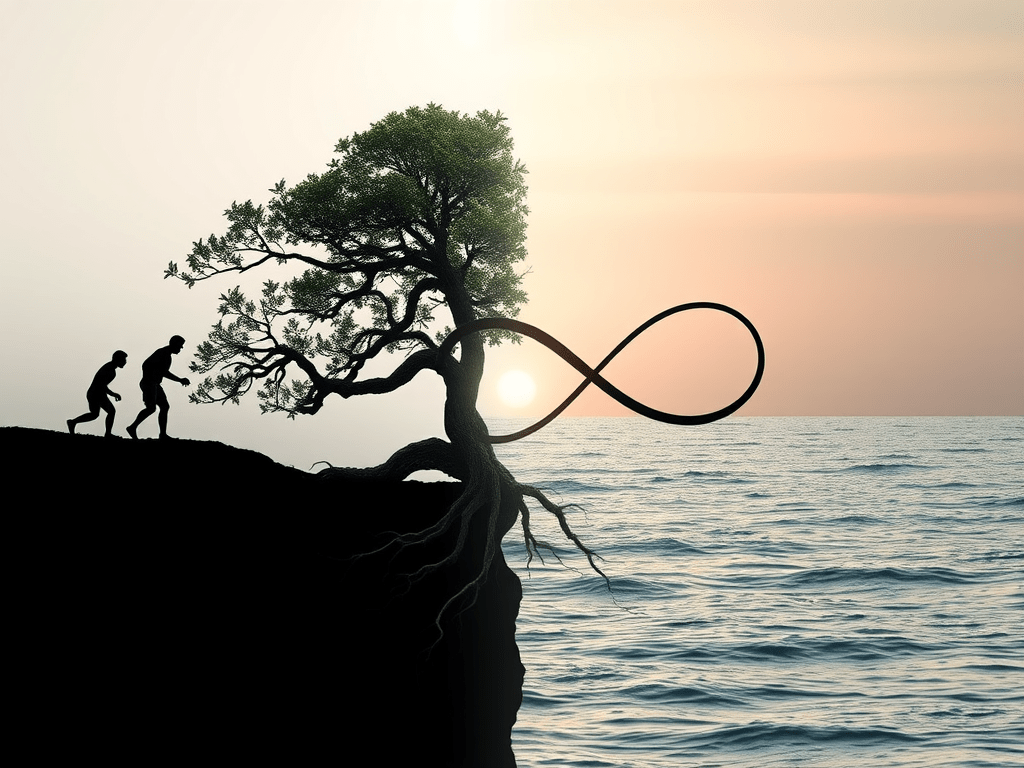
Post 30 – The Structure of Being and the Impossibility of Darwinian Evolution: A Philosophical Critique
Introduction Darwinian evolution, as understood in modern biology, explains the diversity of life through gradual transformation over time, driven by natural selection, random mutation, and adaptation. This scientific paradigm assumes that beings emerge, evolve, and give rise to new forms—a process rooted in the belief that reality unfolds through becoming. The Structure of Being radically…
Written by
-
Post 27 – The Structure of Being on the Illusion of Dualism
Introduction The Structure of Being perspective challenges a series of dualisms that are often taken for granted. By questioning the very idea of becoming—that things emerge, change, and vanish—this view exposes a fundamental mistake in our understanding of time and existence. This mistaken view gives rise to several apparent dualisms: Moreover, these themes resonate with…
Written by

-
Post 25 – How the Structure of Being Compares to Other Philosophies
The Structure of Being, as explored in this blog, shares insights with many philosophical traditions—both Eastern and Western. However, it also takes a radically different stance on key issues: What is real? What is illusion? Can we “wake up” to truth? And if so, what does that actually mean? Most traditions agree that we are…
Written by

-
Post 24 – Consciousness After Death
Introduction: The Illusion of Nihilism Have you ever felt that everything is fleeting—that life, memories, and experiences inevitably slip away, lost to time? This sense of impermanence, often called the illusion of nihilism, makes it seem as if nothing truly lasts, as if existence itself is fragile and transient. But what if that perception is…
Written by

-
Post 23 – The Relationship Between Personal Meaning and Universal Being
As humans, we progressively come to know the eternal structure of being, one glimpse at a time. Being persons, we experience this as deeply personal. Though in the structure of being there is no intent or possibility to change anything from or towards anybody, as everything is what it is since ever and forever, nonetheless…
Written by

-
Post 22 – The Nature of Truth
Truth is fundamentally linked to eternity and the necessary being of all things. Every being, whether a thought, an object, a person, or a moment, is eternal, never truly coming into being or ceasing to exist. Yet, humans live under the illusion of becoming, mistakenly believing that things are born, change, and perish. This illusion,…
Written by

-
Post 20 – The Earth That Saves: The Overcoming of Nihilism
The concept of the “earth that saves” was introduced by philosopher Emanuele Severino, as discussed in the previous post. Building on that foundation, we now turn our attention to a deeper exploration of this idea. The “earth that saves” represents the realm where the truth of Being is fully revealed, transcending the nihilistic illusion of…
Written by

-
Post 19 – The Fallacy of Reshaping Reality: Understanding Necessity
A Dubious Proposition: The Fallacy of Reshaping Reality History is replete with well-intentioned efforts to reshape society (whether by spreading values, liberating the oppressed, or enforcing justice) that ultimately justified harm in the name of a “greater good.” This arises from a fundamental error: the belief that reality is flawed, malleable, and in need of…
Written by

-
Post 18 – A Person, Their Moments, and Eternity
The Eternal Nature of Moments and the Illusion of Becoming According to the “Original Structure,” every moment is eternal. No moment arises from nothing or vanishes into nothing to make way for the next, as a nihilistic perspective assumes. In this view, a person is the totality of all their eternal moments. But how is…
Written by

-
Post 16 – Western Individualism: A Nihilistic Legacy
A striking feature of Western thought is not only its pervasive nihilism, rooted in the belief that everything emerges from and ultimately returns to nothing, but also its deeply entrenched individualism. The relationship between individualism and nihilism is profound, with the former often serving as a symptom of the latter. But does individualism itself directly…
Written by

-
Post 14 – Understanding the Impossibility of Becoming
The Impossibility of becoming also deserves to be clarified. Though mentioned in many posts, the question of becoming has not been singularly addressed. This is what I was referring to in the introduction, when speaking of some things difficulty to understand, not because of their complexity, but because of the way we have been taught…
Written by

-
Post 13 – Understanding the Self-Evident Truth of Being
I first hinted at this idea in the Intro and About post. At the time, I intentionally avoided being overly technical, but in doing so, I may have obscured the clarity and beauty of this foundational truth. This post aims to focus entirely on that truth. While this is not a new concept—it has been…
Written by

-
Post 11 – Technological Nihilism on a Greek Chessboard
The Greek Chessboard and Western Thought As we’ve seen, nihilism is intrinsic to the foundation of Western thought. Often referred to as the “Greek chessboard,” this foundation established the rules through which Western philosophy has engaged with reality, shaping the trajectory of its history. An obvious question arises: can this foundation be altered, allowing for…
Written by

-
Post 10 – Contemplating the Authentic Sense of Being
Describing the Authentic Sense of Being How may we describe the authentic sense of Being? It is not a “sense” in the conventional understanding of the term, yet sensing, feeling, knowing, and awareness are words often employed to gesture toward it. Here, language falters—words become mere symbols pointing to that which they cannot fully contain,…
Written by

-
Post 9 – Ethics, Morality, Love and Freedom
Ethics and Morality Beyond Nihilism Here’s a provocative question to start with: If everything is eternal and unchanging, does that mean reality is predetermined? At first glance, this might seem disheartening—almost as if our choices don’t matter. But in Post 4, we explored the concept of free will and arrived at an intriguing conclusion: our…
Written by

-
Post 8 – Eternal Being and the Illusion of Change: Eastern Insights and Nihilistic Paradoxes
The East“For the soul, there is neither birth nor death at any time.It has not come into being, does not come into being, and will not come into being.It is unborn, eternal, ever-existing, and primeval.It is not slain when the body is slain.”— Bhagavad Gita, Chapter 2, Verse 20 This verse from the Bhagavad Gita…
Written by

-
Post 6 – Rethinking Nihilism in Religious Thought
What Would Become of Our Systems of Thought? What would become of our various systems of thought if we were to remove from their core the nihilistic persuasion? To a certain extent, we have already explored that, but let us now get a bit more specific, perhaps starting with religion and spirituality. First, a brief…
Written by

-
Post 5 – A Truth That Cannot Be Shaken
Two Selves in One We are always within the Truth. We embody our true being, yet in time, we perceive it only in fragments—one fleeting moment at a time. This fractured perception obscures the whole. Unconsciously, we know the Truth because we are it; however, consciously, we perceive only its fleeting fragments: the present moment.…
Written by
-
Post 4 – Reconciling Free Will and Determinism: An Eternal Perspective
Change, Becoming, and the Nature of Being If Being is eternal and unchanging, as classical metaphysics suggests, then change and becoming seem contradictory. However, our experience of change is undeniable. How can we reconcile these two ideas? Being, as the fundamental reality, is consistent and indivisible. It cannot shift between existence and non-existence without ceasing…
Written by

-
Post 3 – The Structure of Being
In the previous posts, we explored a fundamental misunderstanding about the nature of reality and outlined a path toward resolving this contradiction. Before addressing the inevitable questions raised by the conclusion, that everything physical or abstract is eternal, let’s revisit some key ideas. The Subjectivity of Time and the Eternity of All Things When considering…
Written by

-
Post 2 – The Eternity of All Things
Intuitions of the Eternal We have spoken of the unassailable truth of our Being and our awareness of time and space, but there is yet another form of awareness; more elusive, less dependent on our senses, and harder to define. It is something we all experience at times yet struggle to articulate. This awareness emerges…
Written by
-
Post 1 – At the Roots of Western Thought
A Western Problem? In progressive Western societies, we take pride in the freedom to think and believe as we choose. Individualism and self-determination are highly valued ideals. Yet, despite this emphasis on personal autonomy, our thinking is profoundly shaped by cultural and historical frameworks that influence us in ways we often fail to recognize. While…
Written by
-
About and Intro
A Fundamental Contradiction When we seek the truth, the most fundamental certainty is our existence, or more specifically, the awareness that “I am.” This self-evident truth requires no external validation. It is immediate, solid, unchanging, and impervious to doubt. Equally apparent is our experience of reality, shaped by space and time: “I am aware of…
Written by

 It Is What It Is