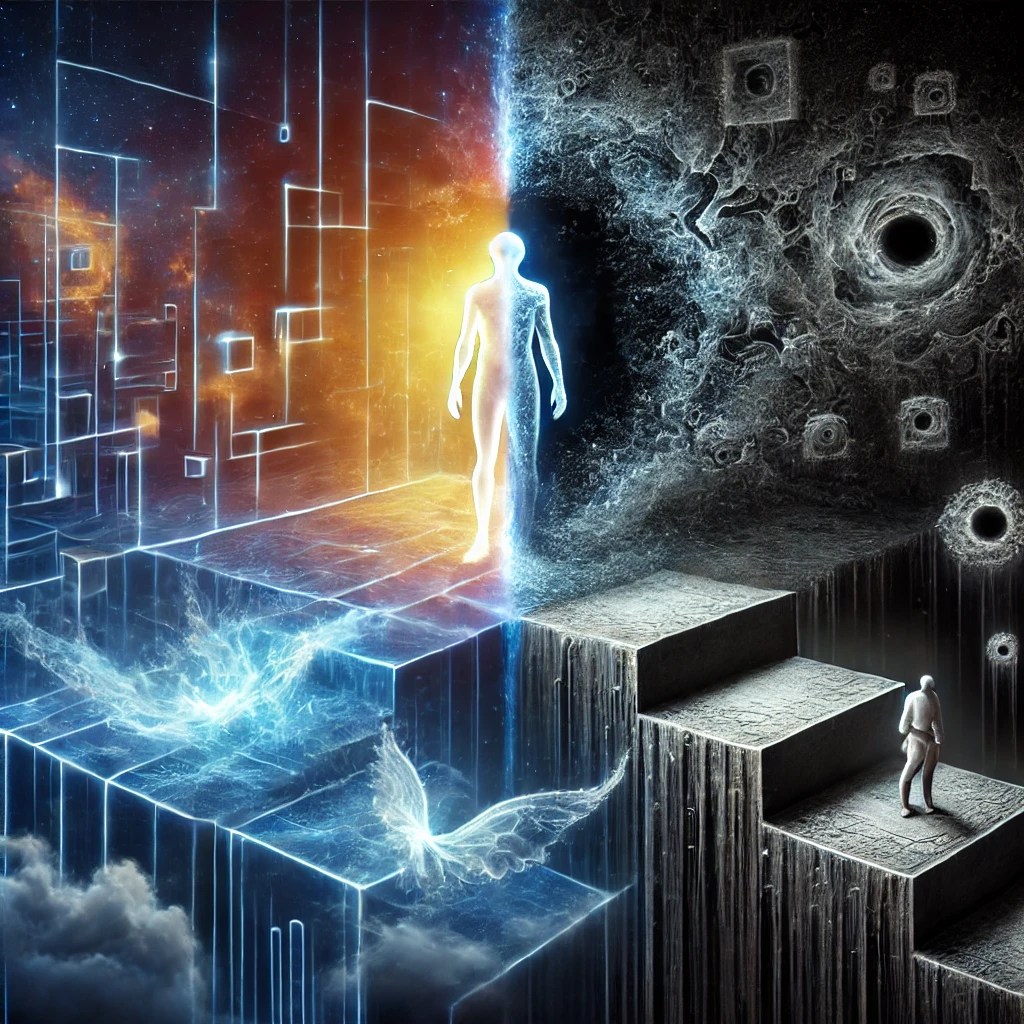
A Western Problem?
In progressive Western societies, we take pride in the freedom to think and believe as we choose. Individualism and self-determination are highly valued ideals. Yet, despite this emphasis on personal autonomy, our thinking is profoundly shaped by cultural and historical frameworks that influence us in ways we often fail to recognize. While each culture offers unique perspectives, two overarching traditions, Eastern and Western, have significantly shaped humanity.
In this discussion, we will focus on Western thought. By “Western,” we do not mean the geographical West but rather a mindset and perspective on reality that has achieved global influence—even in the East and in countries that consider themselves anti-Western. For example, communist systems base their political frameworks on Western philosophy, drawing on thinkers like Marx and Hegel. Similarly, democratic nations trace their principles back to Greek philosophy, with democracy itself rooted in Western intellectual traditions.
This global expansion of Western ideologies has brought both opportunities and crises. Much of the latter stems from the profound turmoil Western thought is undergoing today. On the surface, this turmoil manifests as a clash between religious conservatism and secular liberalism. However, beneath this tension lies a deeper conflict between two opposing worldviews: the theistic traditions of antiquity and the atheistic perspectives that have gained prominence in recent centuries.
Western Europe, the birthplace of much of Western philosophy, has largely transitioned from theism to atheism. Yet the present crisis is not simply a matter of choosing between the two. It arises from an enduring, unresolved question at the heart of both; one that has shaped Western thought for millennia. To understand this, we must trace its origins back to the dawn of Western philosophy in ancient Greece.
The Foundations of Western Thought
From the earliest days, humans have faced a hostile world where beasts, natural forces, and other humans threatened suffering and death. In response, they sought solace by aligning themselves with perceived supreme powers that governed these forces. Myths arose from this need, crafted to secure divine favor and protection for tribes, cities, and individuals.
Myths offered a sense of destiny and connection to the supernatural, promising safety and continuity beyond death. However, myths only function when believed. As the Greeks encountered a diversity of conflicting myths, it became increasingly difficult to take any one of them literally. This tension drove Greek thinkers toward a more rational approach to understanding the world.
Philosophy emerged as a critique of myth, recognizing that myths alone could not address humanity’s deepest fears, particularly the fear of death. A true remedy, philosophers argued, must be universally accepted and logically irrefutable.
In this spirit, Parmenides (6th–5th century BC) offered a groundbreaking insight: “Being is and can never not be; Not-Being is not and can never be.” This unassailable truth, immune to contradiction, laid the foundation for the Principle of Non-Contradiction (PNC), a cornerstone of clear thought and sound reasoning.
Yet, by affirming the absoluteness of Being, philosophy also evoked the unsettling notion of Not-Being—nothingness, a necessary opposite to Being that paradoxically does not exist. While only Being is, its timeless and unchanging nature seemed irreconcilable with the transient world of the senses, where things appear and disappear as if emerging from and returning to nothing. Lives, objects, and events appeared fleeting, challenging the permanence of Being.
Confronted with this paradox, Parmenides dismissed the sensory world as illusory, a view echoed in concepts like Maya or emptiness in Eastern philosophies. Plato, acknowledging Parmenides’ insight, sought to resolve the tension with a dualistic framework. He proposed that true Being resides in the hyperuranion, an eternal realm of perfect Forms or ideas. The material world, according to Plato, is merely a flawed imitation of these ideal Forms. However, by placing Being in a transcendent domain, Plato distanced it from tangible reality.
Aristotle offered a different solution. He argued that while certain aspects of Being (such as the unmoved mover) are eternal, individual material things possess Being only temporarily, losing it when they cease to exist. This grounded Being in the observable world but failed to fully resolve the tension between its absolute nature and the impermanence of material existence.
Despite these efforts, the contradiction between Being and Not-Being remained unresolved. The persistent notion that things emerge from and return to nothing blurred the distinction between the two, equating absolute Being with nothingness itself.
Philosophy, which aimed to replace myth with reason and definitive answers, faltered when confronted with the concept of “nothing” and its opposition to and distinction from Being. This unresolved dilemma ultimately gave rise to nihilism.
The Christian Synthesis
Christianity emerged during a pivotal era when ancient mythologies were losing their influence, and philosophy had inadvertently ushered in the specter of nihilism. Its success can be attributed, in large part, to its compelling response to these challenges. Rather than opposing reason, Christianity sought to synthesize faith and reason. Unlike many religious systems that conflicted with rational thought, Christianity embraced the intellectual traditions of Greek philosophy, particularly Plato’s dualistic model of reality. Like Greek philosophy, it rejected local tribal mythologies and claimed a universal scope.
Christianity’s bold claim was that it fulfilled and transcended Greek thought. It adopted Heraclitus’ Logos (the divine rational principle), Parmenides’ concept of eternal Being, and Plato’s idea of eternal Causation, asserting that all these were incarnated in Christ. In this synthesis, the divine became flesh: Christ was not merely an abstract principle but a real person who lived, died, and rose again, offering immortality to all.
This combination of rational philosophy with a concrete historical event proved to be a winning formula, especially in a world increasingly marked by nihilism. As faith in ancient mythologies waned, particularly among the educated classes, Christianity offered an alternative that was both intellectually compelling and spiritually uplifting. It filled the void left by the collapse of old systems, providing a cohesive framework of meaning, hope, and purpose. Over time, Christianity became the state religion, replacing fragmented tribal myths with a unified worldview.
However, in integrating Greek philosophy (particularly Platonism) Christianity also inherited the nihilism implied in its unresolved contradictions, such as the tension between Being and Not-Being. Unable to resolve this dilemma, Christianity offered a reframing, an alternative narrative: “Yes, you come from nothing and return to nothing, so you are nothing; but the eternal God who brings you out of nothing can grant you eternal life, Being.”
This reframing provided solace, keeping the latent nihilism of Greek metaphysics in check. Christianity did not resolve these philosophical contradictions but transcended them through faith in the transformative power of God. For centuries, this synthesis endured, offering both intellectual coherence and existential meaning.
The Fragility of the Synthesis
Over time, however, this delicate balance began to waver. The rise of scientific inquiry and rationalism in the modern era challenged traditional cosmologies and the biblical account of creation. As reason increasingly eclipsed faith, Christianity’s ability to address the deepest human concerns weakened. What had once been a powerful antidote for nihilism began to lose its efficacy.
The contradictions embedded in Greek metaphysics, long subsumed within Christian theology, resurfaced with greater force. As faith eroded and the existential grounding Christianity provided diminished, the latent nihilism (anchored in the idea of creation from nothing) reemerged in Western thought. What had once been held at bay by the promise of eternal life through God now became a philosophical and cultural crisis, leading to new attempts to grapple with meaning in an increasingly disenchanted and fragmented world.
The Emergence and Essence of Nihilism
The history of nihilism is, at its core, the history of forgetting the eternity of Being. It arises from the way Greek philosophy conceptualized existence as suspended between Being and Not-Being. The inability to sustain the tension, distinction, and opposition between the two (an insight first articulated by Parmenides) ultimately led to the conflation of Being with nothingness.
When we believe that things arise from nothing and return to nothing, we are, in effect, asserting that reality itself (things, entities, and the entire world we experience) is nothing. This belief forms the essence of nihilism.
Yet, nihilism operates largely on an unconscious level. It fails to recognize itself as such, assuming instead that it perceives reality as it truly is: pragmatic and materialistic. While it adamantly denies being rooted in faith or belief, its inherent contradictions reveal precisely that.
This brings us to an often-overlooked truth: the shared, unconscious foundation of theism and atheism, as well as materialism and idealism. By ignoring the nihilistic underpinning of their arguments, these perspectives engage in conflicts over interpretations they mistakenly regard as self-evident truths. In doing so, they fail to address the deeper issue: the proverbial “elephant in the room.”
Even common definitions of nihilism reflect this core issue. They often claim that “there is no truth,” yet this assertion is self-contradictory: if “there is no truth,” how can that statement itself be true? Even the staunchest nihilists cannot escape the undeniable truth of their own existence. This unassailable fact points to the eternal nature of Being—a reality immune to contradiction.
Despite this, the nihilistic mindset persists due to the unresolved tension between Being and Not-Being. The sensory world, with its apparent impermanence, fosters the misconception that things emerge from and vanish into nothing. This misinterpretation undermines the absolute truth of Being, perpetuating the nihilistic mindset.
The Present Dilemma
Modernity has inherited nihilism in its “weakened” form through Christianity, which once kept it in remission through faith in the providential intervention of an eternal god. As that faith declined, nihilism resurfaced in full force, challenging contemporary thought. Nietzsche’s proclamation of the “death of God” symbolized this crisis; not just the end of Christian theology but the collapse of all universal narratives that once provided meaning.
At its core, nihilism proclaims a fundamental lie: that Being is not and that Nothing is. This absurdity has become embedded in modern thinking. We accept the idea that birth marks a passage from nothing into Being and death a return to nothing, embracing the ultimate absurdity of believing in “nothing.”
A Way Forward
The unresolved contradictions inherited from Greek philosophy have shaped the Western worldview for millennia, but they also point the way to its next transformation. Revisiting the original insights of Parmenides (his unshaken truth that Being is eternal) offers an opportunity to transcend nihilism. To do so, we must challenge the mistaken assumptions about nothingness that have clouded Western thought and confront our misunderstanding of sensory experience.
As we face the crisis of nihilism today, the task is not merely to choose between faith and doubt, theism and atheism, but to fundamentally rethink our understanding of Being. This pivotal moment offers the potential for a new synthesis, one that transcends the limitations of the frameworks we have inherited and addresses the profound questions that have shaped our civilization.
 It Is What It Is
Leave a comment