Intuitions of the Eternal
We have spoken of the unassailable truth of our Being and our awareness of time and space, but there is yet another form of awareness; more elusive, less dependent on our senses, and harder to define. It is something we all experience at times yet struggle to articulate. This awareness emerges in fleeting moments when our ordinary perceptions seem to step aside, allowing something deeper to surface. These glimpses, brief flashes that last only moments, leave a profound and deeply satisfying impression.
We cannot say whether this awareness is an “it” or a “who,” an “I” or a “you,” or whether it resides here, there, or everywhere. Yet it always feels familiar, as though it is something we have always known: timeless, ancient, and ever-present.
Some describe these moments as religious experiences; others frame them philosophically. Many link them to specific circumstances: deep love, awe, suffering, or encounters with extraordinary beauty. For some, they are purely material phenomena, explained by hormones, endorphins, or other biochemical reactions.
Whatever their explanation, or lack thereof, these experiences remain a mystery, defying complete understanding. Words such as God, soul, spirit, the numinous, the unconscious, or the true self attempt to capture their essence, yet most people leave them unnamed. These moments, scattered across our lives, are often ignored or left unexplored.
The philosopher Baruch Spinoza once observed, “We feel and know that we are eternal.” Freud, in turn, noted the timelessness of the unconscious and wished for it to be “taken into consideration in philosophical thought.”
Consciously or unconsciously, we all resonate with these feelings, knowings, or intuitions. Yet we rarely allow ourselves to fully embrace them. When they do surface, they feel so intimate and personal that we hesitate to talk about them, fearing that the act of expression might diminish their significance. And even if we dared to speak of them, what could we possibly say?
It often feels safer to remain within the confines of accepted thought and belief. After all, we live in a world governed by an intricate architecture of knowledge that claims to have answers for everything and dismisses such experiences as irrational. Why, then, venture into the uncharted, grappling with things we are ill-equipped to understand, risking words that will almost certainly be misunderstood?
The fact is that if we were to delve deeper into these experiences and intuitions, they would reveal something far more rational and grounded than we might imagine. Physics, science, and philosophy could, in fact, offer more validation for them than refutation. Consider, for example, the special theory of relativity and its perspective on time, not to mention more recent cosmological discoveries.
Returning to the Path of Truth
This brings us back to the ancient, forgotten path mentioned in the introduction. It alluded to Parmenides’ first great affirmation about the nature of Being: “Being is and can never not be.” The implication is profound. If Being can never not be, it is eternal.
Yet Parmenides himself lost that original, genuine sense of Being when he attempted to reconcile it with the impermanence of things in the sensory world. Other philosophers recognized the inconsistency, but in their own ways, they too abandoned the path of truth. The direct implications of Parmenides’ insight were simply too counterintuitive to accept.
To move forward, we must return to Parmenides’ first realization, his path of truth, without following the reasoning that caused him to lose it. What would have been the more immediate and incontrovertible conclusion—the step that would have kept him on the path? To take that first truth so seriously as to follow it to its necessary conclusion: there is no true impermanence in the sensory world. Everything, every thought, every event, every fleeting thing, has Being and is eternal.
Evidence or Misunderstanding?
We can understand why Parmenides and those who followed him could not shake the apparent evidence of things coming into being and ceasing to be. The seeming emergence from nothing and return to nothing still challenges our intellectual grasp of their eternal nature. How could they be eternal, we ask, when we see with our own eyes that things which were are no more?
Yet we also never see things truly becoming nothing or nothing becoming things. As counterintuitive as it may be, the eternity of all things, even those that last just a moment, enjoys more logical coherence and evidence than the belief that they arise from and vanish into nothing.
The appearance of change and becoming arises from a misinterpretation of what is fundamentally eternal. Like a reel of film or a novel whose entirety exists simultaneously, reality unfolds sequentially for us due to the constraints of our perception. Each frame or page always exists; it is our movement through them that gives the illusion of change and temporality.
Time: The Persistent Illusion
Time, as Einstein noted, is a “stubbornly persistent illusion.” Scientific advancements, particularly in relativity, affirm that past, present, and future coexist in what physicists term the block universe: a timeless reality where all events exist equally. From this perspective, time is not an external force dictating reality but a subjective experience arising from our consciousness moving through the eternal.
This concept is echoed in personal phenomena such as déjà vu or near-death experiences (NDEs), where individuals report perceiving their entire lives or even future events in a single, timeless instant. Such experiences suggest that events do not “become” but are always present, existing in an eternal now. Our perception of time as linear (a sequence of “before” and “after”) is thus a practical tool for navigating life but does not reflect the underlying reality.
Eternity and Perception: The Truth of Appearance
If all things are eternal, every fleeting moment we experience is but a slice of the eternal whole. This idea challenges traditional interpretations of change and becoming. What we perceive as transformation is not a movement from being to nonbeing but our limited apprehension of the eternal through the lens of time. Just as a train passenger might believe the scenery moves while the train is stationary, we mistake the eternal for the temporal.
This realization reframes the apparent contradiction between free will and determinism. As Bernardo Kastrup puts it, “What nature wills is what it must, and what it must is what it wills.” From the eternal perspective, our choices are not contingent possibilities but necessary expressions of what we eternally are. Free will and determinism are two sides of the same coin: seen from time, we choose; seen from eternity, those choices are already fixed in the tapestry of Being.
Reconciling Eternity with Change
A common thread emerges: the resolution of contradictions is key to understanding truth. The temporal world, rife with contradictions, is a necessary dimension for resolving them. Through the lens of time, we encounter and transcend errors, gradually moving toward a more comprehensive understanding of truth. Yet ultimate truth (the infinite resolution of all contradictions) lies beyond time, in the eternal.
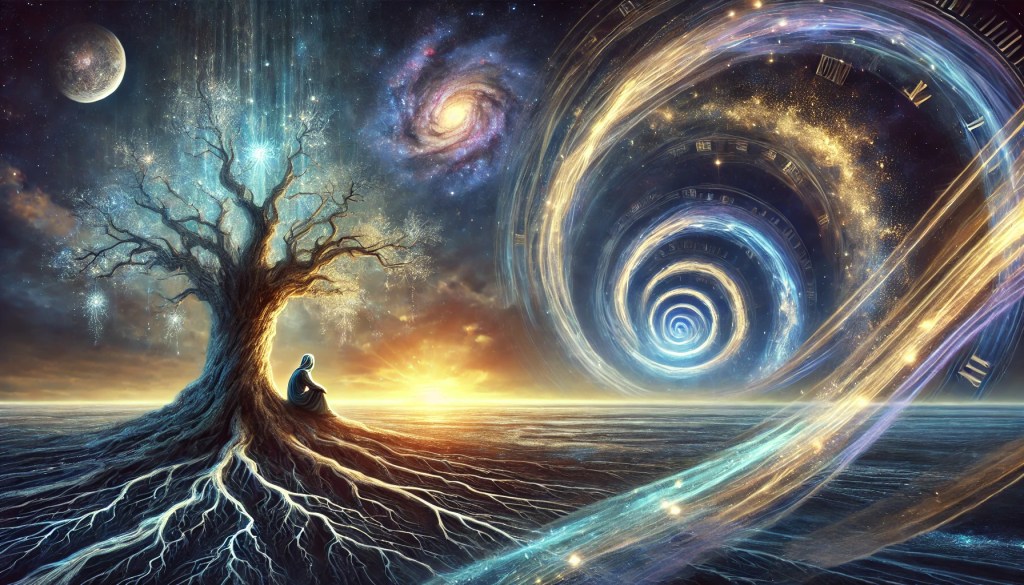
Time is the unseen root, sustaining the eternal branches that reach into the infinite. Both are essential and inseparable. Without the temporal, the eternal would lack the means to manifest; without the eternal, the temporal would dissolve into incoherence.
Conclusion: The Eternal in the Temporal
By integrating the insights of The Eternity of All Things and The Impossibility of Nonbeing, we find a unified vision of reality where Being, time, and perception harmonize. Time, though illusory, is a necessary dimension through which the eternal becomes accessible. Change and becoming, far from contradicting eternity, are the ways in which we, as finite beings, engage with the infinite.
In the end, the paradox resolves itself: everything that is, always is, and nothing can ever truly cease to be. Life is not a fleeting journey toward nothingness but an eternal dance of Being, where each moment shines as an integral part of the whole. Time may be the veil, but through it, we glimpse eternity.
 It Is What It Is
Leave a comment