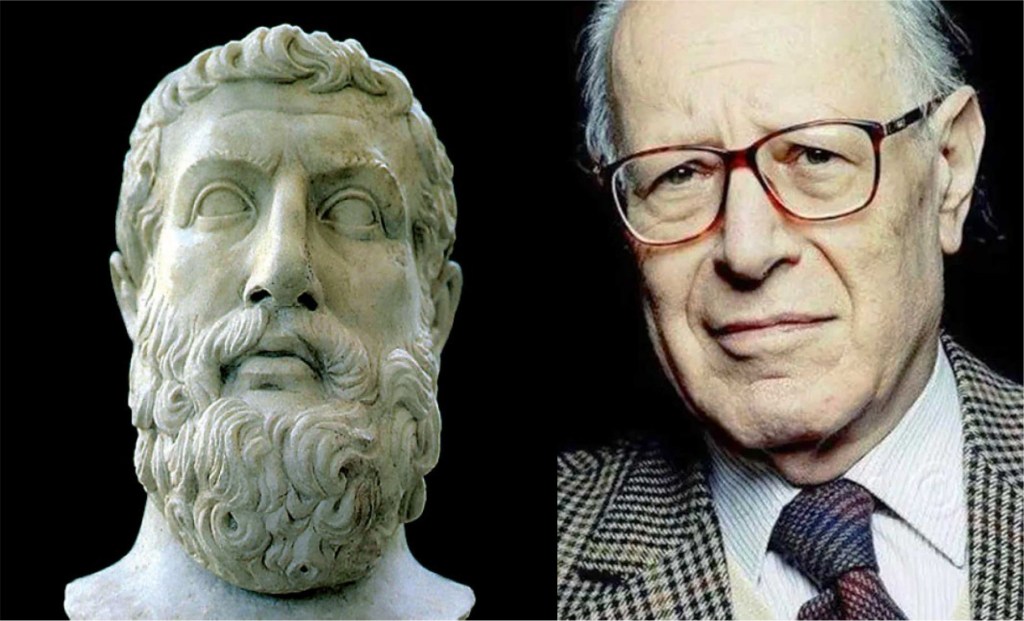
The history of Western thought is the history of the appearing of truth—an appearing that first manifested with Parmenides but remained incomplete, leading to millennia of nihilism before culminating in the necessity of its fuller recognition with Emanuele Severino. The unfolding of the structure of Being is not merely an intellectual progression but the necessary course of thought itself as it struggles with and eventually overcomes the contradictions that have obscured the eternal truth of Being.
Parmenides: The First Appearing of Eternal Being
The first glimpse of the Structure of Being appears in the thought of Parmenides. Confronting the prevailing assumption that things come into and pass out of existence, he exposed the contradiction at the heart of such a belief. If Being is, then it cannot come from non-being, nor can it pass into non-being—because non-being is not. Thus, all that is must be eternal, unchanging, and indivisible. With this, Parmenides initiated the first great rupture with the naive trust in becoming.
Yet his vision, though radical, was incomplete. While rightly rejecting becoming, he mistakenly denied the reality of multiplicity and time. His Being was a monolithic, undifferentiated totality, leaving no room for the world of appearances that seemed to contradict it. This incompleteness became the aporia that later thought would struggle to resolve—a struggle that, rather than clarifying the matter, strengthened the assumption of becoming and deepened the distance from the truth Parmenides had glimpsed.
The Descent into Nihilism: The Mistaken Search for Change Within Being
The Western tradition, failing to recognize the necessity of Parmenides’ insight, attempted to salvage the common-sense experience of change. From Plato and Aristotle to modern thought, the effort to reconcile Being with the apparent flux of the world resulted in an implicit acceptance of nothingness. Whether through the notion of creation ex nihilo or the belief in the annihilation of entities, philosophy progressively surrendered to the idea that things could truly emerge from and return to non-being. This was the birth of nihilism: the belief that Being is not absolute and that nothingness has a role in reality.
This descent into nihilism reached its most explicit form with modernity, where faith in becoming took precedence over any recognition of eternal necessity. The world was no longer conceived as an expression of immutable Being but as a process of continual transformation, leading to relativism, existential despair, and the complete loss of any foundation for truth.
The Return to Parmenides: Severino’s Resolution of the Ancient Contradiction
The necessity of truth, however, cannot be extinguished. If Being is, then its structure must appear again in thought, resolving the contradictions that had led to its obscuration. Emanuele Severino enacts this return—not as a repetition of Parmenides’ insight, but as its fulfillment. He recognizes that Parmenides’ denial of becoming was correct but incomplete. Multiplicity and time are not illusions; they are necessary aspects of the eternal.
Severino reveals that the fundamental error of Western metaphysics lies in its belief in the possibility of nothingness. Nothingness is not, and therefore, nothing can transition into or out of it. Every being that appears is eternal, and what we call time is merely the necessary appearing of these eternally real beings within the structure of Being. The contradiction that plagued Parmenides—how to reconcile unity with multiplicity, eternity with time—is resolved: beings do not become, but they appear and disappear within the necessary order of the eternal.
The Full Unfolding of Being and the End of the Illusion of Becoming
With Severino, the truth of Being stands in its full necessity. No longer is the world of appearances dismissed as deceptive, nor is change conceived as a transition between being and non-being. Rather, all things, all experiences, all beings are eternally real, and their appearances in time follow a necessary order. The nihilism that dominated Western thought for millennia is revealed as the inevitable consequence of misunderstanding Being.
The unfolding of the structure of Being, then, is not merely a historical progression but the necessary movement of thought toward the recognition of its own eternal foundation. Parmenides began this appearing; the path of nihilism obscured it; and in Severino, it stands in its full light. Thought can no longer retreat into the illusion of becoming—it must recognize, as it always has, the eternal necessity of Being and its appearing.
This is not merely the resolution of an ancient philosophical problem. It is the recognition that all things are as they must be, that truth is not something constructed or discovered but something that necessarily appears. The path has always been leading here—to the understanding that nothing is ever lost, that all beings are eternal, and that the appearing of truth itself is an unshakable necessity.
 It Is What It Is
Leave a comment