When Power Loses Its Illusion, Truth Begins to Appear
A World in Turmoil
We are living through a period of increasing disorientation. The symptoms are everywhere: political instability, cultural fragmentation, ecological degradation, and the collapse of trust in institutions. Each crisis feels like a rupture, and yet taken together, they begin to form a single, undeniable revelation: something deeper is unraveling beneath the surface.
For centuries, the modern world has oriented itself around the promise of progress—a belief that the future would be better than the past, and that human knowledge and power could shape the world toward greater freedom, control, and prosperity. This narrative was carried and promoted, often forcibly, by what we call “the West.” But today, that narrative has begun to fail.
The West and the Faith in Becoming
The West, for much of modern history, has held a central position in defining what it means to be developed, civilized, advanced. From Enlightenment rationalism to industrial capitalism, from liberal democracy to technological supremacy, it offered a vision of the world that appeared both desirable and inevitable.
But that vision was built upon a metaphysical belief so deep it rarely needed to be named: the belief that reality is fundamentally changeable. That things can be made, unmade, and remade according to human will. That Being itself is subordinate to becoming—to time, to history, to progress.
Now, as the confidence of the West diminishes, it becomes clear that its strength was never purely military or economic. It was philosophical. And that philosophy is in crisis.
The Globalization of the Illusion
The decline of Western dominance does not mean that a radically different worldview is taking its place. Quite the opposite. As power shifts geopolitically, the deeper assumptions remain largely untouched. Nations that once resisted Western influence now emulate its structures. The global economy, media, and technological systems all operate within the same underlying logic.
This is why the collapse is not regional, but global. The belief in the supremacy of becoming—in a world where nothing is stable, everything is contingent, and the future is always open to manipulation—is not just Western. It has become the silent grammar of global civilization.
The Naked Emperor
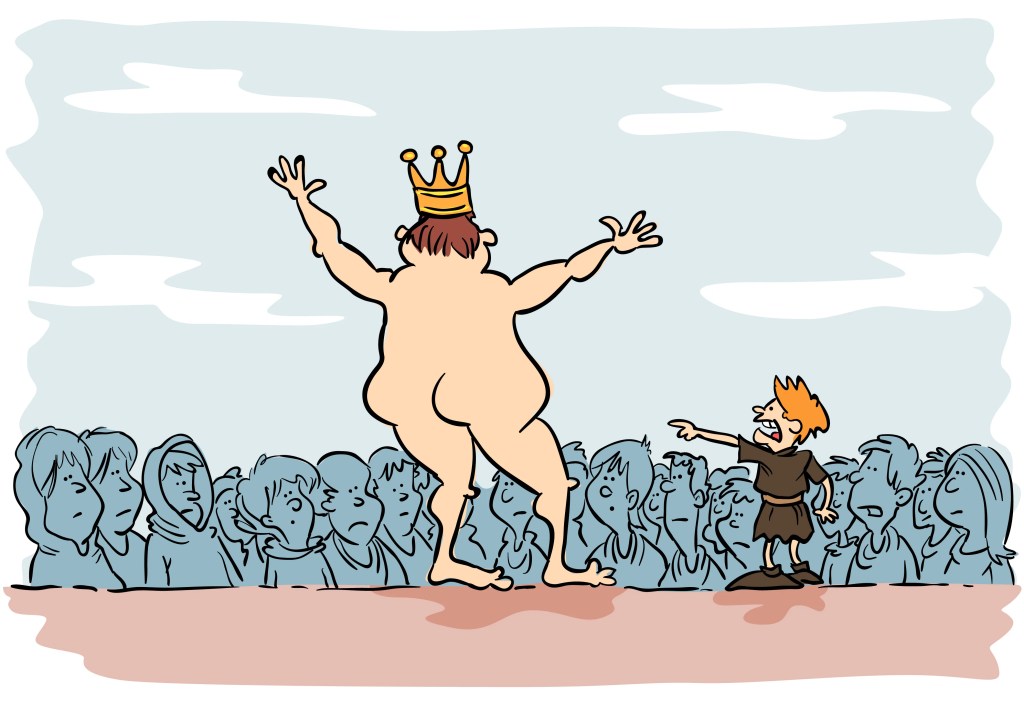
In the well-known fable, a vain emperor is deceived into wearing no clothes, believing they are visible only to the wise. His subjects, afraid of appearing ignorant, pretend to admire the invisible garments. It takes the honesty of a child to point and say what everyone already sees but cannot admit: the emperor is naked.
Today, the emperor is not just a person or a nation, but a way of seeing the world. The illusion is that power, progress, and control are sufficient to ground meaning. The crisis we are witnessing is not merely one of leadership, but of vision. The structures we once revered as invincible are being exposed as hollow. The child who speaks now is not one individual, but a growing awareness that dares to name what can no longer be denied.
When Illusion Fails, Truth Appears
This exposure is painful, because it reveals not only the failure of others but our own entanglement in the same illusion. No culture or individual escapes the seduction of control and progress. And yet, the failure of the illusion may be the condition for a more profound recognition.
Truth does not need to be built. It does not evolve through history or depend on outcomes. It is not what comes after the collapse, but what remains when the illusion collapses. When the world no longer pretends that the emperor is clothed, what is left is not chaos, but the possibility of seeing clearly.
This is not a call for return or nostalgia, nor a new ideology to replace the old. It is a call to witness what was always already there, though hidden: a structure of reality that does not depend on power, possession, or becoming. The West may have led the world into the illusion, but it may also be the place where its undoing becomes visible first. In that exposure, something deeper begins to shine through.
And from there, everything changes—not because we made it so, but because the truth finally appeared.
 It Is What It Is
Leave a comment