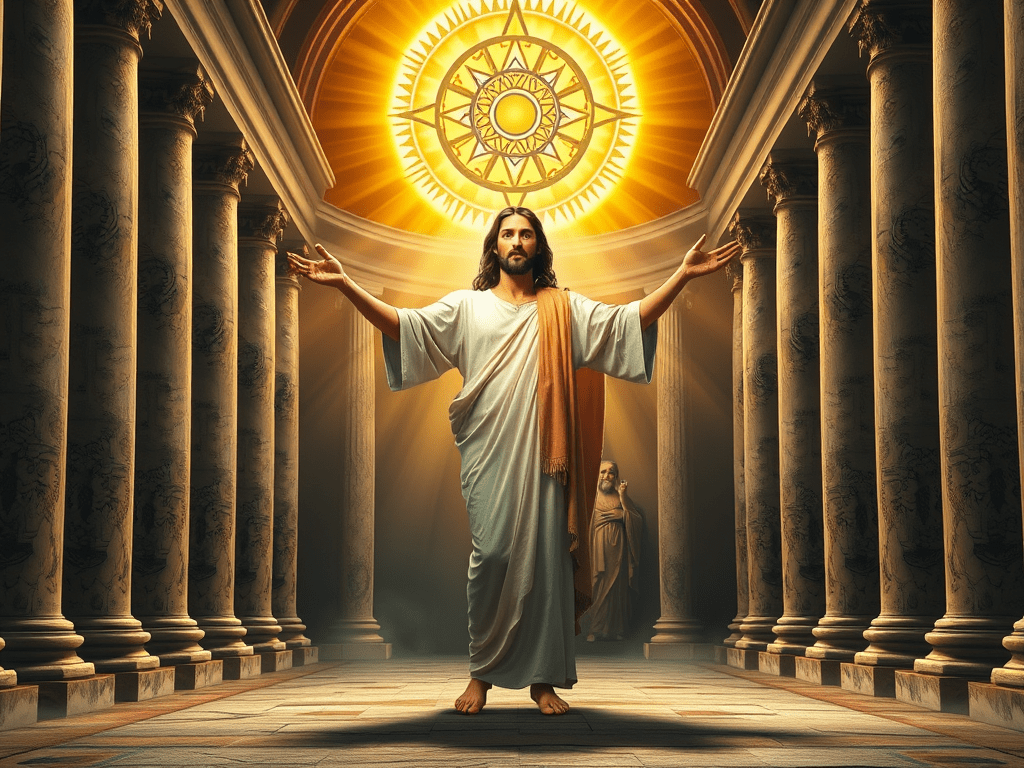
From Augustine to Modernity: How Christianity Carried the Logic of Annihilation
By the time Christianity emerged as the dominant religious force of the Roman Empire, the seeds of a deeper metaphysical tension had already been sown. The Christian proclamation of the eternal had fused with the Platonic suspicion of time, matter, and change. The result was a theology suspended between two visions: one in which the world is sacred, incarnate, and destined for glory—and another in which the world is transient, fallen, and destined to vanish.
Rather than being resolved, this tension was codified into doctrine. And over the centuries, it was not overcome but deepened, shaping Christian thought from Augustine through Aquinas and into modernity.
Augustine and the Will That Falls
Augustine, one of the foundational figures of Christian theology, was deeply influenced by Neoplatonism. Though he broke from its impersonal metaphysics in favor of a personal God, he retained its suspicion of the mutable and the material. For Augustine, creation was good—but fallen. The human will, originally ordered toward God, had turned away, and history became a drama of exile and return.
His doctrine of original sin framed all human beings as inheriting a will inclined toward evil. The world, far from being the eternal unfolding of Being, became the stage of a cosmic deviation—a place from which humanity must be redeemed.
What is crucial here is Augustine’s presupposition of contingency: creation is not necessary, but the result of a divine choice. It was brought into existence from nothing and could, therefore, be cast into nothing. In this way, Augustine solidified the metaphysical possibility of annihilation—not only for individuals, but for the world as a whole.
As Farotti notes in Gustare il destino nel cristianesimo, this framework plants within Christianity a deep and lasting anxiety: a fear that what exists is suspended over the abyss. Salvation, then, becomes not the revelation of Being’s eternal structure, but the hope for rescue from annihilation.
Aquinas and the Scholastic Synthesis
Thomas Aquinas brought a new philosophical precision to Christian theology, integrating Aristotle’s metaphysics with Augustine’s theology. But in doing so, he preserved—and in some ways reinforced—the foundational dualisms of the Platonic tradition.
For Aquinas:
- God alone is necessary; all created beings are contingent.
- The world is good, but its goodness is derived and temporary.
- Salvation consists in the beatific vision—a future state in which the soul beholds God directly, beyond the mediation of temporal things.
In this system, time remains subordinate to eternity, and the body—though affirmed—is ultimately destined for transformation. Aquinas upholds the resurrection of the flesh, but only within a metaphysical framework that denies eternity to what appears.
This synthesis became the theological foundation of Catholic orthodoxy. And with it, the logic of becoming from and toward nothing was preserved at the very heart of Christian doctrine.
The Fall, Sin, and Salvation as Temporal Drama
Across the centuries, Christian theology has continued to narrate human existence as a temporal drama suspended between origin and end:
- The Fall is a plunge into contingency.
- Sin is the failure to remain anchored in the eternal.
- Salvation is the future resolution of this failure—usually beyond this world, beyond time.
Even in Protestantism, where emphasis shifted to grace and inner faith, the underlying metaphysics remained: the world is impermanent, salvation is not yet, and Being is still something that can be lost.
This structure can be comforting in its promise of redemption—but it is also haunted by negation. It suggests that what appears can disappear, that what is can fail to be, and that the eternal is not already present, but must be reached.
Paul and the Church’s Struggle with Annihilability
Farotti draws particular attention to Paul—not as the architect of Christian nihilism, but as a figure caught in its early tension.
Paul proclaims a Christ who defeats death, who reveals the resurrection of the body, and who brings about a new creation. But Paul also speaks of judgment, destruction, and a cosmic timeline that moves from fall to restoration.
The Church, in interpreting Paul, has often emphasized the drama rather than the structure: the not yet over the already. And in doing so, it has maintained a subtle belief in the annihilability of beings.
Farotti highlights how the Church still wavers on this point. While it proclaims the final redemption of the world, it also retains doctrines—such as eternal damnation or the destruction of the wicked—that affirm the possibility of absolute loss. This is the unspoken metaphysical contradiction: affirming eternal salvation, while believing that some beings may be cast into nothingness.
A Metaphysics of Fragility
The result of this long tradition is a Christianity built on a metaphysics of fragility:
- The world is good—but not guaranteed.
- The person is sacred—but not necessarily eternal.
- Salvation is promised—but not certain for all.
This worldview is suspended between the intuition of eternity and the belief in becoming. It is a faith that wants to affirm the necessity of Being but is trapped in the language of contingency, will, and disappearance.
As Farotti puts it, Christianity intuits the eternal, but continues to speak in the voice of Plato’s fear of the temporal.
The Way Forward
This article has traced how Christian thought, through its greatest figures and doctrines, preserved the Platonic division between the eternal and the temporal. But this is not the end of the story. For even within this framework, the longing for eternity has never disappeared. It re-emerges in mysticism, in the sacraments, in the longing for union and glory.
In the next article, we will examine how these deeper intuitions persist—how, despite centuries of dualism, Christianity has always carried within itself the seeds of a different vision: one in which Being is eternal, nothing is lost, and the world is not passing away, but appearing within the eternal structure of truth.
 It Is What It Is
Leave a comment