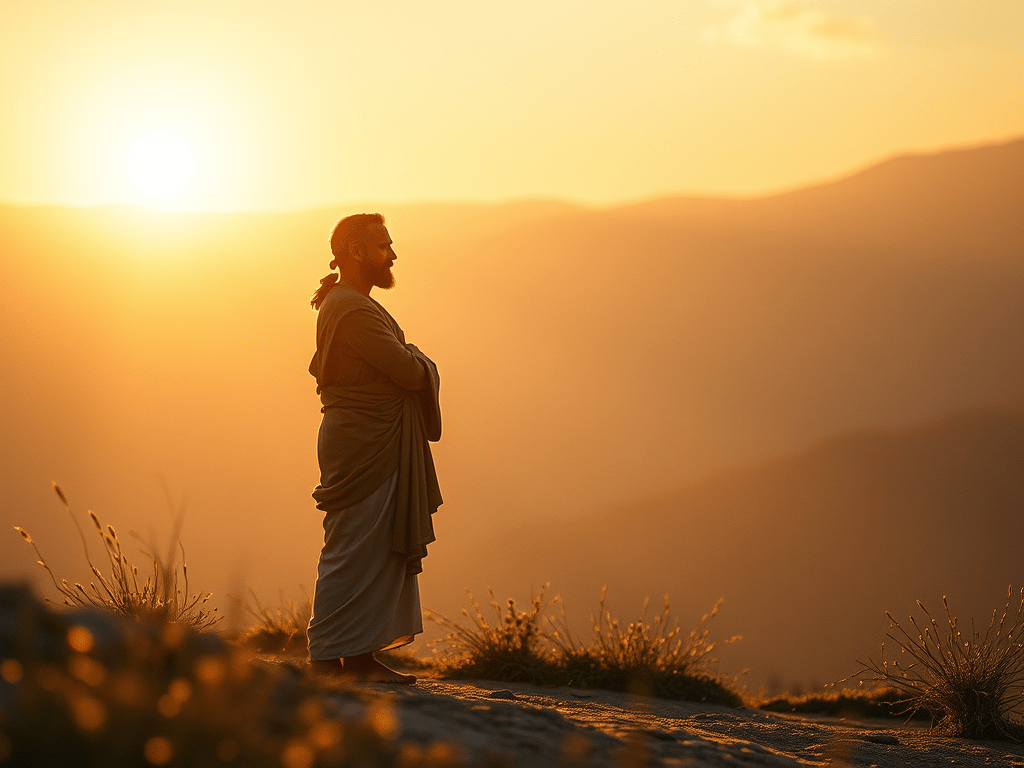
Before there were systems, there was wonder.
In the earliest days of philosophy, Greek thinkers turned from mythos to logos; not to dismiss the sacred, but to seek its structure. Beneath the shifting appearances of the world, they began to ask: what abides? What is the principle that does not pass away? What is real?
Among these early seekers, one voice stands apart: Parmenides of Elea. With a starkness that shattered the assumptions of his age, he declared what remains one of the most radical insights ever uttered:
“What is, is. What is not, is not.”
From this seemingly simple assertion, a revolution begins.
Parmenides does not speak of a god, nor of a cosmos. He speaks of Being—that which is, necessarily, and which cannot come from non-being. For him, becoming, the birth, transformation, and death we observe, is not the movement of reality, but the illusion of thought gone astray. What truly is, cannot not be. It does not arise. It does not change. It does not vanish. It is.
This is not a statement about a particular object or substance. It is a recognition of the fundamental structure of reality. And with it, the history of Western metaphysics is born.
The Inescapability of Being
Parmenides’ poem, On Nature, sets out two paths: the Way of Truth and the Way of Opinion. The first insists on the strict identity of Being with itself: immovable, ungenerated, eternal. The second speaks the language of the senses, of change and multiplicity, of what seems but cannot truly be. Most thinkers of the ancient world could not follow him all the way down the path of Truth. To deny change, to assert that the world of experience is appearance alone, seemed too severe.
And yet, no one who came after could entirely ignore him.
His insight; that what is cannot come from what is not, became a touchstone, a limit that every subsequent philosophy had to confront. Even those who rejected his conclusions felt the weight of his argument: Being cannot be explained by appealing to non-being. To do so is to think nothing, and that is unthinkable.
In this way, Parmenides inaugurated not only ontology, but also the deep contradiction that would haunt thought for centuries: the desire to account for the world of change without abandoning the permanence of Being.
The First Contradiction
What followed Parmenides was not a rejection, but a struggle.
Heraclitus, Empedocles, Anaxagoras, and Democritus each tried in their own way to preserve the appearance of becoming without violating the axiom of Being. Plato would divide reality into two realms: immutable forms and changing shadows. Aristotle would introduce potentiality and actuality, trying to explain motion without denying permanence.
But something had been lost: the radical clarity of Parmenides’ vision. The effort to save becoming from illusion led to increasingly complex reconciliations. And at the heart of these efforts, a contradiction was silently carried forward: the belief that what is can become what is not.
This is the contradiction Severino will later expose at the root of all Western thought, a contradiction that is not merely logical, but ontological: the belief in the annihilation of Being.
Parmenides saw too clearly to accept such a notion. But he could not yet affirm what the senses insist upon, the multiplicity, change, and unfolding of beings, without retreating into illusion. He stood at the edge of vision, seeing Being, but not yet understanding its appearing.
The Eternal Seed
And yet, the truth was there, in seed form.
Parmenides did not invent Being. He recognized it. He saw that what is, is, and that this cannot be denied without contradiction. In doing so, he glimpsed what would later appear more fully: that the real is eternal, and that the illusion lies not in the world itself, but in the way it is thought.
His insight is not an error to be corrected, but a beginning to be fulfilled.
Later thinkers, Plato, Plotinus, the Christian mystics, Nāgārjuna, even modern idealists, would echo fragments of his truth. But it would not be until the late 20th century, in the work of Emanuele Severino, that the radicality of Parmenides would be affirmed without retreat or compromise.
In Severino, Parmenides returns; not as a shadowy ancestor, but as the one who first glimpsed the eternal structure of all things.
This first light has not faded. It is the origin of philosophical thought. And it still shines.
 It Is What It Is
Leave a comment