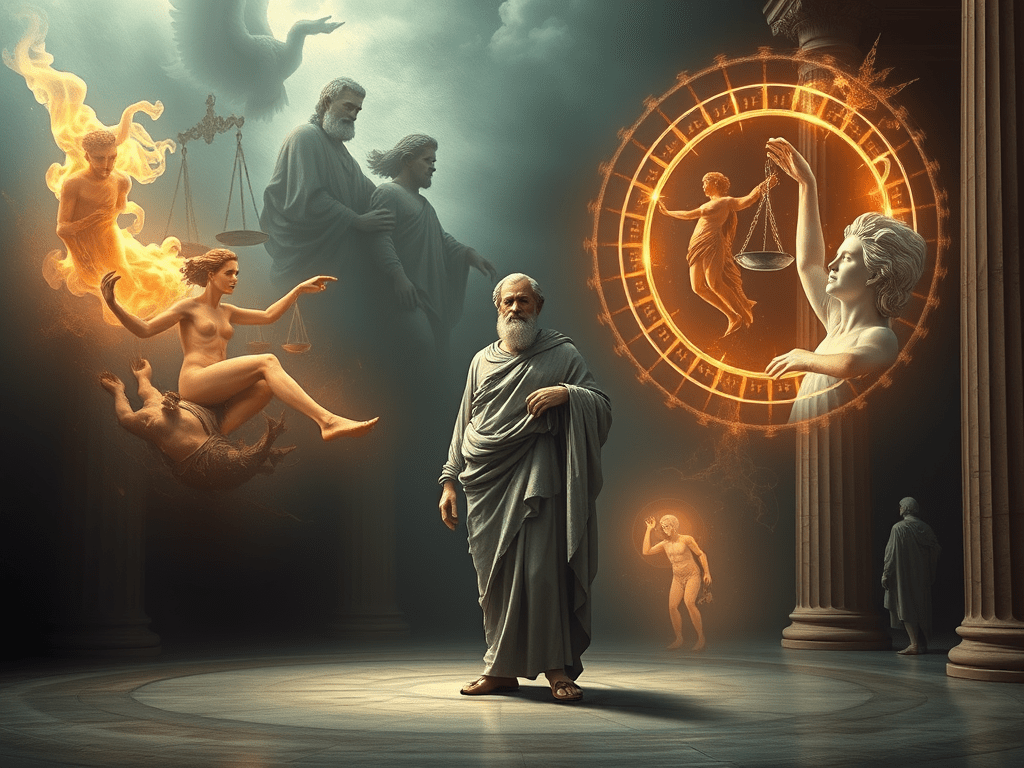
Parmenides had shown that Being cannot not be. Change, then, must be illusion. But human experience contradicts this at every turn: we see birth, death, decay, motion, transformation. If thought must reject the evidence of the senses, how is truth to be known?
It is Plato who takes up this task, and with him, philosophy begins to build its first great edifice.
The Realm of Forms
Plato inherits the Eleatic insight, but refuses to reject the manifold appearances of the world outright. Instead, he proposes a deeper structure: beyond the world of sense lies a world of Forms—unchanging, eternal, intelligible realities. Justice, Beauty, Equality, the Good: these are not names for shifting phenomena but for the abiding principles that make all phenomena possible.
The world of becoming, for Plato, is not unreal, it is a shadow. It participates in the real but is not itself the real. Sensible things come into being and pass away, but what they reflect, the Forms, remains untouched. True knowledge (epistēmē) is knowledge of these Forms, while opinion (doxa) is concerned with the appearances.
This metaphysical dualism is not a flaw in Plato’s thought; it is a response to a profound problem: how can what is remain intelligible, if all we encounter is what becomes?
The Soul and the Return to the Real
In Plato’s vision, the human soul, too, belongs to the world of Forms. It preexists its embodiment and will survive it. Life in the body is a kind of exile, a forgetting of the real. Learning is recollection. Philosophy is not merely the love of wisdom; it is the soul’s journey back toward its origin.
This ethical and metaphysical dimension is crucial. For Plato, to know the Good is to be drawn toward it, and to love truth is to be transformed by it. The structure of the real is not cold abstraction; it is the radiant order of what is most worthy of being known.
Contradictions Preserved
And yet, in solving one contradiction, Plato introduces another.
If the realm of Forms is eternal and perfect, how can the world of becoming participate in it without diminishing its perfection? What is the ontological status of this lower world, neither nothing nor fully real? What is the nature of participation itself? Is becoming an illusion, a derivative form of being, or something else altogether?
Plato tries to resolve this in myths: the myth of the cave, the chariot of the soul, the demiurge who fashions the cosmos by looking to the Forms. But these are poetic gestures, not rigorous answers. The gap between Being and appearance remains unhealed.
Later thinkers, especially Plotinus, will attempt to clarify this metaphysical architecture. But the shadow of contradiction endures: if what is can become what is not, or vice versa, then Being is not secure.
The Glimpse and the Limit
Still, Plato’s achievement is immense.
He affirms the primacy of the eternal. He recognizes that truth is not a product of becoming, but that thought must be grounded in what does not pass away. He sees that the soul, too, is eternal, and that philosophy is a way of remembering the real.
But the contradiction remains unresolved. Becoming is not abolished, but subordinated. Non-being is not affirmed, but neither is it entirely excluded. The “participation” of the many in the One remains a mystery; beautiful, suggestive, but structurally fragile.
Where Parmenides insisted on the immutability of Being, Plato tries to include the changing world without collapsing into illusion. It is a noble attempt, but the cost is a divided reality.
The structure of Being has begun to appear, but not yet in its clarity.
 It Is What It Is
Leave a comment