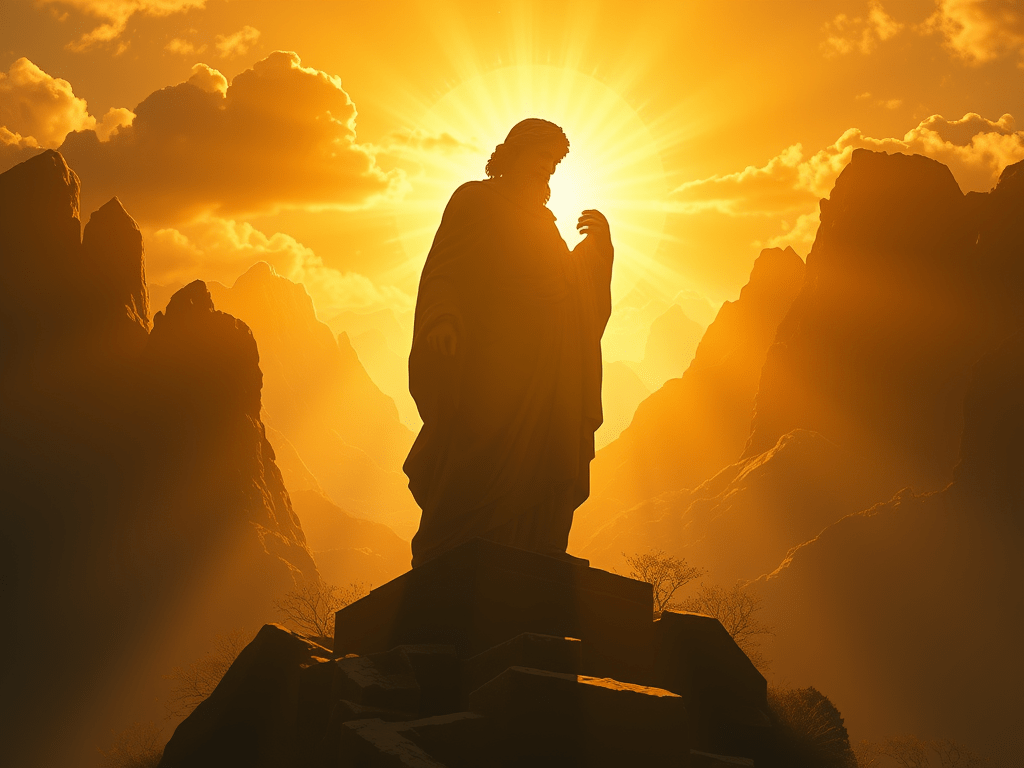
The Afterglow of Revelation and the Return of Aristotle
As the Middle Ages matured, a remarkable convergence took place: the truths of revelation were increasingly systematized through the lens of Greek metaphysics, particularly that of Aristotle. The fusion promised much: clarity, coherence, and the ability to defend faith through reason. Yet behind this synthesis lay an unspoken contradiction inherited from earlier thought: the persistent attempt to reconcile the eternal with the temporal, Being with becoming, without surrendering either.
Aristotle’s Metaphysics reentered the scene not as a philosophical threat to Christian doctrine, but as a potential ally. His logic, substance metaphysics, and concept of the unmoved mover gave intellectual structure to the emerging scholastic project. Aquinas, Maimonides, and Averroes, working across Christian, Jewish, and Islamic traditions, sought to stabilize the relationship between the created world and its eternal source, without allowing the world to become illusory or God to become finite.
This was not a regression but the final systematization of metaphysics before its collapse.
Necessary Being and Contingent Creation: The Central Dilemma
At the heart of scholastic thought is the distinction between:
- Necessary Being (God, whose essence is existence), and
- Contingent beings (creatures, whose existence is received).
This distinction, while seemingly clear and ordered, subtly preserves the contradiction at the heart of the Western tradition:
If beings are contingent—that is, if they can not be, then they are ultimately reducible to non-being.
But if they are from God, who is Being itself, then how can anything derived from Being lead to what is not?
This is the contraddizione C in scholastic dress. The doctrine of creation ex nihilo, central to all three Abrahamic faiths, claims that God brings being out of nothing—an act of supreme power. But this very act quietly legitimizes the transition from nothing to being and back again, placing annihilation within the horizon of thought.
Thus, despite its metaphysical precision, the scholastic system does not escape what Parmenides forbade: the passage of Being into non-being.
Participation Recast: From Plato to Aquinas
In Plato, beings participated in the eternal Forms, but this participation remained vague and dualistic. Aquinas, refining Aristotle, sought to ground this participation more concretely through the analogy of being (analogia entis). Created beings do not share Being equally with God, but they reflect it in proportion to their essence.
Yet this refinement does not erase the contradiction. For in Aquinas:
- Being is “act” (actus essendi)—pure actuality in God.
- Creatures have a composite nature: essence + received existence.
- Therefore, their existence is always contingent, always dependent, always on the brink of not-being.
Participation becomes asymmetrical and hierarchical, reflecting not eternal necessity but temporal fragility. The eternal remains unreachable except by grace, and even then, only as a future state (beatific vision), not as a present identity.
Islamic and Jewish Echoes: Averroes and Maimonides
The same tension plays out across Islamic and Jewish scholasticism:
- Averroes emphasizes the unity of intellect but separates the eternal world of intelligibles from the individual soul. The many cannot attain eternal identity, only merge abstractly with the universal intellect.
- Maimonides insists on God’s absolute unity and transcendence, but concedes that God’s essence is ultimately unknowable, and His act of creation is a free will act from nothing.
In both, the eternal is preserved by isolating it, making creation a contingent shadow; real, yes, but ontologically vulnerable.
These thinkers do not fail in insight; they reach the limits of the metaphysical language available to them. And they reach it together.
The Result: A Fortress of Thought—Cracked at the Foundation
By the high Middle Ages, metaphysics had become a fortress—imposing, structured, internally rigorous. But the contradiction at its base, that beings can come from and return to nothing, was left unresolved.
This contradiction would not be ignored forever. The very rigor of scholastic thought would prepare the way for its rejection. For in denying contradiction, it preserved it. In trying to explain creation, it domesticated Being—while smuggling in the annihilation it feared.
When the moderns arrived, they did not simply refute scholastic metaphysics. They saw that its answers were no longer credible—and they began again, not from Being, but from the self, the will, and eventually, the abyss.
A Moment Before the Fall
This was the last great effort to hold Being and becoming together without collapse.
It was not simply a theological era; it was the culmination of ancient metaphysics attempting to survive within time. But the contradiction could not be contained forever. The scholastic attempt did not fail because it lacked brilliance; it failed because it could not resolve what no synthesis could resolve.
That task awaited another mind, one who would not attempt a better system, but who would finally see through the illusion that had haunted philosophy since its beginning:
That what is, could one day not be.
 It Is What It Is
Leave a comment