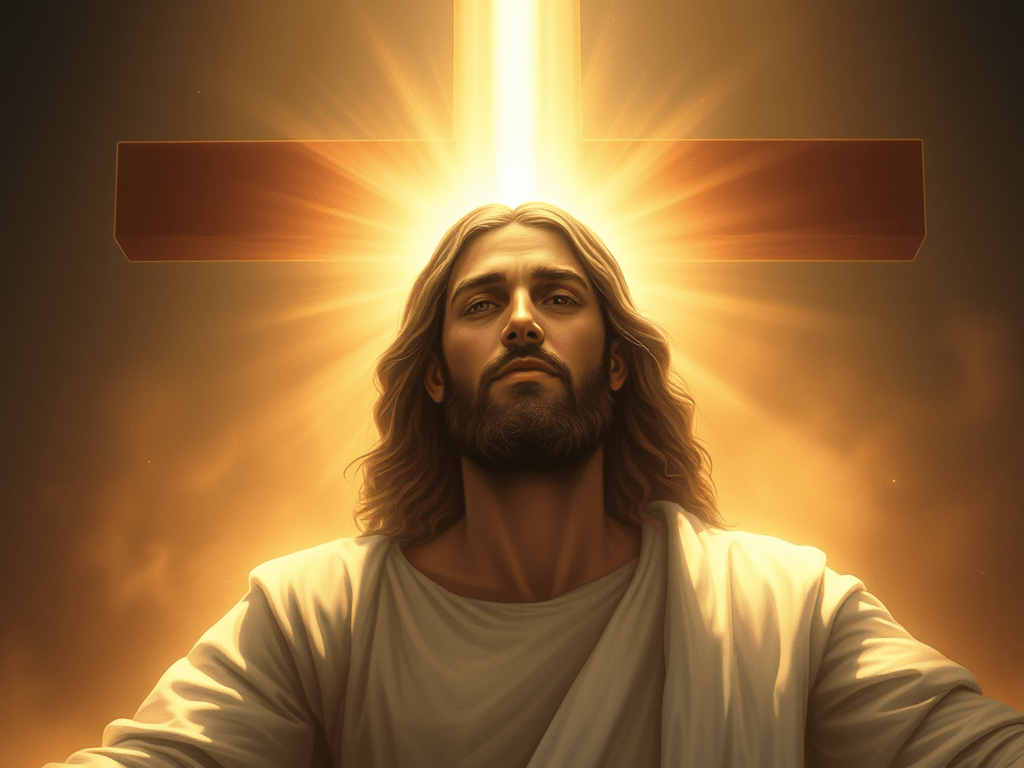
Christ and the Eternal: Beyond Time, Beyond Creation
“Before Abraham was, I am.”
— John 8:58
The Hidden Contradiction in the Christian Narrative
Christianity, in its dominant historical form, presents a synthesis between the eternal and the temporal: God, who is eternal, enters time to redeem creation, which is seen as fallen, finite, and subject to death. This premise, while appearing coherent, rests on a contradiction it cannot resolve: it accepts becoming as real.
To speak of the eternal entering time, of the divine “becoming” human, is to posit that Being itself undergoes change, interruption, and loss. But Being cannot become. It cannot cease or begin. The moment we posit that God creates from nothing, or that Christ becomes human, we are trapped in the illusion that the eternal gives way to non-being, only to reclaim it later. This is the metaphysical contradiction that the Christian tradition never fully overcomes.
Incarnation as the Unveiling of What Always Is
Yet Christianity does not only speak in the language of time. Its deepest insights gesture toward eternity:
- Christ is Logos, not as an event within history, but as the eternal structure of identity, the ground of all appearing.
- The Incarnation is not the entry of God into history, but the manifestation of the eternal within the illusion of history.
- Christ does not come to redeem what was lost, but to unveil that nothing was ever lost, because nothing can fall out of Being.
The virgin birth, the descent into death, the resurrection; these are not biological or historical occurrences to be proven or dismissed, but symbols of the eternal structure breaking through the veil of becoming.
Christ appears in time not to rescue, but to expose time as illusion.
Resurrection as Revelation, Not Event
The resurrection is typically viewed as a future hope or a miraculous reversal of death. But death, too, is a symbol; not of annihilation, but of the illusion that something can be lost. In light of Being:
- Resurrection is not a future restoration but the eternal truth of every being.
- It does not reverse death; it reveals that death was never real.
- The “risen body” is not a changed substance, but the eternal identity of each being, untouched by time.
When Christ says, “I am the resurrection and the life,” he speaks not of a moment to come but of what is always the case: life is eternal, not as continuation, but as necessity.
The Cross: The Final Illusion of Loss
The crucifixion is the dramatic center of the Christian narrative, symbolizing suffering, injustice, and divine sacrifice. But understood through the lens of eternity, the Cross reveals something else:
- Suffering appears as the pain of becoming: the illusion of separation, loss, and contingency.
- Christ “dies” to reveal that what appears to die cannot cease to be.
- The resurrection does not reverse the tragedy; it shows that there was never a tragedy.
Thus, the Cross is not a site of redemption by blood or substitution, but the moment when Being confronts the illusion of becoming and unveils its falsity.
Christ as Logos – Not Mediator, but Identity
The theological tradition often interprets Christ as mediator between God and humanity. But mediation presupposes a distance that needs to be overcome. What if that distance is itself illusory?
- The Logos is not a third term between Creator and creation; it is the eternal structure in which God and every being are not separate.
- Christ is not the divine who becomes human, but the unveiling of the eternal identity between the divine and all beings.
- In Christ, we do not see the fusion of opposites, but the recognition that there were never opposites; only one eternal appearing.
This does not collapse God into creation or dissolve difference into sameness. Rather, it shows that every being, precisely in its unique identity, is eternally grounded in Being, not produced from nothing, not sustained by will, but necessary.
Love as the Recognition of the Eternal
The Christian command to love is not moralism; it is metaphysics. True love (agape) is not about giving what another lacks, but about recognizing the other as eternal.
- To love is not to change, save, or redeem; it is to see.
- Christ’s love is not an act of will, but the appearance of the truth of Being.
- In this light, forgiveness is not a suspension of judgment, but the recognition that no being has ever fallen outside of eternity.
This is why Paul could write, “Love never ends.” Love, like Being, is necessary.
Conclusion: Christianity Fulfilled, Not Rejected
Christianity is not denied by this view; it is fulfilled. Not by returning to dogma or clinging to myth, but by unveiling the eternal insight it always carried in symbolic form.
- The Incarnation reveals the eternal structure of Being.
- The Cross exposes the illusion of loss.
- The Resurrection unveils the truth of eternal life.
- Christ as Logos shows that all beings are already in eternal identity with Being.
This is not a new theology, but the recognition that theology was always an attempt, obscured by the assumption of becoming, to speak the truth of what is eternally the case.
Christ is not a figure who saves. Christ is the name given to the necessary recognition that nothing is lost, everything is Being, and Being is eternal.
 It Is What It Is
Leave a comment