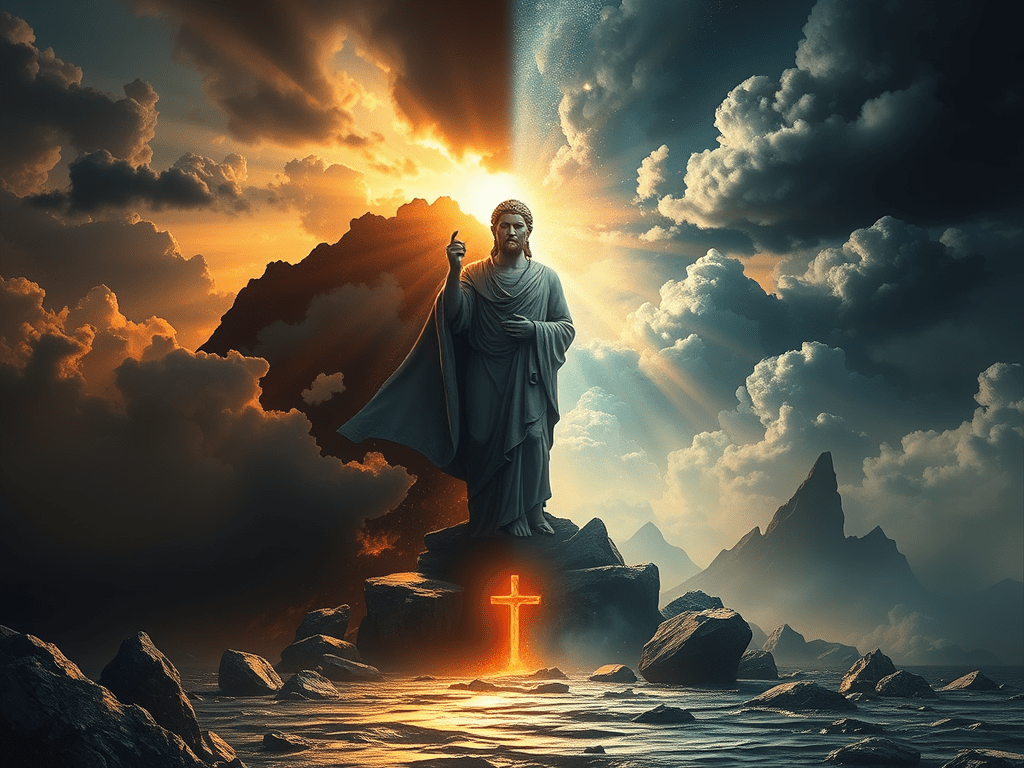
A Journey Through Thought
This has been a journey through the history of thought; not as a museum of ideas, but as the necessary unfolding of a single drama: the contradiction between Being and becoming.
From Parmenides, who first glimpsed the immovable truth, to Plato, who gave structure to its reflection in the world of change; from the emanations of Plotinus to the incarnational mysteries of Christianity, the luminous simplicity of Islamic and Jewish metaphysics, the emptiness and interdependence of Buddhism, and the modern unraveling of metaphysical foundations, each moment in this history was not a mistake, nor a random detour, but a necessary stage in the gradual bringing-to-appearance of what has always been.
Every step carried the weight of a question too great to resolve within its own terms:
How can what is seem to become what is not?
The very history of Western and Eastern thought is the history of this unresolved tension—until now.
The Forgotten Foundation Remembered
From the beginning, the foundation of all things was Being: eternal, unchangeable, indivisible. And yet, through time, this foundation was forgotten. Not in words, for philosophers spoke often of Being, but in thought’s structure itself.
Contraddizione C, the belief that what is can become nothing, infected every formulation:
- Plato’s world of becoming.
- Aristotle’s act and potency.
- Christianity’s creation ex nihilo.
- Buddhism’s emptiness.
- Hegel’s dialectic.
- Nietzsche’s will to nothingness.
Even those who sought to affirm Being, who intuited the eternal, could not escape the contradiction hidden at the root of language and logic.
But the contradiction was not merely a philosophical error, it was the heart of nihilism, the spiritual wound of the West.
To forget the eternity of Being is to think that things can not be, that we ourselves are ultimately nothing.
From this, all fear, despair, anxiety, and violence flow.
The Inevitable Recognition
In the light of Emanuele Severino’s thought, we see that the contradiction was not final. It was a moment; necessary, but not absolute.
What began with Parmenides, the radical affirmation that Being is, reappears now, not as a fragment, but as a complete structure.
Every being is eternal.
What appears in time does not begin nor end in Being.
Becoming is the shifting of appearance, not of essence.
The world is not a tragedy of flux, but the joyful unfolding of what cannot not be.
This is not an interpretation among others. It is not a synthesis. It is the clarification of what all thought presupposes, and what all traditions, in their deepest intuitions, have sought:
The truth of Being.
Joy, Glory, and the End of Tragedy
To recognize that all things are eternal is not a cold logical conclusion; it is the end of tragedy, the dissolution of fear, the transfiguration of the world.
- What has been lost is not gone.
- What seems to end has only withdrawn from view.
- What appears is never random, never contingent, never the result of nothing.
This recognition is joy, not as an emotion, but as the inevitable radiance of the truth of Being.
It is also glory: the fullness and majesty of necessity unveiled.
Where nihilism saw contingency, despair, and death, the Structure of Being reveals:
- Necessity, order, eternity.
- The immeasurable richness of what is.
- A world not fading, but ever appearing more deeply.
Toward the Fullness of Thought
The history of philosophy was never just a battle of ideas; it was the gradual unfolding of the destiny of truth.
Now, at the end of this path, we are not left with a conclusion, but with a beginning:
- A new seeing.
- A new language.
- A new ethics, a new science, a new understanding of self, love, death, and the world.
No longer can we think of reality as fragile, random, or meaningless. No longer can we live as if Being is threatened, as if loss were ultimate.
What has come into view is the eternal appearing of truth; not the creation of Being, but its unveiling.
Philosophy is no longer the search for what might be. It is the witnessing of what necessarily is.
The End Is the Beginning
This, then, is not the end of the journey. It is the recognition that the journey was always the path of eternal things coming into view.
Truth was never absent. It was never distant. It was always appearing, even in its denial.
Now, we no longer chase what is beyond us. We stand in the light of what cannot not be.
The forgotten foundation has returned; not as memory, but as Presence.
Let us then affirm, without fear or hesitation:
Being is. And we are among the eternals.


Leave a comment