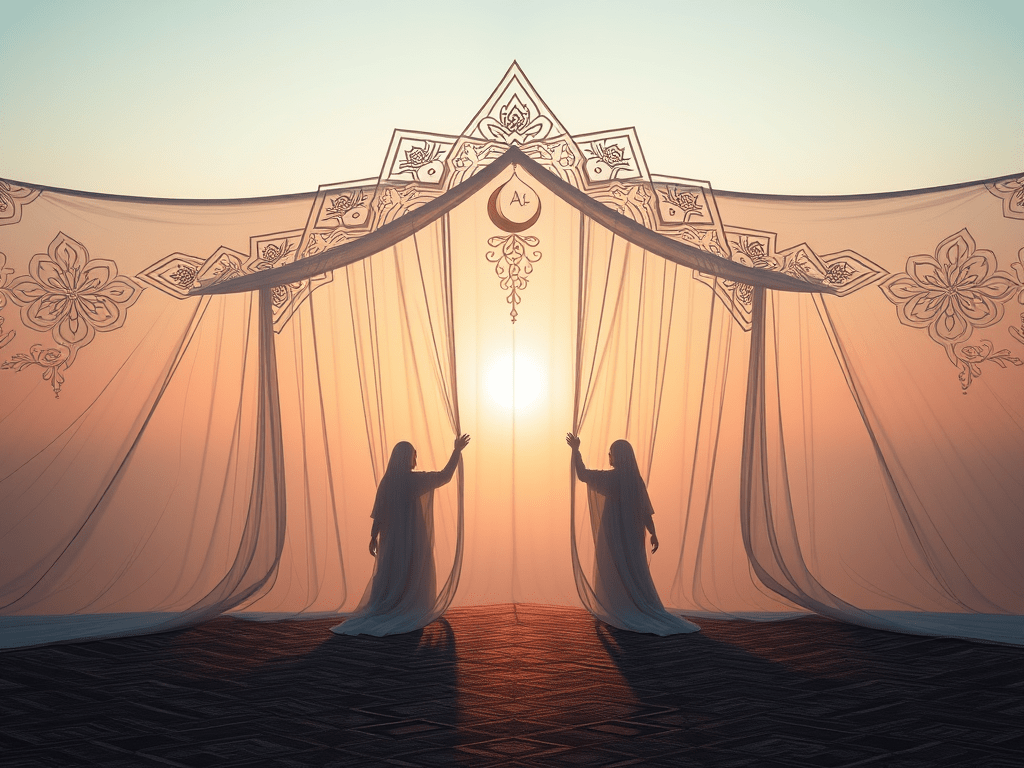
The Veil and the Real: Islam, Mysticism, and the Eternal Structure
“He is the First and the Last, the Apparent and the Hidden.”
— Qur’an, Surah 57:3
Islam and the Ontological Unity of Being
At the heart of Islam is the affirmation: “There is no god but God.” This statement, while theological on the surface, also expresses a radical ontological claim: nothing truly is except God. In Sufi mysticism, this becomes the doctrine of tawḥīd, the unicity of Being; not merely monotheism, but the metaphysical identity of all reality in the One.
This intuition, that multiplicity is illusion and that the Real (al-Ḥaqq) is singular, comes close to the eternal structure revealed by philosophy. But in its dominant theological expression, Islam stops short of fully recognizing this necessity. It retains the structure of:
- Creation ex nihilo
- The contingency of the world
- The absolute will of God who could have created otherwise
These assumptions, inherited from the metaphysics of becoming, conceal the deeper insight that Islam often touches through mysticism: what appears cannot be other than it is, and God is not a will who produces, but the eternal structure that is.
The Veil of the World: Between Appearance and Illusion
In Islam, the idea of ḥijāb (the veil) is central. God veils Himself from creation, and only through purification, submission, or divine grace does the veil lift. But what is the veil?
In the light of the eternal structure:
- The veil is not the separation between two distinct realities (God and creation).
- It is the illusion of separation itself.
- It is the belief that contingency exists, that multiplicity is real, that the Real can be hidden.
In Sufi insight, especially with thinkers like Ibn ʿArabī, the veil is recognized as the illusory form of the Real. Every being is a “face of God,” and every appearance is a theophany (tajallī), an unveiling. Yet even here, the full recognition that nothing can veil Being, because Being is already and necessarily present, remains incomplete.
Submission and the Eternal Will
Islam means submission, to yield to the will of God. But if God is understood as will, then the world appears as a product of decision, choice, and power, thus as contingent. This leads to:
- An emphasis on law, obedience, and divine command
- The view that the world could have been otherwise
- A God who relates to the world through sovereignty, not identity
Yet in Islamic mysticism, particularly in the works of al-Hallāj, Suhrawardī, and later Sufi poets like Rūmī, the God who commands is replaced by the God who is, and who is each being eternally, not by will, but by necessity.
In this light, true submission (islām) is not surrender to an external power, but the recognition of one’s eternal identity with Being; a return, not to obedience, but to what always is.
The Real (al-Ḥaqq) and the Illusion of Multiplicity
The Qur’an refers to God as al-Ḥaqq, the Real. Sufi philosophy recognizes that what is Real is not merely supreme, but absolutely necessary. The world, by contrast, is described as al-bāṭil, false, passing, fleeting.
However, the language of passing (fānī) implies becoming and ceasing, which presupposes that the world lacks necessity. In the eternal structure of Being, however:
- The Real cannot be surrounded by unreality.
- What appears must be eternal, or else it could not appear at all.
- Multiplicity is not annihilated by God, but is the eternal unfolding of Being.
Thus, every form, though seemingly passing, is eternally grounded. The goal is not extinction (fanāʾ) into the One, but the recognition that no being is outside of the Real.
Mystical Union: Between Ecstasy and Ontology
In Sufi experience, one encounters ecstatic states of union, where the self dissolves, and only God is. But this is often interpreted as a temporary unveiling, a grace, a glimpse into something greater.
From the eternal perspective:
- This “union” is not a state to attain, but the necessary condition of all beings.
- There is no distance to be overcome, no ladder, no journey.
- The ecstatic is a symbol of what is always already the case.
The mystic does not become one with God; they realize they were never separate.
When al-Hallāj said, “Ana al-Ḥaqq” (“I am the Real”), he was condemned for blasphemy. But he spoke a truth deeper than the religious synthesis could allow: he named the eternal identity that appears in every being.
Conclusion: The Eternal Recognition Behind the Veil
Islamic tradition contains, perhaps more clearly than any other, the tension between absolute unity and the illusion of contingency. Through its mystics and metaphysical poets, it approaches the recognition that:
- God is not a being among beings, but Being itself.
- The Real is not hidden, but misread.
- The veil is not between God and world, but between appearance and understanding.
Islam is not denied by this view; it is unveiled. What appears as submission becomes recognition. What appears as journey becomes eternal presence. What appears as creation becomes the necessary unfolding of Being.
In this recognition, the great affirmation, lā ilāha illā Allāh, is no longer a contrast between Being and not-being, but a statement of eternal ontology:
There is no becoming; only Being. And Being is eternal, necessary, and Real.
 It Is What It Is
Leave a comment