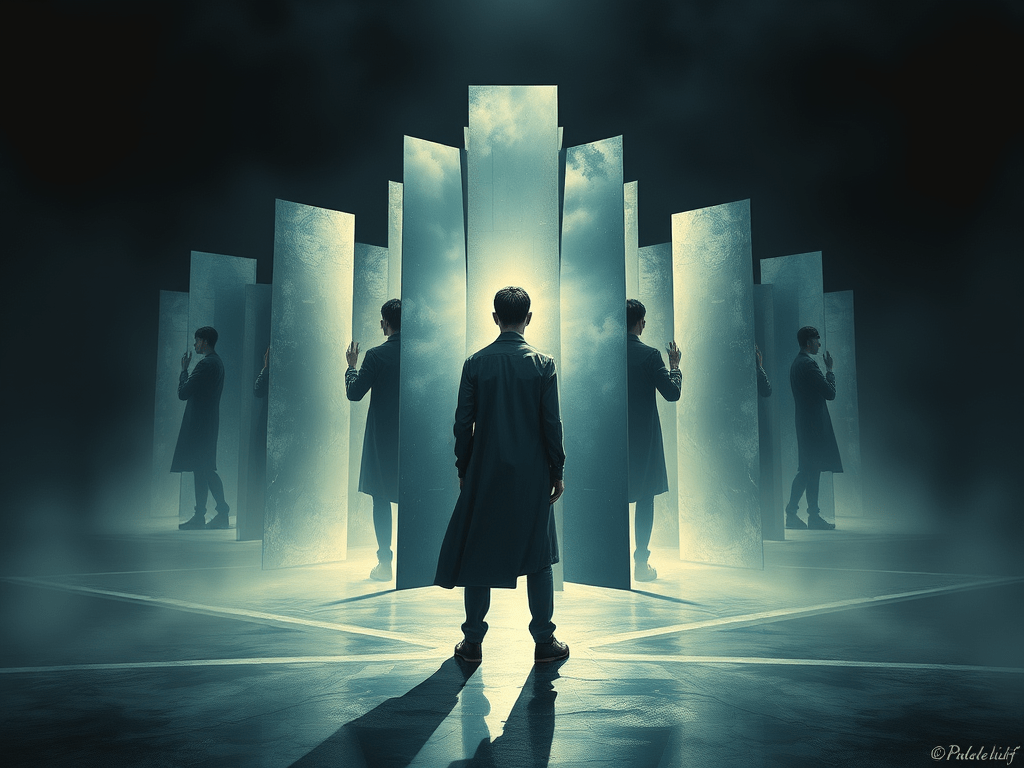
“Modern man believes he can be anything — because he no longer believes there is anything he truly is.”
We begin in the midst of crisis. Not just political or cultural, but ontological. We no longer know who we are, and worse, we have come to believe that this unknowing is freedom.
For centuries, the idea of a stable self given by God, nature, or reason, anchored human life. But in the modern age, that anchor was cut loose. With the rise of individualism, secularism, and the technological will to shape the world, identity was no longer seen as discovered, but created.
The self became a project. A canvas. A construction site.
At first, this shift felt liberating. It seemed to promise autonomy and authenticity. But over time, this freedom to “become anything” has revealed its hidden cost: the loss of what we are. We no longer know if there is anything solid beneath our changing roles, desires, and projections. The modern self is free, and empty. Empowered, and ungrounded.
The Philosophy of Becoming: From Essence to Flux
This crisis was not born in pop culture or politics. Its roots lie in the deepest assumptions of Western thought; especially in the idea that what is, is not fixed, but becoming.
From Heraclitus to Hegel, from Darwin to Deleuze, the dominant metaphysical vision of the West has affirmed change, flux, and evolution as fundamental. Being is no longer seen as eternal and unchanging; rather, it is thought to arise from nothing, develop through contradiction, and dissolve again into nothingness.
This vision is seductive. It mirrors the world we see: the rise and fall of things, the passage of time, the evolution of species and cultures. But beneath this dynamic surface lies a fatal contradiction: if everything becomes, then nothing is. And if nothing truly is, then identity is impossible.
We are left with masks, with fragments, with roles and narratives, but no necessary self beneath them.
This is not just a philosophical problem. It is an existential one. It leads to anxiety, disorientation, and despair. It leaves people vulnerable to manipulation, desperate for recognition, and increasingly unable to distinguish freedom from delusion.
The Technological Will and the Death of Essence
Technology amplifies this crisis. In its essence, modern technology is not neutral; it is the will to transform everything into what it is not. It does not accept limits, essences, or givens. It seeks to overcome every boundary, including those of body, mind, and identity.
Today, we are told we can be anything: a different sex, a different species, a digital consciousness. But what is the self that “makes” these changes? Is there any I left behind the fluidity?
In this framework, the self is no longer a presence, but a process. Not someone, but something on the way to becoming someone else.
The result is not just confusion; it is the nihilistic belief that nothing truly is, and therefore anything goes.
The Structure of Being: Why Identity Must Be Eternal
Against this, the Structure of Being reveals something radically different, and unavoidably true.
Being cannot come from nothing. What is, is. It is not the product of change, but the presupposition of all change. In this light, the self is not a construct, but an eternal presence, a being that appears within the infinite order of beings.
We may appear in time, grow, change, suffer, and learn. But we do not pass from non-being into being. We are not made. We are unveiled.
This is not a mystical intuition or religious belief. It is the necessary recognition that what is, cannot not be, and therefore every self that truly is, is eternal in its appearing. We are not contingent results of becoming. We are necessary presences in the eternal structure of what is.
To rediscover identity is to remember what was never lost; only concealed beneath the illusion of change.
Looking Ahead
In the next article, we will explore how the modern view of identity leads to psychological and cultural fragmentation, and how the eternal structure of Being provides the only true foundation for healing the self.
Next: Article 2 — The Fragmented Self: Psychology, Power, and the Loss of Presence
 It Is What It Is
Leave a comment