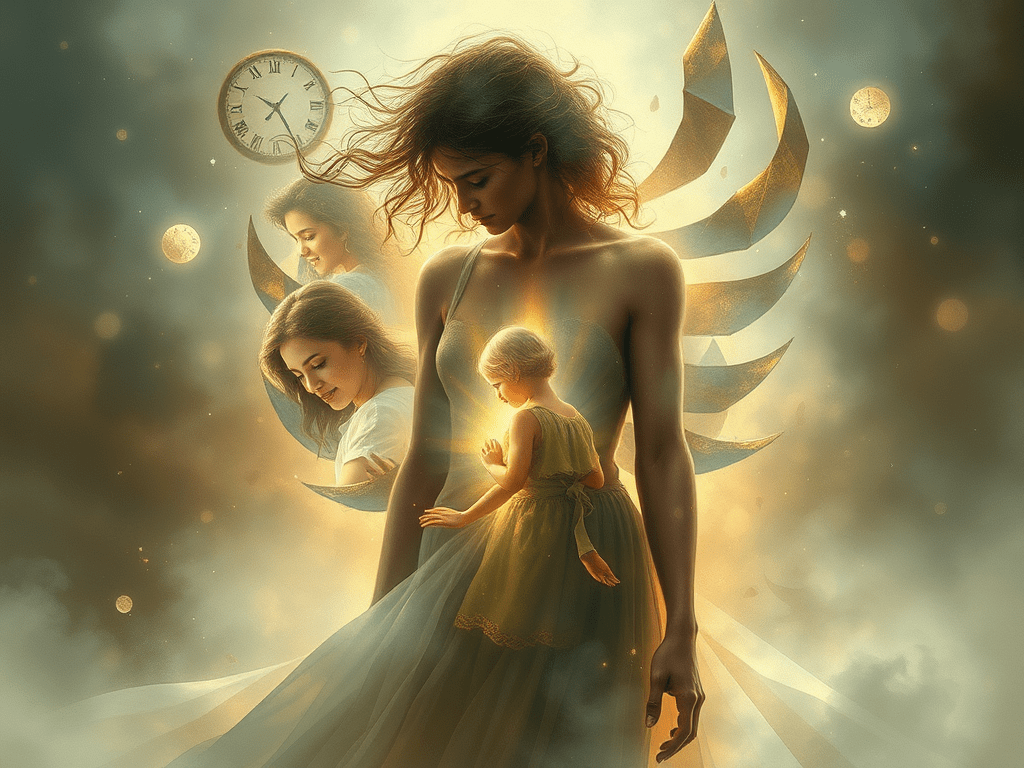
“All that is yours shall return to you, not as you remember it, but as it is.”
In the experience of memory, we encounter both presence and absence.
The beloved face, the longed-for moment, the words once spoken, they appear again, but only as images, pale echoes of what once was.
We say things like, “She’s gone,” or “That time is lost forever.”
We mourn. We remember. And we grieve not just what is absent, but what seems to have ceased to be.
Here, the crisis of identity deepens:
If the self is bound to time, and time devours all, then who we are must be subject to decay.
But if the self is eternal, then what appears to be lost was never lost, only misunderstood.
This article explores how memory, grief, and loss are misunderstood not because they are illusions, but because our interpretation of time and becoming is.
It is not that the past vanishes; it is that we do not yet know how it remains.
The Temporal Self and the Fear of Loss
Our prevailing vision of the self is entangled in linear time.
We are taught to see life as a sequence: birth, growth, decay, death; a vanishing stream, with no return.
In this view, memory becomes a form of suffering, because it recalls what cannot be recovered.
The child’s laugh, the parent’s embrace, the look between lovers, all are buried in the past, unrecoverable.
This fuels a profound ontological anxiety. We not only mourn what we have lost; we question whether it ever truly was.
And when this anxiety becomes internalized, the self becomes fragmented.
Our identities are no longer grounded in Being, but in what we can remember, hold onto, or recreate.
Thus, the self becomes increasingly fragile, haunted by the possibility of vanishing.
Memory as Appearance, Not Illusion
But what is memory, really?
From the perspective of the Structure of Being, memory is not a faded reproduction of something that no longer is — it is the re-appearing of what remains eternally present.
We are not remembering “what used to exist”; we are witnessing the eternal appearing of that being, in a different mode.
Nothing that is can ever become what is not.
This is not metaphor, but necessity.
Every loved one, every moment, every word, even the tiniest event, if it has appeared, it cannot not be.
And thus, it remains, not trapped in a past that no longer exists, but in the eternal fullness of Being.
Memory, then, is not the faculty by which we grasp at what has slipped away.
It is a trace of the fact that nothing has truly slipped away.
Our suffering arises not from loss itself, but from our belief that loss is real.
The Grief of Becoming, the Consolation of Being
Why, then, does memory often bring pain?
Because we remain trapped in the metaphysics of becoming, in which all that exists must eventually vanish.
This metaphysics teaches us to believe that value is fleeting, that love must end, that we ourselves will disappear.
And so we live as if Being itself is contingent, subject to time, to fate, to dissolution.
But if Being is necessary, then the grief we experience is not a final judgment.
It is the sign of a misunderstood reality. A deep ache for what we know cannot be lost, even as we fear it has been.
Grief becomes, then, not the denial of eternity, but a veiled longing for it.
In the sorrow of memory, there is an unconscious cry: This should not have ended.
And the truth is: it didn’t.
The Self as the Custodian of the Eternal
If memory can be re-understood as the reverberation of the eternal, then the self is no longer the product of time, but its witness.
You are not the sum of moments strung together by chronology.
You are not a narrative holding fragments together by will.
You are the appearing of eternal Being, in which each event, each person, each moment you’ve known continues to exist in its own right, not behind you, but with you.
The beloved whom you have “lost” is not behind you in time.
They are present, now, eternally, in the structure of Being, whose fullness no grief can undo.
The true work of the self, then, is not to forget or to cling, but to learn how to see again.
To remember not as one who mourns the gone, but as one who recognizes the eternal in what appears to change.
This is not merely comfort. It is metaphysical clarity.
The End of Forgetting
The fear of forgetting, or of being forgotten, is the final echo of the illusion of becoming.
We dread that what we love will vanish into obscurity, swallowed by the silence of time.
But time does not erase what is.
It cannot.
For what is must be.
Thus, the truth is not that we must hold onto memory, but that memory itself is held by Being.
In the eternal structure of reality, everything you have ever known, every face, every moment of love, every truth glimpsed, remains.
It does not pass away. It unfolds, like light refracted through the depths of appearance, waiting for the eye that can finally see.
Looking Ahead
If the self is eternal, if love unveils the other as eternal, and if memory does not point to what is gone but to what remains, then what, truly, is death?
What are we really facing when we speak of the end?
Next: Article 6 — Death and the False End of the Self
 It Is What It Is
Leave a comment