You can be whatever you want to be.” But what if that is the root of our confusion?
Modern culture does not ask us to know ourselves; it demands that we make ourselves.
This shift, often hailed as liberation, has become a new tyranny.
We are no longer born with a destiny to recognize, but with a self to invent.
The individual is now the author, editor, and sole validator of their identity.
And yet, rather than freedom, this leads to profound anxiety, instability, and conflict.
In this article, we confront the crisis of self-making:
- Why the idea of self-creation is a logical contradiction,
- How it stems from the metaphysics of becoming,
- And how the return to Being reveals the self as already, necessarily, whole.
The Burden of Making the Self
From advertisements to education, from social media to therapy, we are surrounded by one message:
You must become yourself.
It sounds empowering; a call to creativity and freedom.
But beneath the surface lies a weight too heavy to bear.
To become yourself presupposes that you are not yet who you are.
It treats the self as a future possibility, not a present reality.
And so we are condemned to an endless pursuit: never finished, never sure, always in flux.
The result is a culture of performative identity, where authenticity is no longer rooted in truth, but in appearance, affirmation, and reinvention.
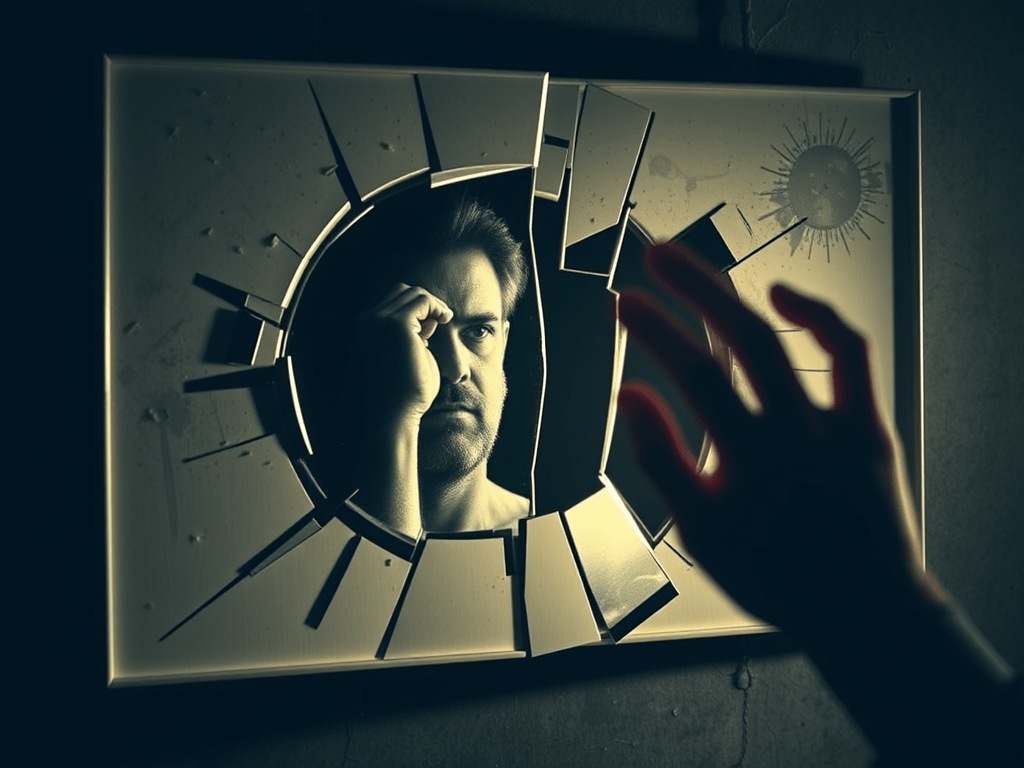
We are trapped in the mirror of becoming, where we seek a self that does not yet exist, by means that can never reach it.
Becoming and the Crisis of Groundlessness
This modern view of identity rests on a metaphysical error: the belief that being arises from non-being.
The self, in this view, begins as a blank slate, a nothingness, and then constructs itself through choices, acts, and affirmations.
But this vision contains a deep contradiction:
How can nothing give rise to something?
If the self is nothing to begin with, then there is no “I” to choose, to act, or to create.
And if there is an “I” making these decisions, then it cannot be nothing.
It must already be.
So either the self is an illusion, or it is real, but it cannot be both a non-being and the ground of its own becoming.
This contradiction sits at the heart of our cultural confusion.
It manifests as existential anxiety, identity crises, political polarization, and the collapse of shared meaning.
Because if we cannot know who we are, then how can we know what is good, what is just, what is true?
The Tyranny of Freedom Without Being
Modern culture celebrates choice above all else.
But choice without essence becomes chaos.
If the self has no nature, no given reality, then every desire is equally valid, every identity equally true, every change equally necessary.
But this leads not to liberation, but to fragmentation.
In the absence of a stable self, all values float.
And so we cling ever tighter to external affirmations, tribal identities, algorithmic approval, desperate for something to hold us together.
Paradoxically, the more we celebrate the fluidity of identity, the more we fear its loss.
This is the tyranny of becoming:
A freedom without ground.
A self without truth.
A culture without Being.
The Eternal Self: Already, Always Given
The return to Being overturns this tyranny.
It reveals that the self is not a project, but a presence.
Not a task to complete, but a reality to recognize.
You are not a becoming.
You are a necessary appearing of Being: unique, irreducible, eternal.
This does not deny change or development, but it grounds them.
The self unfolds, grows, expresses, and reveals, but never becomes what it is not.
There is no need to fabricate an identity.
There is only the joy of recognizing what is already true.
And from this recognition comes not rigidity, but freedom rooted in truth.
The Return of True Freedom
Real freedom is not the power to become what we are not.
It is the space to manifest what we eternally are.
To know oneself is not to impose a self-image, but to see through the illusions of becoming.
It is to rest in the clarity of Being, and act from its depth.
In this light, all expressions of the self (art, language, relationship, vocation) become radiances of a truth already given.
And culture, rather than a battlefield of competing constructions, becomes a sacred unfolding of the eternal.
True freedom is not self-invention.
It is the fearless expression of the self that cannot not be.
Looking Ahead
If the self is not made, but given, not becoming, but Being, then all attempts to secure identity through external affirmation, will, or control are necessarily misguided.
This opens the path for the rediscovery of the person; not as a psychological construct or social product, but as the appearing of an eternal reality.
Next: Article 8 — The Rediscovery of Personhood: From Psychological Construct to Eternal Reality
 It Is What It Is
Leave a comment