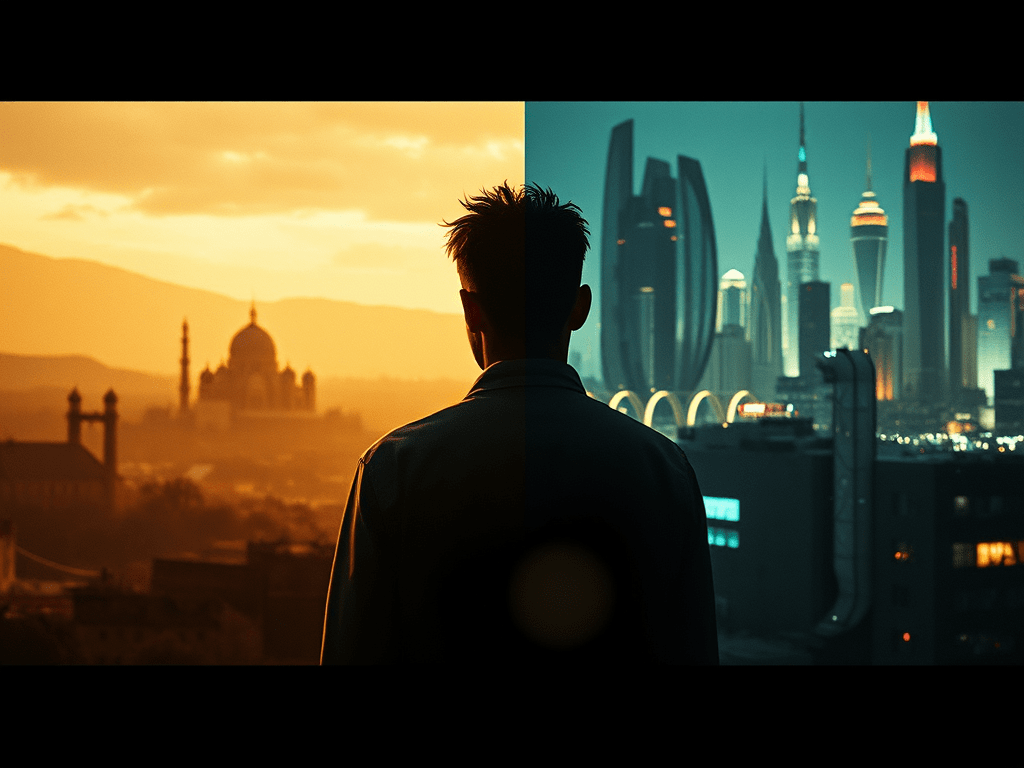
When a worldview collapses, the first instinct is to escape.
Some try to go back — to recover the world before the rupture, to restore the lost forms, to rebuild what once gave meaning.
Others try to go forward — to invent something radically new, to design new values, new identities, new worlds beyond the ruins.
These responses appear as opposites:
— On one side, tradition, memory, return.
— On the other, progress, creativity, reinvention.
But beneath both is the same refusal:
The refusal to remain with what is.
Nostalgia — The Illusion of Return
Nostalgia is not love of the past — it is the belief that truth once belonged to the past, and that to recover truth we must recover history.
This often takes the form of:
- Religious fundamentalism
- Traditionalism in gender or family roles
- Nationalist longing for former greatness
- Romantic idealizations of “simpler” times
But the past, like the future, is a construct.
We remember it through myth, through projection, through loss.
And more importantly: truth does not belong to the past.
What was true then is not true because it was then — it is true because it is, eternally.
No form, no structure, no institution can contain Being.
And so the attempt to rebuild what once held truth often becomes idolatry — not reverence, but nostalgia disguised as fidelity.
Invention — The Illusion of the New
If nostalgia is reaction, invention is intoxication.
We tire of the old, so we create — new values, new selves, new myths, new technologies.
We imagine utopias: genderless, godless, borderless, weightless.
We see the self as pure potential, the world as canvas.
This is the dominant response of the modern age — the cult of becoming at full intensity.
But invention does not free us.
It only pushes us deeper into the illusion that truth is ahead, and that meaning must be built.
Invention becomes ideology.
It becomes the pressure to create oneself, to evolve, to stay relevant, to innovate identity and transcend nature.
But every invention still rests on becoming.
And becoming, as we have seen, cannot offer ground.
Both Forget Being
Though they move in opposite directions, nostalgia and invention share one blindness:
they seek refuge in time.
One in the past, the other in the future — but both avoid the eternal now.
Both flee the silent clarity of what is.
Both prefer a world made — remembered or imagined — to a world recognized.
And both end in disappointment.
Nostalgia collapses into reaction.
Invention collapses into fragmentation.
Only the truth remains.
To Remain Without Escape
There is a third posture — more difficult, more silent, more luminous.
Not a path backward.
Not a leap forward.
But a remaining.
Remaining with what is.
Remaining in the truth that cannot be lost, cannot be invented, and does not change.
This remaining is not passivity.
It is fidelity — not to a system, not to a memory, not to a dream,
but to Being.
It is what allows us to endure the transition without falling into illusion.
Looking Ahead
If we cannot escape through nostalgia or invention, how then do we live through this transition — this time between worlds? In the next article, we turn to endurance itself: not as passive waiting, but as the courageous fidelity to truth in the absence of support. What does it mean to wait for truth — and not lose heart?
Next: Article 3 — The Courage to Endure: Waiting in the Time of Transition.
 It Is What It Is
Leave a comment