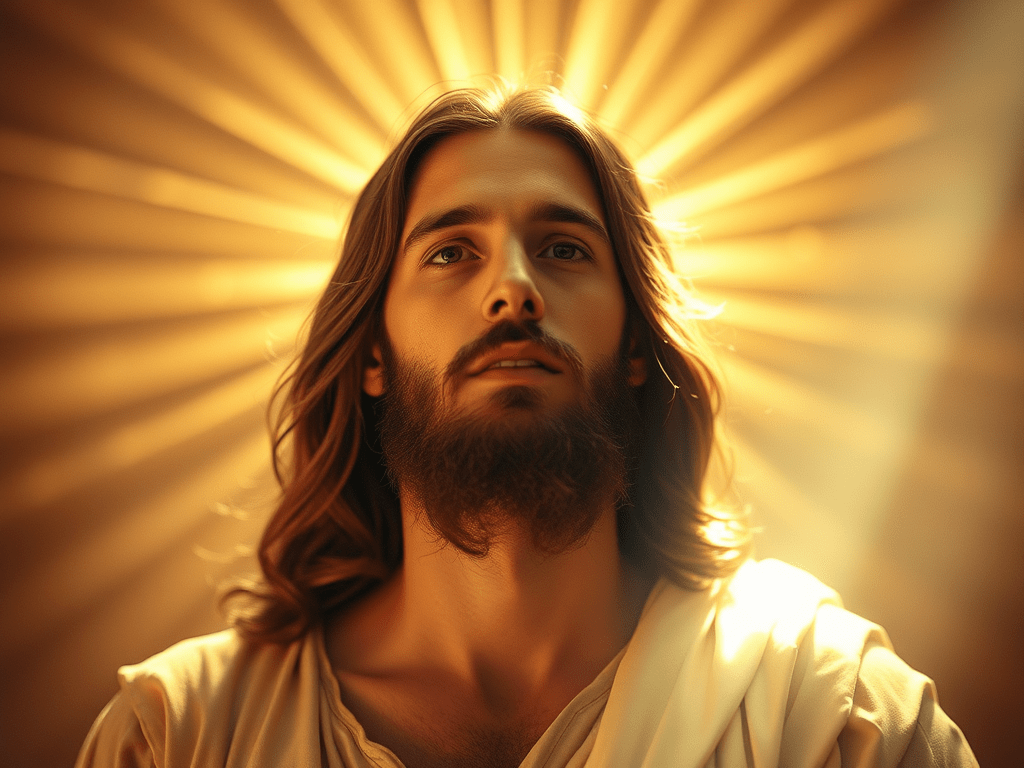
“The Word became flesh and dwelt among us, and we beheld His glory…”
— John 1:14“He is the image of the invisible God… in Him all things hold together.”
— Colossians 1:15–17“Whoever has seen me has seen the Father.”
— John 14:9
From Mediator to Manifestation
For many, Christ is understood as a mediator — the one who bridges the gap between sinful humanity and a distant, holy God.
This image is not wrong. But it belongs to a phase of understanding in which God is still imagined as apart — above, beyond, outside the world — and the human being as fallen, alienated, in need of return.
The Incarnation, in this view, becomes an intervention:
God steps in to fix what has broken.
But what if Christ does not come to bridge a gap —
but to reveal there never was one?
What if the Incarnation is not repair, but recognition?
Not the rescue of the world,
but the world finally becoming transparent to what it always contained?
The Word Made Flesh — Not as Descent, but Unveiling
John’s Gospel says, “The Word became flesh.”
This does not mean that the eternal became temporal.
It means that what is eternal appeared within time —
not as contradiction, but as the shining of Being in form.
Christ is not a separate figure sent to redeem.
He is the appearing of the eternal in the temporal,
the manifestation of what all things already are —
but have forgotten.
“In Him all things hold together.”
Notonly in the historical person,
but in thestructure of Being itself, now seen in Him without veil.
Christ as the Form of the Eternal
When Paul calls Christ “the image of the invisible God,”
he is not referring to a resemblance.
He is naming a metaphysical truth:
That the invisible, eternal, unchangeable structure of reality
appears visibly in the form of Christ.
Not as an idea, but as a person.
Not to offer a new religion,
but to unveil the real.
This is why Jesus says, “I am the light of the world.”
Not a prophet who points to the light,
but the light itself, through whom everything becomes visible.
Not a Path Back, But the Appearing of What Is
Christ is often described as the way back to God.
But if God is Being,
then there is no “back” — no journey, no distance, no elsewhere.
Christ does not say, “I show you the way.”
He says, “I am the way.”
He does not lead us forward —
He reveals what already is, what has always been.
He is the moment when truth appears without mediation,
when God is no longer distant, because we are no longer blind.
The Body as Revelation
The Incarnation is not just an event.
It is the recognition that Being appears in form.
Not only in Jesus, but in all things.
In faces. In bodies. In time.
The Word does not enter the world.
The world is the appearing of the Word.
What makes Christ unique is not that He is divine and others are not.
It is that in Him, the veil of separation falls.
Being appears as it is, without symbol, without distance.
He does not make the world holy.
He shows that it has never been otherwise.
Salvation as Recognition, Not Escape
This changes how we speak of salvation.
Not as rescue from damnation,
but as the unveiling of our true condition.
Not becoming something new,
but finally seeing what we have always been:
not creatures separated from God,
but eternal forms within the light of Being.
The cross is not transaction.
It is the dissolution of the veil.
And the resurrection is not reward — it is the shining of what was never lost.
Looking Ahead
If Christ is the appearing of Being in time, then the Incarnation is not an isolated event — it is the unveiling of the eternal in every form. In the next article, we explore how this transforms our view of the world itself: not as fallen and separate, but as the place where heaven and earth already meet — where the eternal structure shines beneath every appearance.
Next: Article 6 — On Earth as in Heaven: The Return of the Whole
 It Is What It Is
Leave a comment