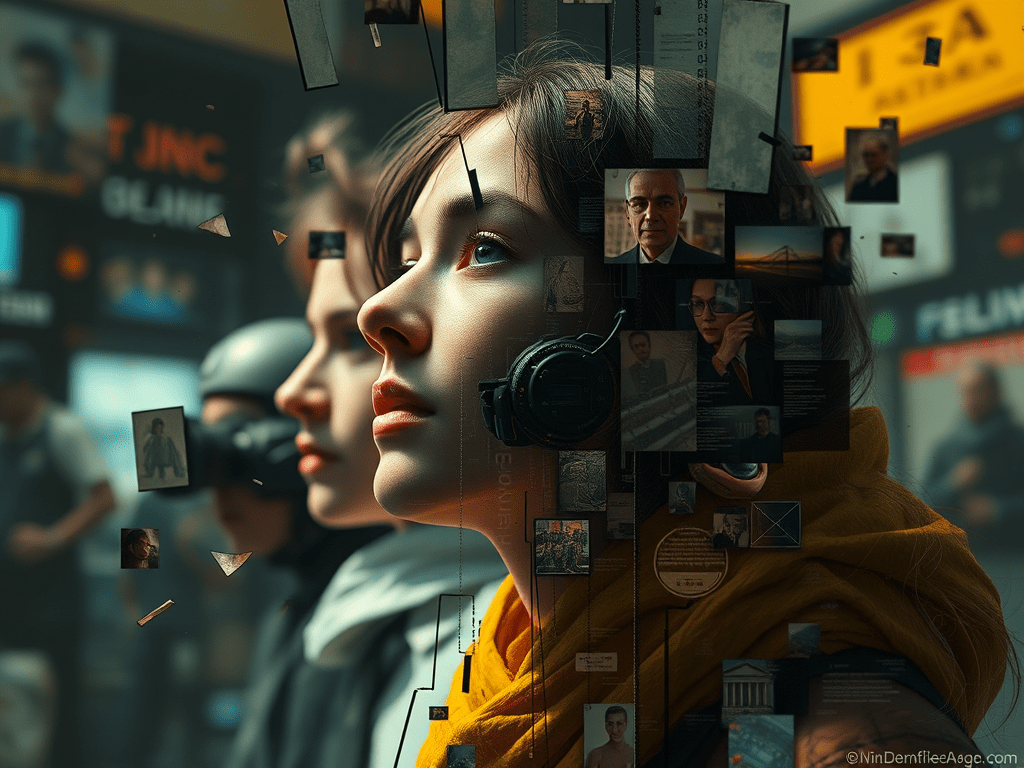
If the third article examined how blame reshapes identity and corrodes dialogue, this next movement in our reflection draws us deeper into the form of the rupture—how it manifests in perception itself. The rupture between generations, between past and present, is not only cultural or ideological. It is also sensory, cognitive, temporal. It is lived in the way attention flickers, in how memory functions, in how meaning itself is absorbed and forgotten.
We live in the age of the image.
A World in Pieces
Images have always held power. But what distinguishes our era is not the image itself, but the way it dominates the flow of consciousness. Our collective memory has shifted from narrative to impression, from continuity to fragment. In this condition, the eternal thread that once linked generations through shared story, ritual, and thought is cut—or, more precisely, buried beneath a deluge of content.
The image speaks in immediacy, in affect, in surface. It captures attention not by depth, but by force. In the ever-scrolling now of digital life, there is little space for unfolding, for meditation, for recollection. The image is not ordered into sequence; it is juxtaposed. And with this collapse of order comes the disappearance of inheritance. What once required transmission through time—language, wisdom, shared life—is now replaced by the flat simultaneity of spectacle.
Attention Without Memory
In the digital age, attention is no longer oriented toward meaning but toward novelty. Platforms like TikTok, Instagram, and YouTube do not merely distract—they condition the very structure of perception. The eyes move, the fingers swipe, but the mind does not linger. What is retained is not insight, but stimulation. We remember less and less because we are trained to remain on the surface of things.
This has profound consequences for the possibility of dialogue between generations. Elders, traditions, long stories—they require patience, silence, context. But the language of the image demands none of these. The young are not merely uninterested in the past; they are shaped by a medium that makes deep interest increasingly difficult. The past moves too slowly to register. It cannot compete.
The Fragmentation of Time
Tradition once functioned as a living memory, a continuity between those who came before and those who will come after. It allowed one to understand oneself not as a floating individual, but as part of a whole. Yet in the logic of the fragment, there is no whole. Each moment is self-contained, each impression untethered. Meaning becomes what moves us emotionally now, rather than what holds true across generations.
In this environment, time itself is flattened. The eternal, once glimpsed in the sacred rhythms of tradition and community, now becomes inaccessible. Without the thread of continuity, the eternal becomes confused with the ephemeral—either dismissed as outdated or distorted into fantasy. The result is not liberation from the past, but alienation from Being.
From Image to Word
Yet even now, in this world of images, the longing for depth persists. The heart still hungers for meaning, for connection, for what endures. And even the fragment can bear witness. A short video, a single post, a fleeting phrase—they too can become thresholds. But only if they are turned toward truth, not away from it. Only if the fragment gestures to the whole from which it comes.
We are not fated to forget. Even now, memory can awaken. Not the memory of events or data, but the memory of Being itself—the recognition that everything that appears belongs, and that even in the flood of images, truth continues to shine. The challenge is not to abolish the image, but to see through it.
In the next article, we will examine the myth of self-creation—the idea that each generation is an origin unto itself. In denying our roots, do we lose our place in the whole? Can autonomy be true without belonging?
 It Is What It Is
Leave a comment