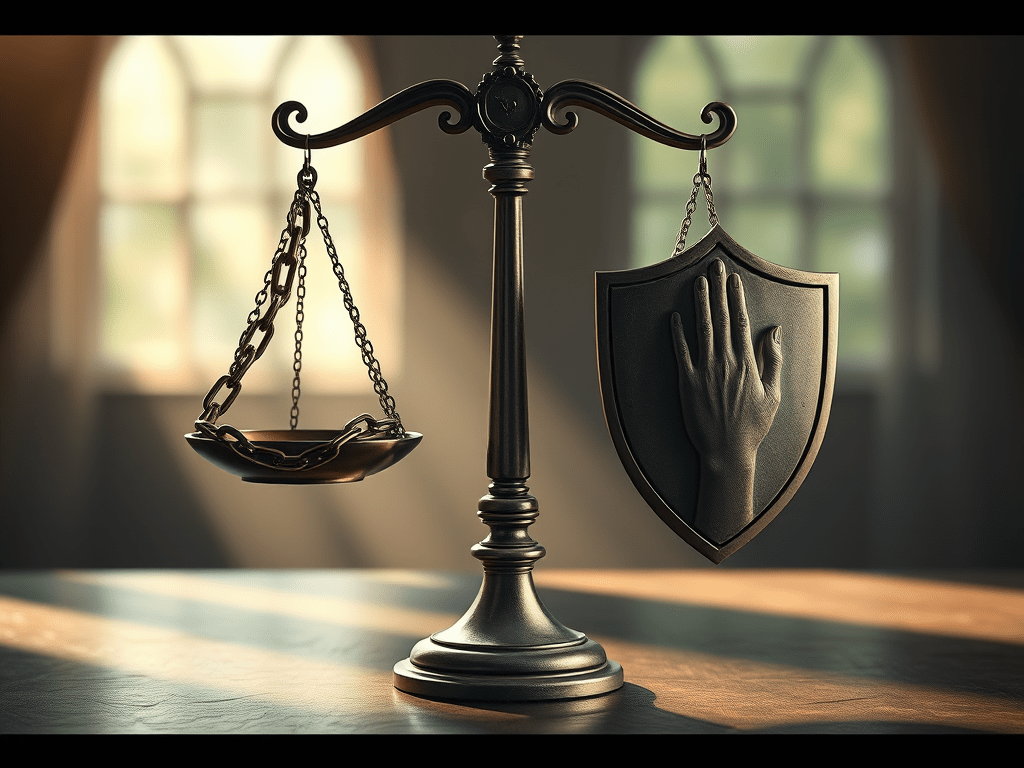
When Guilt Falls, What Holds Society Together?
The objection arises naturally:
Even if guilt is an illusion, isn’t justice still necessary? Don’t we still need laws, boundaries, consequences?
What happens to society when we no longer condemn?
The answer is not the disappearance of justice, but its transformation.
Justice does not vanish—it becomes response rather than retribution, protection rather than punishment, coherence rather than control.
What is falling away is not responsibility, but the false structure that tied it to blame.
The Need for Order Does Not Disappear
We do not deny that incoherence, conflict, and suffering appear.
People still harm others.
Communities still fracture.
Societies must still respond.
But the nature of the response begins to change when it is no longer rooted in:
- The belief that someone could have done otherwise,
- The belief that wrongdoers deserve to suffer,
- The belief that punishment restores balance.
These beliefs arise from the illusion that the self is a free cause acting from nothing. But as we’ve seen, the self is not sovereign—it is the site of a necessary appearing. Nothing that appears could have not appeared. The logic of blame collapses under the weight of truth.
And yet, this does not mean passivity.
It means something far more demanding: to respond not with reaction, but with coherence.
Protection Without Condemnation
What does justice look like when it no longer condemns?
It looks like this:
- Boundaries are set, not to inflict suffering, but to prevent further incoherence.
- Detention or limitation may be necessary—not to punish, but to protect.
- Restitution and reparation are not demands of guilt, but invitations to restore the clarity of relations.
A fire is not “blamed” for burning. But it is still contained.
Likewise, a person whose actions fragment coherence may need to be restricted—not because they “deserve it,” but because the appearance of Being calls for protection and re-alignment.
This view does not trivialize harm. It takes it more seriously—because it recognizes that the proper response to incoherence is not retaliation, but truth made visible.
The End of Moral Debt
Much of traditional justice depends on the notion of moral debt—that someone has broken a rule and must now “pay” for what they’ve done.
But this structure rests on a metaphysical fiction: that a different outcome was possible, and that one is guilty for not having chosen it.
Once this fiction falls, so does the economy of guilt and debt.
In its place, a new structure appears: not a scale to be rebalanced by punishment, but a field in which the necessity of Being is re-affirmed through response.
“Crime is not a wound in Being—it is a distortion in time. Being remains untouched, and thus offers the space for repair without condemnation.”
(Reflecting the logic found in Severino’s “Téchne. Le radici della violenza”)
Real Justice Is Not Reactive
To be reactive is to respond out of injury, fear, or offense.
To be just, in the light of eternity, is to respond from clarity.
This means:
- Justice does not seek to retaliate—it seeks to protect what is coherent.
- Justice does not isolate or shame—it makes visible the eternal that still shines, even in the one who has caused harm.
- Justice no longer divides the world into “the good” and “the guilty”—it recognizes that all beings are necessary, and that each has a place in the unfolding of truth.
This is not a naïve idealism. It is a realism more radical than any tradition of punishment.
For it dares to respond to harm without needing to hate, and to contain danger without denying the eternal.
When Response Replaces Judgment
Justice now appears as response: not the reaction of a wounded will, but the necessary unfolding of coherence.
Where blame once ruled, now clarity enters.
Where shame once silenced, now understanding speaks.
Where punishment once sought balance, now truth restores alignment.
This does not eliminate the need for limits, consequences, or social protections.
But it roots them in necessity, not guilt.
Transition:
If blame no longer motivates us, and fear no longer controls us, then what leads us to care? What moves us to protect, to love, to act?
The next article explores the true source of action, and how love appears—not as choice or obligation, but as recognition.


Leave a comment