Tag: Becoming
-
The Final Non-Duality 2 – Buddhism: Emptiness and the Movement Beyond Suffering
The Eternal Structure Misread as Impermanence Among the spiritual paths of the world, Buddhism stands out for its analytical clarity and radical focus on the problem of suffering. Its foundation — the Four Noble Truths — begins not with metaphysical speculation but with existential urgency: dukkha, the suffering that characterizes life, and the promise of…
Written by

-
The Final Non-Duality 1 – Advaita Vedānta: The Identity of Self and Brahman
The Eternal Truth Beyond the Path of Realization Among the world’s spiritual philosophies, few have exerted as profound an influence as Advaita Vedānta. With clarity and subtlety, it proclaims a truth that stands at the heart of the human search: that the Self (ātman) is not separate from the ultimate reality (Brahman), and that the…
Written by

-
The Final Non-Duality: Rereading Spiritual Traditions in Light of Being — Introduction
The Spiritual Quest and the Hidden Contradiction Across the world’s spiritual traditions, from ancient Vedānta to contemporary non-dual teachers, we encounter the same longing: a desire to overcome division, to dissolve the sense of separation, to awaken into unity. Whether spoken of as enlightenment, liberation, realization, or union with God, this quest appears as humanity’s…
Written by

-
The Last Dualism 3 – Awakening Without Becoming
The Contradiction of Enlightenment in the Light of Eternal Being The modern non-dual discourse is saturated with the language of awakening. One is said to awaken from illusion, from ego, from time, from the false self. This awakening is often described as a shift, a transformation, a sudden recognition, or the end of seeking. For…
Written by

-
The Last Dualism 2 – The Myth of the Body’s Illusion
Plato’s Legacy and the Persistence of the Great Dualism In the midst of today’s non-dual revival, a strange contradiction persists. While the language of unity, presence, and wholeness is widespread, the body—this visible, touchable, vulnerable being—is often spoken of as an illusion, a veil, a mistake. In countless spiritual teachings, the body is subtly or…
Written by

-
The Last Dualism 1 – What Is Truly Non-Dual?
Beyond the Confusion of Experience, Metaphor, and Ontology In recent decades, few terms have gained as much traction in spiritual and philosophical circles as “non-duality.” From Eastern teachings like Advaita Vedanta and Dzogchen, to Western spiritual movements, therapy sessions, and even casual Instagram posts, the term has become a kind of shorthand for ultimate truth,…
Written by

-
The Structure of Madness
Madness is the belief in what is not. The common image of the madman who is Napoleon is crude, but correct: he affirms nothingness. Pursue this logic, and all are mad. We are mad in our faith that will originates action, that “if” governs “then.” This is humanity’s primordial error. The Faith in Contingency This…
Written by

-
Beyond Materialism & Idealism 3: The Unveiling of the Necessary
After exposing the contradictions of materialism and idealism, we arrive at a crucial crossroads. Both worldviews, despite their opposing stances, share a fundamental flaw: they are rooted in the concept of becoming—the notion that reality either comes into being or evolves through mental processes. The only consistent and coherent alternative is the recognition of being…
Written by

-
Beyond Materialism & Idealism 2: Why Idealism Also Fails – The Limits of Mind as Reality
Materialism collapses under the weight of its own contradiction: it insists that things come into and out of existence, yet it offers no justification for this assumption. Idealism, often considered its intellectual counterpoint, seeks to overcome materialism’s limitations by placing mind or consciousness at the center of reality. However, despite its valuable critiques, idealism ultimately…
Written by

-
Beyond Materialism and Idealism: The Search for the Real
For centuries, materialism has shaped the modern worldview. It presents itself as a sober, evidence-based approach to reality—asserting that all things, including thought and consciousness, emerge from material processes and ultimately vanish into nothingness. Yet beneath its claims of objectivity lies an unexamined assumption: that things come into being and cease to be. This belief…
Written by
-
Identity 2: The Fragmentation of the Individual – Forces Dividing the Self in Contemporary Society
In the previous article, we uncovered identity as necessary (unchangeable and eternally true—it simply is) and eternal, hidden by misconceptions tied to time, nihilism, and cultural emphasis on becoming. Now, we turn to the fragmentation of the individual—how and why our true identity is obscured and divided in today’s world. Modern society, with its rapid…
Written by

-
Parmenides, the East, and the Question of Illusion
Across cultures and millennia, human thought has struggled with the same enigma: if Being is eternal, how do we account for the change and disappearance that fill our experience? Parmenides in Greece and the sages of the East each intuited the permanence of Being, yet consigned the world of appearances to illusion. Their insight was…
Written by

-
Babylon and the Apparatus: Beyond the Civilization of Technique
The Great City as a Timeless Symbol When Toynbee and Spengler spoke of the megalopolis, they described a concrete historical reality: cities that grow until they devour the life of a culture. But long before them, this same reality had already been intuited in symbols and myths. The Book of Revelation names it “Babylon the…
Written by
-
City, Country, and Destiny: From Toynbee and Spengler to Severino
The Ancient Tension Civilizations have always carried within them a tension between city and countryside. The countryside ties human life to the soil, the rhythms of nature, the continuity of community and tradition. The city concentrates wealth, intellect, and power, but often at the cost of uprootedness, alienation, and imbalance. This polarity has become particularly…
Written by

-
Mind & Heart – 1: The Existential Crisis and the Collapse of Meaning
The Necessity of Nihilism’s Appearance The contemporary crisis in mental health is not merely a matter of personal struggles or biochemical imbalances. The rising prevalence of depression, anxiety, and despair coincides with the dissolution of once-dominant narratives of meaning. This is no accident but part of a necessary unfolding. The decline of religious, philosophical, and…
Written by

-
Beyond Conditioned Thought: Article 4 – The NDE as an Unveiling—Death and the Fracturing of Time
The Near-Death Experience: A Radical Disruption of Ordinary Perception Near-death experiences (NDEs) represent one of the most profound disruptions of conditioned thought and perception. Those who undergo them often report a sudden detachment from their physical body, a feeling of weightlessness, an all-encompassing light, or encounters with deceased loved ones and transcendent beings. More importantly,…
Written by
-
Beyond Left and Right – Article 10: The Eternal City – Towards a Civilization Aligned with the Structure of Being
Western civilization, having undergone profound crises of meaning, has long been caught in the oscillation between competing ideologies—none of which have been able to provide a stable foundation. The failure of both progressive deconstructionism and reactionary restorationism points to a deeper issue: the absence of a necessary and indestructible foundation upon which civilization can rest.…
Written by

-
🗂️ Updated Glossary & Key Concepts
Understanding the Eternal Structure of Being in Light of Severino’s Thought This glossary introduces essential terms and distinctions for readers encountering the philosophy of Emanuele Severino and the paradigm of the eternal structure of Being. Each term is presented in accessible language, followed by clarifying analogies or diagrams where helpful. 1. Contraddizione C Definition: The…
Written by
-
Post 60 – Sexuality, Gender, Marriage, and Family as Expressions of the Structure of Being
Building upon the understanding of human relationships as necessary expressions of the eternal structure of being, we now turn to specific aspects of this reality: sexuality, gender, marriage, and family. In contemporary discourse, these elements are often viewed as fluid constructs, shaped by personal choice and cultural influence. A key aspect of this perspective is…
Written by

-
Post 59 – The Eternal Necessity of Human Relationships in the Structure of Being
Introduction: The Question of Human Relationships In the modern world, human relationships are often viewed as contingent, shaped by historical, cultural, and psychological factors. Friendships, romantic bonds, family ties, and even broader societal structures are frequently treated as mutable, open to individual or collective revision. However, from the perspective of the Structure of Being, relationships…
Written by

-
Post 58 – Beyond Method: Science and the Structure of Being
The preceding exploration of philosophy, mysticism, theology, and near-death experiences (NDEs) examined how different paths attempt to unveil truth. Each of these approaches, despite their differences, ultimately gestures toward the same reality: the immediate, self-evident appearing of truth. What remained unaddressed, however, is the role of science in this interplay. If science, too, seeks to…
Written by

-
Post 54 – The Paradox of Action: If Nothing Can Be Otherwise, Why Do We Strive?
The Question If we are a will, but our will is also our being and there is no becoming; if life unfolds as it is and not as a contingency subject to alternative options, then what is the use of trying to steer it one way or the other? If necessity determines all, what role…
Written by

-
Post 53 – Suffering, Guilt, and Resentment from the Perspective of the Structure of Being
Human existence is marked by suffering, guilt, resentment, and the struggle with wrongdoing. These arise from our experiences of loss, injustice, and the relentless passage of time. How can philosophy address such profound challenges? The Structure of Being offers a radical perspective—one that dissolves the assumptions underpinning these existential burdens by revealing the eternal nature…
Written by

-
Near Death Experiences 8: Conclusion: NDEs as an Expression of the Unfolding of Truth
Near-Death Experiences (NDEs) have long been the subject of debate—are they proof of an afterlife, hallucinations of a dying brain, or something else entirely? Throughout this series, we have moved beyond these conventional interpretations, recognizing that both the materialist and religious readings of NDEs remain confined within the assumption of becoming. Rather than proving or…
Written by

-
Near Death Experiences 5: The Perception of a “Return” and the Misconception of Leaving and Coming Back
A central theme in Near-Death Experience (NDE) accounts is the idea of returning. Many who undergo these experiences describe reaching a threshold—often depicted as a boundary of light, a door, or a vast expanse—before being told, or realizing, that they must go back. Some recount a choice, others an abrupt re-entry into their physical body.…
Written by
-
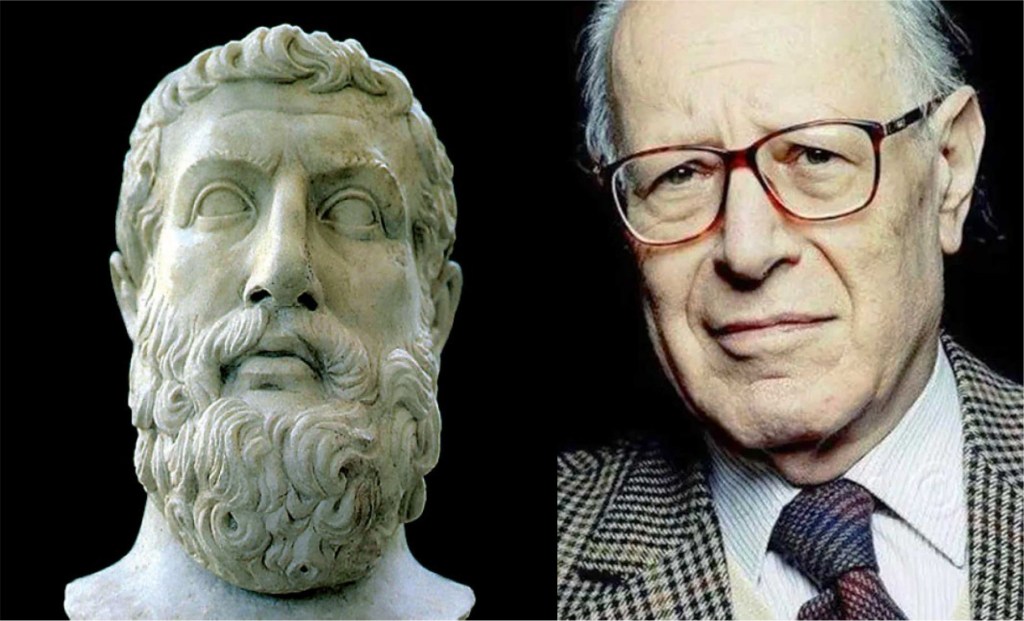
Post 43 – The Structure of Being: Its Unfolding from Parmenides to Severino
The history of Western thought is the history of the appearing of truth—an appearing that first manifested with Parmenides but remained incomplete, leading to millennia of nihilism before culminating in the necessity of its fuller recognition with Emanuele Severino. The unfolding of the structure of Being is not merely an intellectual progression but the necessary…
Written by
-
Understanding the Structure of Being – 7
The Challenge of Language: How Words Reinforce Illusion Language is the medium through which we express, conceptualize, and communicate reality. Yet, it is also one of the greatest barriers to understanding the eternal structure of being. The very words we use are steeped in the assumption of becoming—of things arising, changing, and perishing. As it…
Written by

-
Understanding the Structure of Being – 1
The Inescapable Belief in Becoming One of the most immediate and profound difficulties in understanding the Structure of Being is the deeply ingrained belief that things come into existence and pass away. This belief—what Emanuele Severino calls “becoming”—is not merely a theoretical assumption but a fundamental lens through which we perceive reality. We do not…
Written by

-
Understanding the Structure of Being: An Introduction
Many who first encounter the Structure of Being, as revealed in Emanuele Severino’s thought, find themselves facing profound difficulties—not because the truth is obscure, but because habitual ways of thinking resist it. The idea that being is eternal, that nothing truly comes into or goes out of existence, contradicts the deeply ingrained belief in becoming—the…
Written by

-
Near Death Experiences 2: The Illusion of Linear Time
One of the most pervasive features of Near-Death Experiences (NDEs) is their apparent structure as a journey—a passage from life to death, from darkness to light, from earthly existence to an encounter with something beyond. Many accounts describe moving through tunnels, crossing thresholds, or entering vast, radiant spaces. Others speak of being sent back, of…
Written by

 It Is What It Is