Tag: Emanuele Severino
-
The Wound of Time –5: What Appears Without Time — The Eternal Now and the Structure of Reality
We live as if the present is a razor’s edge — a vanishing point between past and future, always slipping away. We try to be present, to stay present, to return to the present — but no matter how we focus, the moment seems to dissolve the instant we notice it. The “now” appears to…
Written by

-
The Wound of Time – 1: The Appearance of Time and the Fear of Disappearing
There is a fear that runs deeper than all others — one that haunts every joy, waits at the edge of every accomplishment, and whispers beneath even our happiest moments. It is the fear that what is will not last. That we, and all we love, will vanish. That time will take everything. This fear…
Written by

-
Male & Female 3: The Necessary Unfolding – Beyond the Crisis to the Recognition of Being
The crisis surrounding gender identity is more than a cultural upheaval—it reflects a deeper metaphysical tension between the rejection of structure and the inevitable recognition of Being. As explored in the previous articles, the polarity of male and female isn’t a social construct to be discarded or reshaped at will; it is a necessary expression…
Written by

-
Male & Female 2: The Crisis of Gender – Modernity’s Challenge and the Illusion of Becoming
Modernity brought unprecedented change—technological progress, scientific discoveries, and social revolutions reshaped human life. Amid these transformations, traditional gender roles, once tied closely to function and hierarchy, began to shift dramatically. The shift reflects a broader cultural and philosophical movement: the rejection of fixed structures in favor of change and becoming. This movement, however, overlooks a…
Written by

-
Male & Female 1: The Polarity of Being – Male and Female as a Fundamental Structure
Polarity is woven into the fabric of reality. From the forces governing the cosmos to the tiniest particles in physics, the universe operates through the tension and balance between opposites. One of the most fundamental and enduring polarities is that of male and female. This polarity isn’t just a social or cultural construct—it reflects a…
Written by

-
Know Thyself – 8: The Rediscovery of Personhood: From Psychological Construct to Eternal Reality
Know Thyself: The Crisis of Identity and the Return to Being “Man is not merely a part of the world, but the place where the world begins to appear.”– Emanuele Severino The Disappearance of the Person In an age obsessed with identity, the person has all but disappeared. We speak endlessly of roles, traits, preferences,…
Written by

-
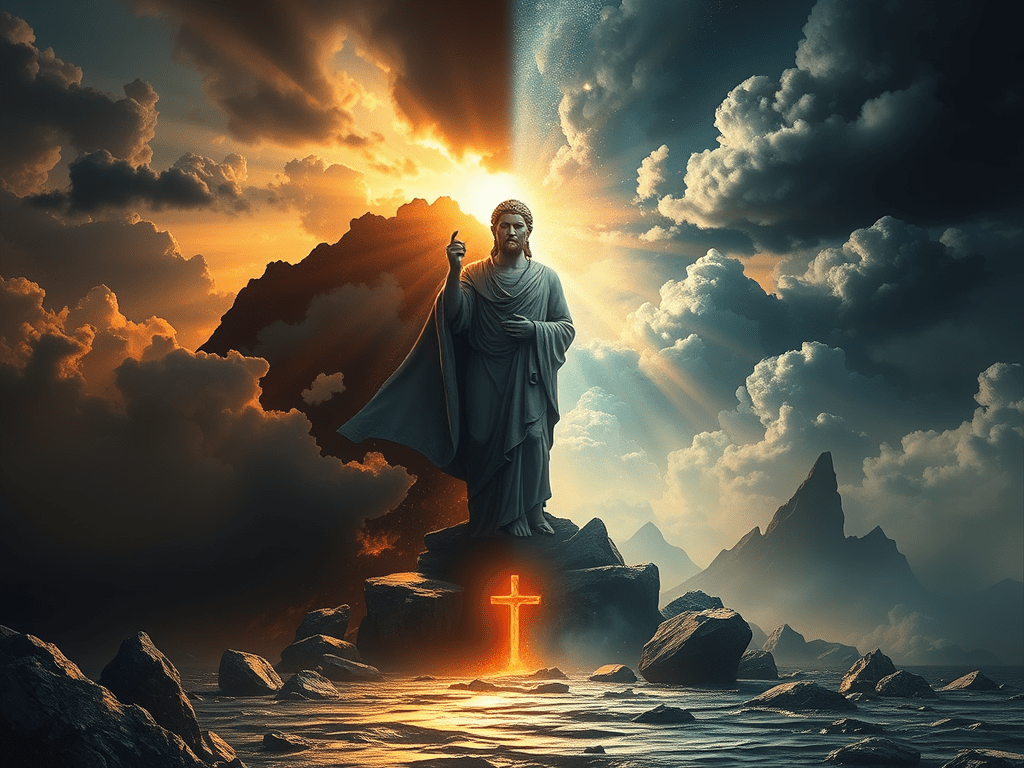
The Unfolding of Truth – 10: Conclusion – The Fulfillment of the Journey
A Journey Through Thought This has been a journey through the history of thought; not as a museum of ideas, but as the necessary unfolding of a single drama: the contradiction between Being and becoming. From Parmenides, who first glimpsed the immovable truth, to Plato, who gave structure to its reflection in the world of…
Written by
-
The Unfolding of Truth – 9: Emanuele Severino – The Inevitable Resolution of the Contradiction
The Final Contradiction The journey of philosophy, from Parmenides to postmodernity, is marked by one recurring drama: the tension between Being and becoming. Parmenides declared: Being is; non-being is not. And yet, all of history, Platonic dualism, Christian creation, Buddhist emptiness, modern subjectivity, has wrestled with the appearance of change: These questions have driven metaphysics,…
Written by

-
The Unfolding of Truth – 1: The First Light: Parmenides and the Emergence of Being
Before there were systems, there was wonder. In the earliest days of philosophy, Greek thinkers turned from mythos to logos; not to dismiss the sacred, but to seek its structure. Beneath the shifting appearances of the world, they began to ask: what abides? What is the principle that does not pass away? What is real?…
Written by

-
The Unfolding of Truth Through the History of Thought – Introduction
Throughout the history of human thought, there has been a persistent intuition, often obscured, often contradicted, yet never entirely extinguished, that reality is not what it seems. From the first metaphysical inquiries in ancient Greece to the contemplative insights of Eastern sages, from the mystical speculation of late antiquity to the rational rigor of modern…
Written by

-
Christianity and the Structure of Being–A Metaphysical Map
From Plato to the Eternal Structure of Being 🔹 1. Plato (4th c. BCE) Core Move: Eternal Forms vs. Temporal World 🡺 Impact: Introduces the first metaphysical dualism→ Sets up the world of change as ontologically inferior→ Seeds the logic of annihilation (what becomes can also vanish) 🔹 2. Early Christianity (1st–4th c. CE) Core…
Written by

-
Christianity and the Structure of Being – 2: The Infiltration of Platonism
How Greek Metaphysics Entered Christian Thought In its earliest centuries, Christianity encountered a world saturated with Greek philosophy. Among the many schools of thought that shaped late antiquity, none was more influential—or more seductive—than Platonism. Plato offered a majestic metaphysical vision: a realm of eternal, unchanging Forms—the true Being of which all sensible things were…
Written by

-
Christianity and the Structure of Being– Introduction to the Series
From Dualism to Destiny For centuries, Christianity has offered the Western world its deepest intuitions about the eternal: that life does not end in death, that the person is sacred, that love is stronger than the grave, and that a kingdom without end is not only possible—but promised. And yet, these luminous insights have long…
Written by

-
The Final Non-Duality 1 – Advaita Vedānta: The Identity of Self and Brahman
The Eternal Truth Beyond the Path of Realization Among the world’s spiritual philosophies, few have exerted as profound an influence as Advaita Vedānta. With clarity and subtlety, it proclaims a truth that stands at the heart of the human search: that the Self (ātman) is not separate from the ultimate reality (Brahman), and that the…
Written by

-
The Final Non-Duality: Rereading Spiritual Traditions in Light of Being — Introduction
The Spiritual Quest and the Hidden Contradiction Across the world’s spiritual traditions, from ancient Vedānta to contemporary non-dual teachers, we encounter the same longing: a desire to overcome division, to dissolve the sense of separation, to awaken into unity. Whether spoken of as enlightenment, liberation, realization, or union with God, this quest appears as humanity’s…
Written by

-
The Last Dualism 5 – Direct Cognition and the Necessity of Recognition
The End of the Search and the Fulfillment of Seeing There is a growing interest today in what many call direct experience, pure awareness, or non-conceptual knowing. People seek a state beyond language, beyond belief, beyond thought—something immediate and unmediated, where truth is no longer a theory but lived, seen, known. This yearning often carries…
Written by

-
The Last Dualism 1 – What Is Truly Non-Dual?
Beyond the Confusion of Experience, Metaphor, and Ontology In recent decades, few terms have gained as much traction in spiritual and philosophical circles as “non-duality.” From Eastern teachings like Advaita Vedanta and Dzogchen, to Western spiritual movements, therapy sessions, and even casual Instagram posts, the term has become a kind of shorthand for ultimate truth,…
Written by

-
The Last Dualism – Intro: How Non-Duality Preserves the Root of Nihilism
Introduction A growing chorus in contemporary spirituality and philosophy sings of non-duality, interconnection, and wholeness. Eastern traditions, modern mystics, and therapeutic modalities echo the same refrain: separation is an illusion, all things are ultimately one, and awakening lies in transcending dualistic thought. Terms like oneness, pure consciousness, and non-separation circulate freely, suggesting a new paradigm…
Written by

-
“I Am” – 1: The Unshakable Foundation of Being
The Most Certain Truth The search for truth often begins with questions about reality and existence: What is the nature of being? Yet, the most fundamental certainty is not found “out there” but within the immediacy of our own awareness. Before we inquire about the nature of reality, we must first recognize that we are.…
Written by
-
Beyond Materialism & Idealism 4: The Implications of the Necessary—Reframing Thought and Existence
This series has exposed the contradictions at the core of two dominant worldviews: materialism and idealism. Both are entangled in the impossibility of becoming, whether through the assumption that matter arises and perishes or the belief that reality is dependent on thought. Both, in different ways, attempt to explain being through non-being—an assumption that collapses…
Written by

-
Beyond Materialism & Idealism 3: The Unveiling of the Necessary
After exposing the contradictions of materialism and idealism, we arrive at a crucial crossroads. Both worldviews, despite their opposing stances, share a fundamental flaw: they are rooted in the concept of becoming—the notion that reality either comes into being or evolves through mental processes. The only consistent and coherent alternative is the recognition of being…
Written by

-
Beyond Materialism & Idealism 2: Why Idealism Also Fails – The Limits of Mind as Reality
Materialism collapses under the weight of its own contradiction: it insists that things come into and out of existence, yet it offers no justification for this assumption. Idealism, often considered its intellectual counterpoint, seeks to overcome materialism’s limitations by placing mind or consciousness at the center of reality. However, despite its valuable critiques, idealism ultimately…
Written by

-
Beyond Materialism & Idealism 1: The Faith of Materialism – The Unquestioned Assumption
Materialism presents itself as the most rational, scientific, and evidence-based perspective of reality. It claims to reject unfounded beliefs in favor of empirical knowledge. Yet beneath this confident exterior lies an unquestioned assumption: the belief that things come into being and pass away. This belief, which serves as the foundation of materialist thought, is neither…
Written by

-
Encounters with the Dead: A Perspective from the Structure of Being
Introduction: The Rising Accounts of Contact with the Deceased In recent years, reports of encounters with the dead have proliferated. Whether through mediumship, near-death experiences (NDEs), apparitions, premonitions, or personal intuitions, individuals claim to perceive or communicate with those who have passed. Traditional interpretations often frame these encounters within religious, spiritualist, or psychological paradigms. However,…
Written by
-
Parmenides, the East, and the Question of Illusion
Across cultures and millennia, human thought has struggled with the same enigma: if Being is eternal, how do we account for the change and disappearance that fill our experience? Parmenides in Greece and the sages of the East each intuited the permanence of Being, yet consigned the world of appearances to illusion. Their insight was…
Written by

-
Babylon and the Apparatus: Beyond the Civilization of Technique
The Great City as a Timeless Symbol When Toynbee and Spengler spoke of the megalopolis, they described a concrete historical reality: cities that grow until they devour the life of a culture. But long before them, this same reality had already been intuited in symbols and myths. The Book of Revelation names it “Babylon the…
Written by

-
City, Country, and Destiny: From Toynbee and Spengler to Severino
The Ancient Tension Civilizations have always carried within them a tension between city and countryside. The countryside ties human life to the soil, the rhythms of nature, the continuity of community and tradition. The city concentrates wealth, intellect, and power, but often at the cost of uprootedness, alienation, and imbalance. This polarity has become particularly…
Written by

-
Beyond Space-Time: Perception and the Eternal Structure of Being
Introduction: The Challenge of Perception Following our exploration of distinction without separation, we now turn to another fundamental question arising from near-death experiences (NDEs): the nature of space and time. Many who undergo NDEs report perceiving reality beyond temporal and spatial boundaries, experiencing past, present, and future as a single whole. This challenges the conditioned…
Written by

-
The Necessity of Contradiction: Understanding Suffering Through the Structure of Being
Introduction: The Question That Remains The series From Contradiction to Joy explored how the recognition of Being dissolves the illusion of suffering and reveals the necessity of joy and glory. Yet, one question still lingers: Why contradiction to begin with? Why does suffering, evil, war, and injustice appear in the unfolding of reality? This question…
Written by
-
From Contradiction to Joy – Article 5: The Inevitable Recognition: Toward the Fulfillment of Thought
The Unavoidable Necessity of Recognition The path we have traced—from the fundamental contradiction of nihilism to the infinite resolution of Being, from the dissolution of the tragic view to the fullness of glory—reveals a singular truth: recognition of Being is not a matter of belief or interpretation but the inevitable unveiling of what has always…
Written by

 It Is What It Is