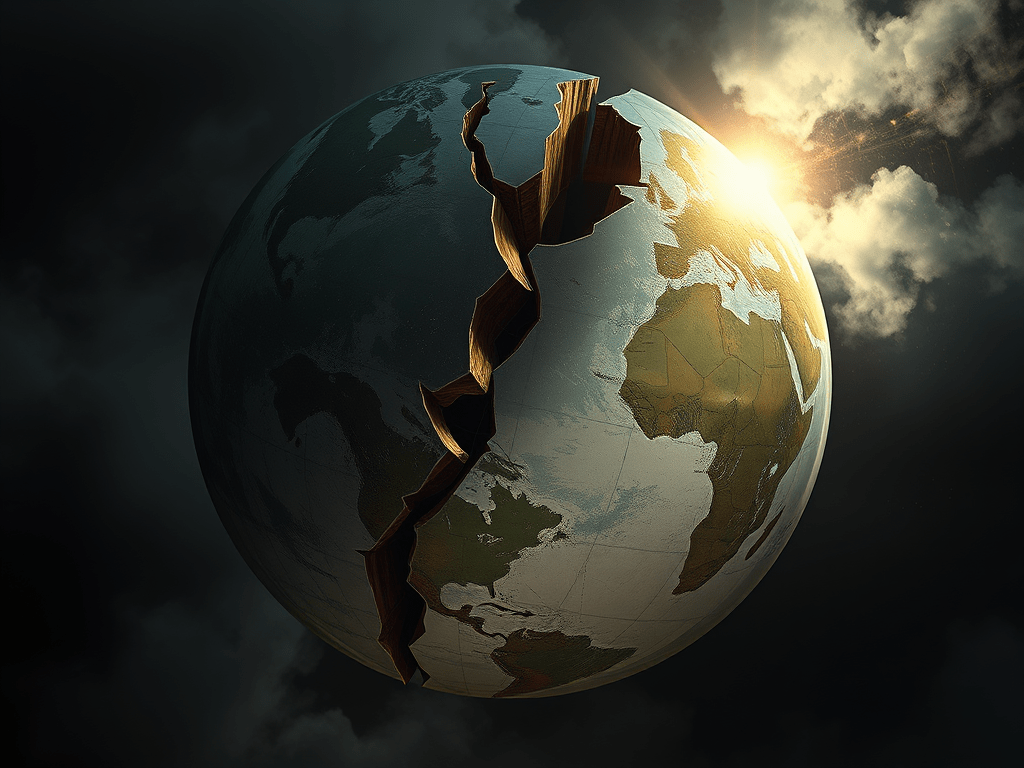
We often think of the current world crisis as something political or economic, something triggered by wars, shifting alliances, the collapse of trust in leadership. And while all this is visible on the surface, something deeper and more enduring lies beneath. What we’re witnessing is not merely a Western crisis, nor a contest between old powers and new; this is a civilizational exposure, one that reveals the fragile foundation on which the entire global paradigm has been built.
A Global Crisis, Not Just Western
The West appears to be unraveling. Its leadership falters, its institutions creak, and the values that once held it together now seem worn and hollow. But to frame this only as a Western decline is to miss the larger truth. Much of the rest of the world, even while seeking autonomy or alternative alignments, has deeply internalized the very foundations that have led the West to its current condition.
The logic of control, the faith in progress, the belief in the self as a solitary creator of meaning and future; these are not uniquely Western anymore. They have become global reflexes. And so, even as the West loses grip on dominance, the underlying logic that shaped it still guides the world’s actions. The crisis, therefore, is not local. It is ontological. It concerns what we believe to be real, and how we think reality itself unfolds.
The Reign of Contingency
Modern thought, whether scientific, political, or spiritual, assumes that beings are contingent: they arise from nothing and vanish into nothing. Things happen, shift, dissolve. History is a field of chance, where power and will battle over an uncertain future. In this view, nothing is fixed, nothing necessary, nothing sacred. Even the self is seen as a construction, a product of circumstances or choices that could have gone differently.
This is not merely a philosophical position. It is the implicit belief behind every institution, every economic system, every educational model. It is the silent grammar of modernity.
But if everything is contingent, then nothing holds. Nothing is safe. Anxiety becomes natural. The pursuit of control becomes frantic. And because nothing is granted as necessary, everything is feared as potentially lost.
This is the real foundation of the global crisis: not politics, but the denial of the necessity of Being.
The Illusion of Mastery
To live under the reign of contingency is to live under the illusion that we are the masters of time. If things arise from nothing, then the future is radically open, and we, supposedly, are the ones to shape it. Technology, policy, revolution: all seem to offer the means to mold reality.
But what if this very project is impossible?
The instability we see today is not simply the result of poor leadership or failed strategies. It is the natural outcome of a world that sees itself as groundless and yet believes it can construct meaning and permanence from that groundlessness.
Like building towers on sand, we grow frustrated when they collapse; unaware that the collapse is not accidental. It is the law of a world based on the denial of Being.
We seek control, but we do not understand what it is we’re trying to control. We think we are shaping history, when we are in fact resisting a truth that precedes and exceeds us.
Toward a Deeper Ground
What if the world is not a passing accident?
What if each being, each thing, person, moment, is not an arbitrary occurrence, but the necessary appearance of what cannot not be?
This is not a belief or a comforting thought. It is the recognition that no being is reducible to a process, a probability, or a fiction. Each thing that appears, appears not from nothing but from its eternal belonging to the structure of what is.
This recognition does not lead to passivity, but to clarity. It does not ask us to withdraw from the world, but to see the world as it is: not as a project we must save, but as the unfolding of what already holds.
When we no longer see Being as accidental, we no longer panic when it appears differently than we expected. We no longer rush to fix, fight, or force. We begin to listen, to witness, to walk in the world not as anxious owners, but as present ones.
The Unavoidable Return to Truth
The old world is collapsing; not because it was evil, but because it was founded on illusion. The truth is not against the world, but moves through it, even when denied.
And now, as the structures of mastery falter and the myth of control grows thin, something else becomes possible: the return of truth. A recognition that cannot be silenced forever.
This recognition does not need names or systems to validate it. It begins when we see that nothing, no being, can come from nothing. That what is, is. And that this “is” is not a momentary flicker in time, but the eternal fullness of appearing.
The world does not need another empire, another savior, or another program. It needs to remember what no control could create or destroy: the unshakable ground of Being.
 It Is What It Is
Leave a comment