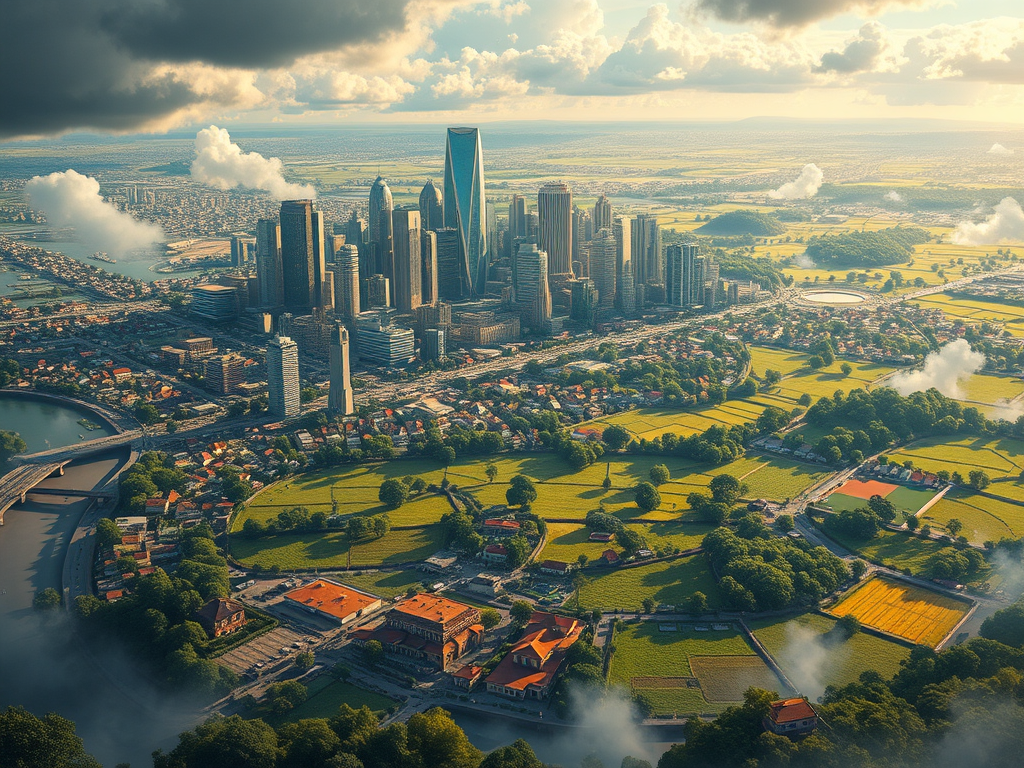
The Ancient Tension
Civilizations have always carried within them a tension between city and countryside. The countryside ties human life to the soil, the rhythms of nature, the continuity of community and tradition. The city concentrates wealth, intellect, and power, but often at the cost of uprootedness, alienation, and imbalance.
This polarity has become particularly visible in modern times, where political polarization often maps less onto “right vs. left” than onto urban vs. rural ways of being. But the conflict is not merely political; it is civilizational.
Toynbee: The City as a Cancer
Arnold Toynbee warned that great cities expand like a cancer. Just as cancerous cells multiply at the expense of the organism, cities consume the resources of the countryside, concentrating people and wealth while weakening the larger body of civilization.
For Toynbee, this unchecked growth is not progress but pathology: the loss of balance between organism and environment, tradition and innovation, rootedness and abstraction.
Spengler: The Fate of the Megalopolis
Oswald Spengler, in The Decline of the West, saw the megalopolis as the final stage of a culture’s life.
- A culture begins with deep ties to the land, myth, and sacred tradition.
- As it matures, it builds cities that eventually dominate and drain the countryside.
- The rise of the megalopolis marks the shift from culture to civilization, from organic, creative life to technical, administrative, and economic structures.
The metropolis, for Spengler, is both the summit and the exhaustion of a culture. It represents intellectual brilliance, cosmopolitanism, and power, but also sterility, anonymity, and disconnection from the sources of meaning. Its triumph signals that decline is inevitable.
Severino: Technology as the Ultimate City
Emanuele Severino radicalizes this analysis. For him, it is not just the city but technology itself that represents the destiny of the West.
Technology is the most consistent expression of the West’s original belief: that beings come from nothing and return to nothing. Because all things are thought to be provisional, they must be dominated, controlled, and transformed. Technology is the boundless process that seeks to secure mastery over becoming, and in doing so, it gathers all beings (city and country alike) into its network.
From this perspective, the city-country opposition becomes a stage within a larger horizon. The city embodies the restless logic of becoming, while the countryside faintly recalls permanence and repetition. But in the age of technology, both are absorbed into the same planetary system of production, efficiency, and control.
Destiny Beyond Decline
Here Spengler and Severino converge and diverge. Both recognize that the city’s triumph is inseparable from exhaustion, and both see technique as the defining feature of our age. But:
- For Spengler, the megalopolis is the tombstone of culture. Civilization dies, and history moves on.
- For Severino, technology is not the end but the prelude to revelation. Its boundless expansion makes visible the hidden assumption of the West: that what exists can slip into nothingness and that new things can emerge from nothing.
This, Severino argues, is the real root of our anxiety and restlessness. If everything is destined to vanish, then we cling to power, progress, and technology in the hope of mastering impermanence.
But this belief itself is the illusion. What exists cannot fall into nothingness. The things we see as “born” and “dying” are not being created or destroyed, but appearing and disappearing within the horizon of our experience. Nothing true is ever lost.
So the exhaustion Spengler described is not the final word. It is the threshold where the illusion of becoming wears thin and the deeper truth begins to shine:
- that nothing real is ever annihilated,
- that every being is eternal,
- and that what we call decline is also the unveiling of what never declines.
Technology, like the megalopolis, accelerates the illusion of becoming until it can no longer be sustained. And when that illusion collapses, what appears is not merely decline, but the eternal ground in which all things already stand.
 It Is What It Is
Leave a comment