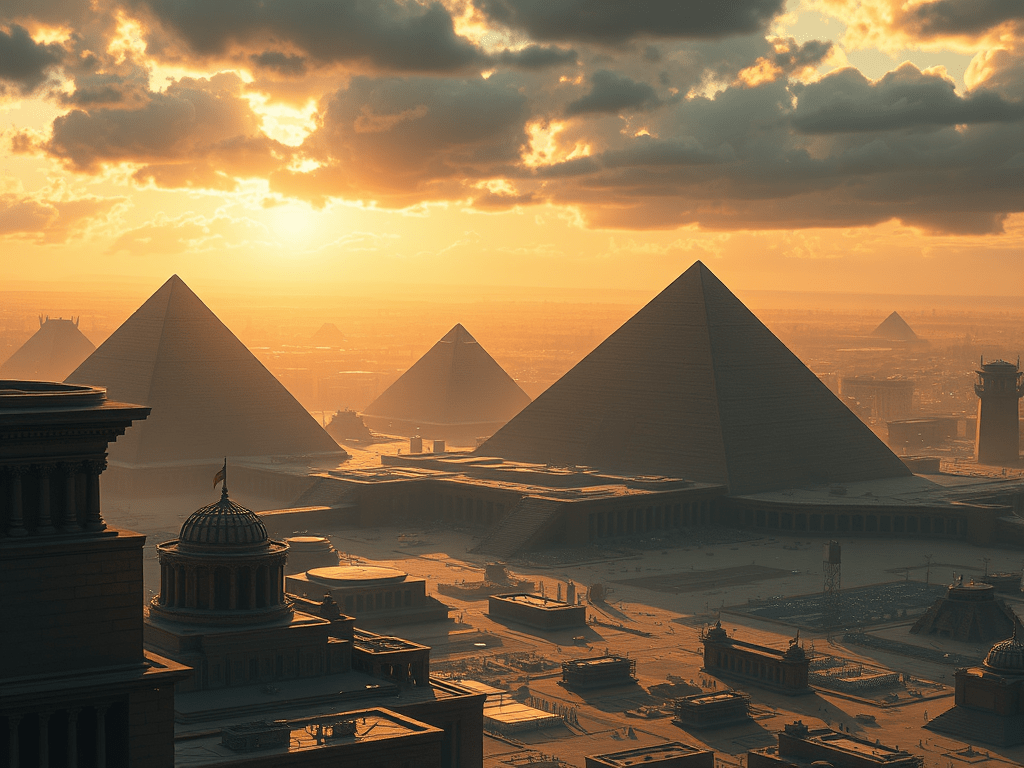
The Great City as a Timeless Symbol
When Toynbee and Spengler spoke of the megalopolis, they described a concrete historical reality: cities that grow until they devour the life of a culture. But long before them, this same reality had already been intuited in symbols and myths.
The Book of Revelation names it “Babylon the Great, the mother of abominations.” A city that enslaves the nations, that dominates with wealth, seduction, and power, until it collapses under the weight of its own corruption.
Babylon is not just an ancient city, nor only a prophecy of Rome or of some empire yet to come. It is the intuition of a global system: a totality where economy, politics, culture, and desire are drawn together into a single force that both sustains and enslaves. In biblical imagery, the “city” becomes the figure of the world-system itself.
Severino and the Apparatus
Emanuele Severino describes something strikingly parallel in the modern age: the rise of the scientific-technological Apparatus (Apparato tecnico-scientifico).
The Apparatus is not just machines or laboratories, but the entire network of economic, political, and social structures that allow techno-science to expand without limit. Finance, governments, universities, corporations, armies — all of them are increasingly subordinated to the logic of technological power.
In this sense, the Apparatus is the modern form of Babylon: a planetary system that gathers everything into itself, promising security and progress, but revealing, at its root, the anxiety of a civilization that believes everything is destined to vanish.
The Philosophy of the Future
But where Revelation sees the fall of Babylon, and where Spengler foresaw decline, Severino points to something deeper. The Apparatus — like Babylon, like the megalopolis — is not merely a historical accident, but the expression of the West’s primordial belief: that what is can become nothing, and what is nothing can become something.
This belief, which seems “self-evident,” is in fact the primordial error, the hidden madness. It identifies being with nothingness, and thus gives birth to nihilism. Out of this soil, both the great city and the great machine arise.
And this “primordial error” is not only the secret foundation of the West. It is the fracture intuited by myths and religions across the world — the fall, the rupture, the exile, the “original sin.” In every culture, we find the memory of a lost wholeness and the attempt to explain why humans live under the shadow of death and impermanence. Severino shows that this fracture is not an accident of history, but the universal illusion of becoming: the belief that what is can slip into nothingness.
The responsibility of philosophy today is therefore unprecedented. It is not to manage decline, nor to offer new utopias. Its task is to make visible that this “evidence” of becoming is false — and that what is, cannot not be.
Before the Beginning
This philosophy is “future,” but not in the Western sense of a time that is “not yet.” It belongs to a dimension that is older than the oldest past: the eternal.
It shows that the truth was always present — in myth, in religion, in ideology — often projected, rarely seen in clarity, but never absent. Babylon, the great city, is one such projection: an image of the system that enslaves by concealing eternity.
The philosophy of the future will not only show the end of nihilism. It will show that what we call past, present, and future are not three separate domains through which things march and eventually perish. They are the ways in which the eternal appears. Nothing real is ever “past,” nothing true is ever “yet to come” — every being abides, even as it appears now, withdraws, or awaits its moment to shine again.
In this light, history is not the record of what was lost, but the unfolding of what is eternal. Prophecy is not the prediction of something not-yet, but the symbolic anticipation of what always was. The “ground” that humanity has sought in gods, myths, ideals, and systems is not something to be built or recovered: it was never missing. It has always been the condition of every appearance, the soil from which nothing can be torn.
To recognize this is to see that the so-called “future” of philosophy is really the clarity of what was always here: the eternal shining through the temporal, uniting beginning and end, above and below, heaven and earth.
The End of the World and the Eternal Kingdom
Toynbee and Spengler saw the city as pathology and decline. Severino recognized in technology the culmination of the West’s path. But beyond decline and exhaustion lies destiny:
- the recognition that becoming is impossible,
- that nothing true is ever lost,
- that every being is eternal.
The ancient images of prophecy — the “end of the world,” the descent of the Kingdom, the vision of a new heaven and a new earth — point toward this same truth. They are not about the annihilation of creation, but about the unveiling of what was always present: that the Kingdom is already within, that heaven and earth are not two, but one.
The “end” that so many traditions foresaw is not the end of being, but the end of the illusion of becoming. It is the collapse of Babylon — the collapse of nihilism — and the dawning of clarity. The new earth is nothing less than the recognition of eternity shining through the temporal, the realization that what is above and what is below, what is eternal and what appears, have never been separate.
Philosophy’s responsibility now is to say this with clarity: the light long intuited in myth and religion is not absent. It is here, always. What comes is not the loss of the world, but the unveiling of its eternal ground.
 It Is What It Is
Leave a comment