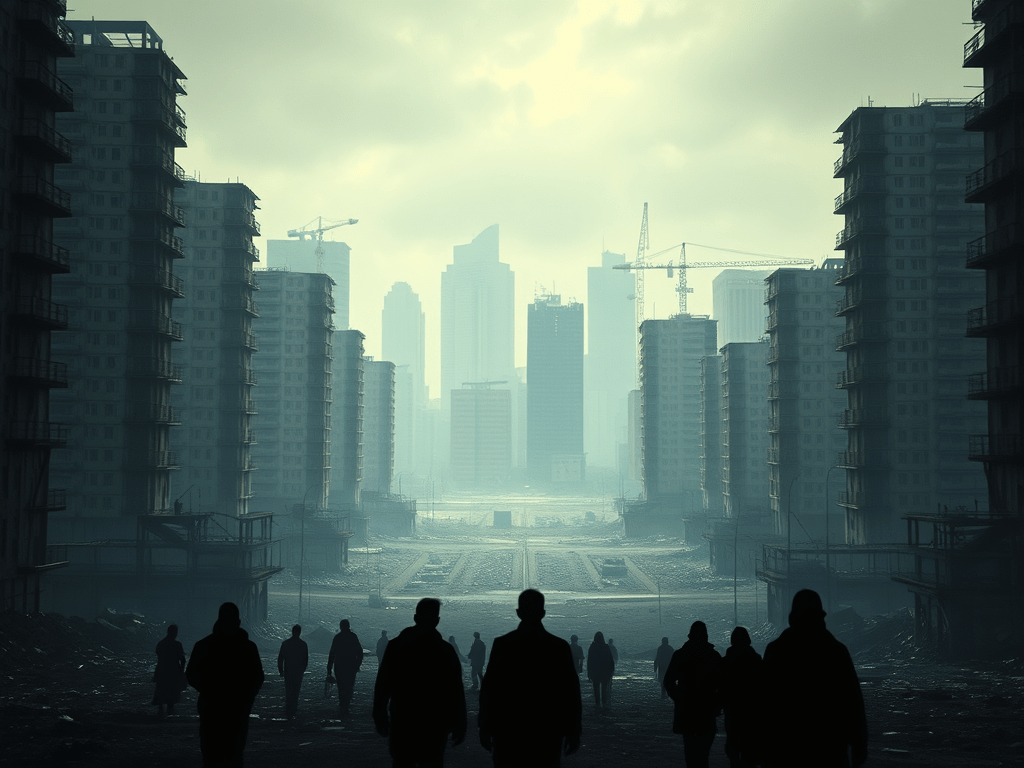
We are witnessing not a problem to be solved, but a fate to be understood. The converging crises of demographic implosion, unsustainable debt, and societal aging are typically diagnosed as separate policy failures: a lack of childcare incentives, flawed economic models, or medical advances that have outstripped our wisdom. But to see them this way is to mistake the symptom for the disease.
These phenomena are the biological and financial epiphany of a deeper, civilizational condition. They are the logical outcome of a world that has subordinated all value to the mechanisms of control and consumption, a process now reaching its final, self-canceling stage. The falling birthrate is the most profound vote of no confidence a civilization can cast; not against a government, but against the future itself. It is the physical embodiment of a spiritual void, a literal choice for nothingness over continuity.
As the human foundation crumbles, we must not expect a return to community, tradition, or faith. These older sources of meaning have already been dissolved by the very forces that now dominate. Instead, the only successor is the logic of global technocracy, which will accelerate its dominion in response to the crisis.
The aging, shrinking population will be framed not as a human tragedy, but as a systems-management puzzle. The individual is reduced to a set of problems to be optimized: a pension liability, a healthcare cost, a missing worker. In this landscape, the system of pure management will pursue its solutions with a ruthless, impersonal logic:
- The Replacement of the Human: Artificial intelligence, robotics, and automation will be aggressively deployed not just in factories, but in nursing homes, hospitals, and homes, attempting to replace the relational and caregiving functions that a depopulated society can no longer provide.
- The Human as a Managed Resource: The system will seek to maintain its stability by any means necessary. This will lead to intensified financial manipulation: devaluing currency and savings to manage unpayable debts, and the treatment of mass migration as a simple labor-supply tool. This is not a solution, but the next phase of the problem: the importation of human capital as fuel for the economic machine, inevitably leading to greater social fragmentation and the final erosion of cohesive cultural identity.
The death throes of the old order will not be peaceful. The instinctual drive for self-preservation of nations, corporations, and political factions will intensify as resources become scarcer. The politics of ideology will devolve into a more primal politics of resentment and survival. The “silent majority,” which today withdraws from the exhausted game of partisan flags, may be radicalized not by a new ideal, but by the direct threat to its material existence. This phase will be characterized by a frantic and escalating struggle, a clear manifestation of a world where collective action has broken down into a bare contest for the remnants of a dwindling world.
This trajectory feels like a descent into darkness. Yet, it is a necessary and even revelatory passage. The demographic collapse is the ultimate, undeniable demonstration of the core illusion of our age: the belief that we can create meaning through endless control and consumption, only to find it leads to an existential void. A civilization that perfected the individual as the ultimate consumer has biologically enacted its own core nihilism; it is producing nothing.
But it is precisely in this absolute culmination of the old way that its failure becomes complete. When the technocratic system, despite all its power, cannot ultimately solve the despair encoded in a birthrate below replacement; when the drive for control, in its final struggle, reveals only exhaustion and self-cancellation, a space opens for a different kind of thought.
This is the horizon of a fundamental shift in consciousness. It is not a political program, an economic reform, or a religious revival. It is the emergence of a thought that is no longer based on the will to dominate, transform, or control existence, but on the contemplation of its inherent, unassailable value. The inevitable decline of the West becomes the grand, tragic spectacle that reveals the futility of the entire project of mastery.
In the silent ruins of the future we chose not to have, we may finally be compelled to stop. And in that cessation, in the profound failure of our doing, we might at last begin to see. We may recognize that the entire frantic history of our modern civilization, with its glorious rises and its necessary, implosive fall, never truly touched or diminished the one thing that is real: the inviolable and necessary ground of being that we, and all that is, have always inhabited.
The peace that follows will not be the peace of a solved problem, but the peace of a finished illusion. It is the recognition that the source of our terror, the specter of nothingness we see in our empty cradles and balance sheets, was always a mirage, obscuring a truth that was too simple, too vast, and too eternal to need our desperate defense.
 It Is What It Is
Leave a comment