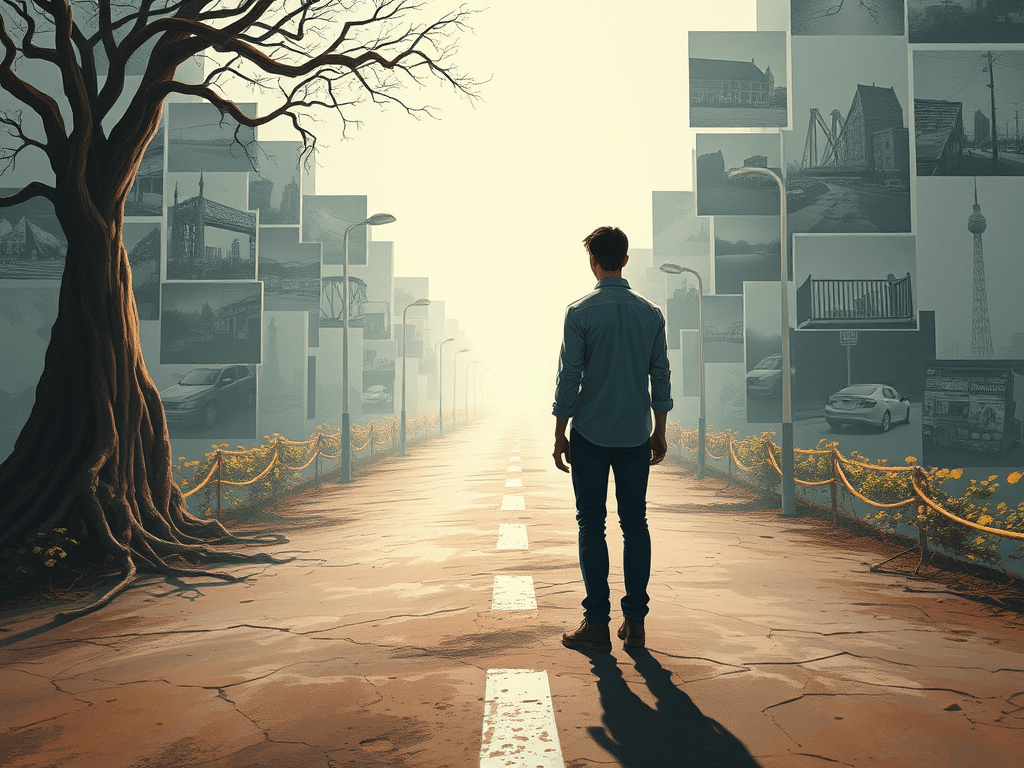
In the fragmented world of images and isolation, another myth has quietly taken hold of the modern imagination—the myth of the self-made self. Inherited not from the past but from the fever of modernity, it whispers to each generation that it must begin again. That the truth lies not behind, but only ahead. That one’s value is not given, but must be earned, asserted, invented.
This myth lies at the heart of the generational severing. It tells us that to be free, we must be unbound—that autonomy requires forgetting. But autonomy, when cut loose from Being, becomes not freedom but burden.
The Weight of Unrooted Freedom
We are told that the mature individual is the autonomous one. But the modern concept of autonomy is haunted by a contradiction: it seeks independence not as an unfolding within a structure, but as the denial of any structure. It says: “You must define yourself.” Yet it offers no ground from which to do so. The self is turned inward, tasked with the impossible: to generate meaning ex nihilo.
This is not empowerment—it is abandonment. The child is told to be strong, but is denied the inheritance of strength. The young adult is told to choose, but is given no truth from which to choose rightly. And the weight of this freedom, lacking foundation, becomes unbearable. The autonomy we celebrate is, in truth, the loneliness of contingency.
The Fear of Belonging
Beneath this myth lies a deeper fear—a fear of roots, of inheritance, of belonging. In a culture where the past is suspect and the eternal dismissed, to belong is seen as weakness. We are trained to associate identity with limitation. To say “I come from” is heard as capitulation. And so we cut the thread. We orphan ourselves—not biologically, but metaphysically.
Each generation repeats this act with new justification. The old were racist. The old were repressive. The old were wrong. Perhaps. But what cannot be denied is that the rupture itself becomes a pattern. It is not merely rebellion—it is ritualized amnesia. And with each forgetting, the burden of self-creation grows heavier.
The Illusion of the Origin
There is no such thing as a self-made person. No generation creates itself. No individual arrives from nowhere. Even the desire to “reinvent” oneself arises within a field already shaped by language, culture, thought. The belief in self-origination is not only historically false—it is metaphysically incoherent.
To appear is to be part of the eternal. And the eternal is not invented—it is revealed. What we are, we are necessarily. And what appears—our families, our histories, our memories—appears within a structure that transcends will. To recognize this is not to lose oneself. It is to come home.
The Return to the Lineage of Being
The myth of the self-made generation can only dissolve when autonomy is understood not as detachment, but as participation. One becomes oneself not by negating what came before, but by entering into it more fully—by recognizing that what appears, appears within the eternal order of truth. True freedom is not the absence of roots, but the flowering of what is already grounded.
To honor one’s roots is not to return to the past in nostalgia. It is to witness that nothing that has appeared can be erased. Our task is not to start anew, but to see anew—to recognize that our being has always already belonged.
In the next article, we turn to modernity’s disdain for simplicity and silence. Why does the “primitive” provoke contempt? What is lost when mystery is replaced by mechanism? Can eternity still be heard in a world that never stops speaking?


Leave a Reply