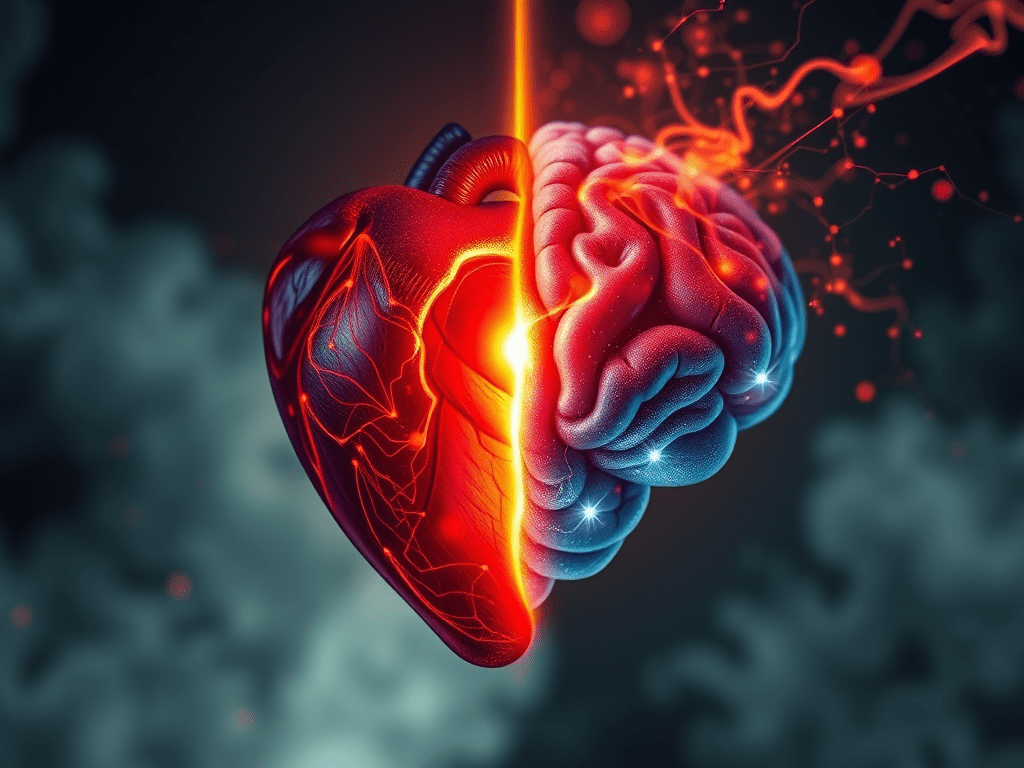
There is a tension each of us knows.
One part of us longs to trust—to rest in what feels immediate, intimate, and real. Another part wants clarity, structure, and proof—something we can hold and explain. We often call them the heart and the brain. One speaks the language of love, intuition, presence; the other speaks in logic, reason, and conceptual order.
Both seek truth. Yet both, at times, feel as if they’re leading us in opposite directions. We try to follow the heart, but begin to fear we’re deluding ourselves. We try to follow the brain, but start to feel lifeless, mechanical, disconnected.
So we go back and forth. We trust, then doubt. We feel deeply, then analyze everything to death. We crave a truth that moves us, but also one we cannot deny.
This is not just a psychological dilemma. It is the surface expression of a deeper contradiction—a split that runs through history, philosophy, religion, and ultimately through the very way truth itself has appeared to us.
The Symbols of a Deeper Drama
The heart and the brain are not enemies. They are symbols—living symbols—of something larger.
- The heart echoes what we might call faith: a trust in what is given, in what shows itself without needing to be proven.
- The brain reflects what we often call reason: the will to understand, to make coherent, to establish certainty.
This tension is not new. It is ancient. It lies at the center of human history—where myth gave way to philosophy, where religion tried to marry revelation and logic, and where modernity broke them apart again.
We often treat this division as a problem to be solved by balance. “Use both,” we say. “Think clearly, but feel deeply.” And while this may offer temporary peace, it does not resolve the deeper unrest.
Because the problem is not just that heart and brain are in tension. It is that both are reaching for something they cannot grasp alone—something neither one creates, something that must already be.
A Deeper Question
What if the conflict between heart and brain, faith and reason, is not a mistake? What if it’s a necessary contradiction—one that reveals the limits of both paths?
And what if this contradiction, pushed to its edge, does not lead us to choose one over the other, but to see what neither one can contain?
What if the truth we seek is not something we build with reason, nor believe in blindly with faith, but something that appears—necessarily—before both?
The Series That Follows
This short reflection is the beginning of a deeper inquiry.
The five-part series that follows does not offer a new doctrine or a synthesis of opposites. It traces a movement: the movement of truth as it has appeared through myth, through philosophy, through faith and reason, and finally through their collapse into contradiction.
What it reveals is not an answer to be accepted, but a structure to be seen—one that cannot be denied once it appears.
This series is for those who feel the split within, and who are ready to ask whether the split is not the end, but the beginning of a greater recognition: that truth is not constructed, but inevitable; that Being cannot not be; and that the heart and the brain, at last, were never enemies, but signs of the longing for what has always already appeared.
 It Is What It Is
Leave a comment