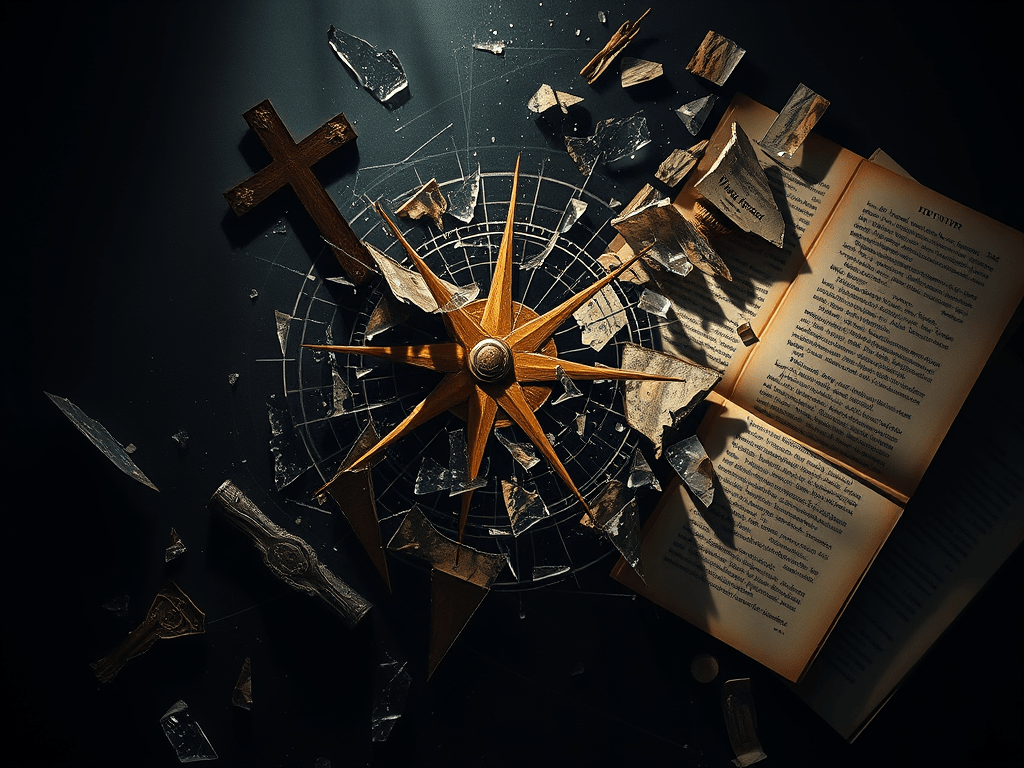
The Fragmented Century
The 20th century did not offer a resolution to the struggle between myth and reason, faith and thought. Instead, it bore witness to their collapse—an implosion of opposites that no longer knew how to speak to one another. On one side, existential philosophy and post-structuralism exposed the fractures in the project of reason; on the other, religious revivals and spiritual movements emerged to fill the void, often shedding the rigor of theology or the structure of tradition. It was not a synthesis but a scattering.
After the breakdown of grand narratives—both religious and rational—human thought found itself in a space of disorientation. Nietzsche’s declaration that “God is dead” was not the end of theology, but the beginning of its haunting absence. Sartre’s atheistic existentialism claimed that man was condemned to freedom, thrown into a world without essence. At the same time, Heidegger, though not explicitly theological, reawakened the question of Being through a kind of philosophical mysticism, revealing that the forgetting of Being lay at the heart of the West’s path.
This was not a transition into clarity, but a deepening of ambiguity. Reason, once triumphant in the Enlightenment, now questioned itself. Faith, once absolute, now fragmented into personal experience, private belief, or militant fundamentalism. No pole stood uncontested. Each exposed the other’s inability to hold the whole.
The Illusion of Alternatives
In this chaos, a false binary emerged: choose either hard rationalism or spiritual relativism; either cold skepticism or emotional mysticism. But this choice itself was already a symptom of the deeper fracture. The world no longer trusted reason to lead to meaning, but neither could it return to the innocence of myth. Both had been deconstructed, exposed, questioned.
Postmodern thought did not reject truth entirely—it simply questioned its accessibility, its unity, its very structure. Foucault spoke of power and discourse, Derrida of différance and the impossibility of presence. Truth, in these views, is never what it seems, always deferred. Yet even these critiques unwittingly affirmed the problem they sought to dissolve: they bore witness to the impossibility of arriving at truth through the existing frameworks.
On the other side, reactionary movements clung more fiercely to tradition, not because of renewed conviction, but because of fear—fear of meaninglessness, of instability, of collapse. Thus, fundamentalism arose not from the strength of faith, but from its crisis. It was the attempt to halt the unraveling by affirming the letter of belief when the spirit was already fleeing.
What both sides missed is that the fragmentation is not a flaw. It is not a cultural misstep to be corrected by better education, purer dogma, or more refined critique. It is the necessary appearance of a deeper contradiction.
The Necessary Contradiction
Severino helps us see that what appears in history—fragmentation, contradiction, collapse—is not accidental. It is the necessary unfolding of a deeper structure. The apparent opposition between myth and reason, faith and thought, heart and brain, reveals something essential: the impossibility of becoming.
The West’s trajectory is not a movement from ignorance to knowledge, from superstition to science. It is the gradual, painful unveiling of an impossibility that was hidden at the core of every worldview that presupposed change, contingency, and separation. Each attempt to grasp the whole—whether through mythic intuition or conceptual rigor—carried within itself a contradiction. It assumed that being can become, that what is can pass into what is not, that truth can emerge from non-truth.
But Being does not become. What is, is—eternally, necessarily, without contingency. Every effort to represent the whole, while denying this necessity, leads not to resolution but to implosion. And yet, this implosion is not an end. It is the very sign that truth is beginning to appear.
In this light, even the confusion of postmodernity is not an error. It is the exposure of a structure that can no longer sustain itself. It is the final trembling of thought before it begins to recognize what cannot be denied.
Between Despair and Yearning
The 20th and early 21st centuries have swung between despair and yearning. On one end, nihilism—no truth, no meaning, only flux, power, and interpretation. On the other, a hunger for transcendence, often expressed through vague spiritualism, esotericism, or a return to ancient myths.
But neither can resolve the rift. Despair emerges when the intellect denies what the heart still senses: that truth must be. Yearning arises when the heart affirms what the intellect cannot justify. We oscillate between poles, unable to bring them into unity, because we still believe that unity must be constructed.
Yet the truth is not constructed. It is not a synthesis we build from fragments. It is the ground that has always been present, hidden beneath the illusion of becoming. The contradiction cannot be resolved by siding with one pole against the other, or by mixing them into a compromise. It can only be resolved by seeing that the contradiction itself is impossible.
To despair of truth is to forget that Being cannot not be. To yearn for truth is to sense what already is. The poles collapse because they were never truly opposed—they were expressions of the same concealed necessity.
The Edge of Recognition
We are not witnessing the failure of philosophy or the breakdown of religion. We are witnessing the end of a certain way of thinking—the way of becoming, of construction, of contingency. The confusion of our age is not a darkness to be feared, but a threshold.
To stand at the edge of contradiction is not to be lost. It is to be in the most privileged position: where the illusion reveals itself, where the veil begins to lift, where the eternal appears—not as something new, but as what has always been.
Severino’s insight helps us reframe this moment. We are not in a crisis because something is wrong, but because something true is being unveiled. The end of oppositions, the collapse of poles, the silence of systems—all of this is the necessary clearing through which truth can appear.
This truth is not a return to an earlier stage. It is not myth, religion, or philosophy in their previous forms. It is the recognition that all forms are appearances of Being, and that Being is eternal. The contradiction of becoming has reached its limit. Now, thought begins to remember.
A World in Labor
Everything around us bears the marks of this transition. Political ideologies splinter into incoherence. Scientific frameworks strain under the weight of paradox. Religious traditions either ossify or dissolve. Personal identities fragment and reform with dizzying speed.
These are not signs of collapse, but of labor. The world is not ending—it is giving birth to the recognition that it cannot end. What is, is. And what appears as fragmentation is the necessary prelude to a different seeing.
This does not mean the pain disappears. On the contrary, as long as contradiction still structures our thinking, pain persists. But we are approaching the turning point where contradiction no longer holds. The edifice of thought built on becoming is crumbling. Not into ruin, but into openness.
This openness is not blank. It is filled—already—with the presence of Being. The eternal structure has never ceased to appear. What changes is not the truth, but our way of seeing it.
Conclusion: Toward the Final Resolution
With the collapse of the poles, we do not face an absence of meaning but the exhaustion of every attempt to construct it. What remains is not nothing—but what has always been: the necessity of Being.
This moment is not a dead end, but a gateway. The appearing of contradiction marks the threshold of recognition. We begin to see that the mythic and the rational, the religious and the philosophical, the subjective and the objective—all are ways in which truth has tried to appear under the illusion of time.
But now, the illusion is breaking. And with it, the opportunity arises for the first time to see Being as it is: eternal, full, indestructible.


Leave a Reply