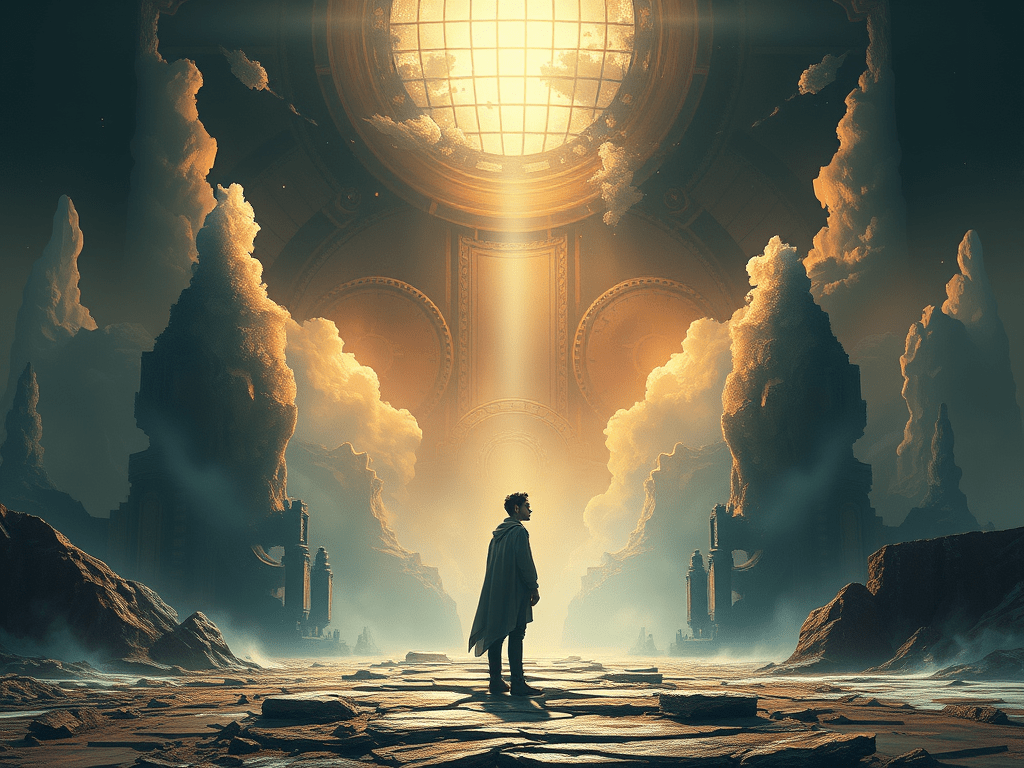
Introduction: The Crown of Reason
There is perhaps no moment more decisive in Western consciousness than the exaltation of reason in the modern age. It arrives with fanfare and confidence, casting off the veils of superstition and declaring the dawn of enlightenment. For many, this marked a liberation from the oppressive dogmas of the past. Science advanced, technology transformed the world, and human understanding flourished. At last, it seemed, we had taken control of our destiny.
But beneath this triumph, something subtle began to fracture. The sacred receded. Meaning withdrew. And while the light of rational clarity brightened the world of objects, it left the soul in shadows. This article examines how the rise of reason, while necessary in the unfolding of truth, also revealed a deeper contradiction—one that would lead not to the mastery of reality, but to a profound dislocation of thought from Being.
The Enlightenment and the Dismissal of the Sacred
The modern world was born in the conviction that human reason could unlock the mysteries of the universe. The scientific revolution, with figures like Galileo, Newton, and Descartes, set the stage for a vision of reality governed by laws discoverable through observation and logic. Enlightenment thinkers pushed this further: the world was intelligible, orderly, and—most importantly—knowable without recourse to faith or myth.
This shift was not merely intellectual. It was metaphysical. The world was no longer seen as a living cosmos infused with divine presence but as a machine, an assembly of matter governed by neutral laws. Truth was no longer revealed through sacred symbols or inner vision but through empirical data and deductive reasoning. Rationality became the highest authority. Mystery was not to be revered, but to be solved—or discarded.
In this sense, the Enlightenment did not simply challenge religious authority. It severed the ontological connection between Being and meaning. What had once been held together by the sacred—intuition and concept, presence and word—was now divided. What could not be measured was dismissed as illusion or subjective preference.
The Autonomy of Reason and the Birth of the Modern Subject
This exaltation of reason brought with it a new image of the self. The modern subject emerged as autonomous, self-directing, and capable of mastering the world through knowledge and technique. The Cartesian cogito—I think, therefore I am—became the cornerstone of modern identity. Here, being is no longer anchored in the eternal or the divine, but in the act of thinking itself.
Yet this move introduced a radical isolation. The self is now abstracted from the world it knows. The “thinking subject” and the “objective world” stand opposed. Reality becomes what is out there, while the knower stands apart, deciphering it from a distance. The ancient unity of knower and known, thought and Being, is broken.
In gaining autonomy, reason also lost its foundation. Without the ground of Being—without the eternal necessity that gives meaning—thought becomes a function of human will, and truth becomes provisional, debatable, contingent. Rationality, once heralded as the path to clarity, now floats without anchor in an ocean of perspectives.
The World Disenchanted
Max Weber famously described modernity as the “disenchantment of the world.” This phrase captures the existential cost of reason’s triumph. The ancient world saw the cosmos as filled with signs, meanings, presences—each thing bearing witness to an unseen fullness. Modernity stripped this away. Forests are no longer sacred groves; stars are no longer signs of destiny. Everything is what it is, and nothing more.
This disenchantment was not accidental. It was intrinsic to the rationalist project. To understand the world “objectively” meant eliminating subjectivity, affect, and mystery. The world became transparent—but also mute. In its transparency, it lost its voice.
With this came a growing sense of alienation. The universe, once intimate and symbolic, became cold and vast. Human life, once seen as part of a divine unfolding, now appeared as an accident of evolution on a minor planet. Meaning, if it existed at all, had to be invented.
Relativism and the Crisis of Meaning
The very tools that were meant to clarify truth ended up undermining its coherence. As reason extended its reach, it exposed the cultural, psychological, and historical conditions of belief. Philosophical reflection, from Hume to Nietzsche, began to unmask the limits of rationality itself. If reason could be turned on religion, it could also be turned on reason.
In place of certainty, a pluralism of worldviews emerged—each internally coherent, none absolute. Postmodernity made this explicit: all truths are constructed, all perspectives partial. The result was not liberation, but vertigo. In denying the eternal, reason also denied itself the possibility of grounding. Logic could analyze structures, but it could not reveal meaning. Science could describe processes, but not purpose.
The crisis of the modern mind is not that it reasons too much—but that it reasons without ground. The triumph of reason, in exiling myth and faith, revealed that reason alone cannot sustain itself. It cannot answer the question of why anything matters. It cannot say what is good, or true, or necessary. It can only calculate, predict, and doubt.
The Illusion of Control and the Will to Mastery
This hollowing of meaning did not lead to resignation. It led to a new will: the will to control. If Being could not be known, it could be managed. If truth could not be discovered, the world could at least be reshaped according to human purposes. Technology became the new theology. Progress replaced salvation. Efficiency replaced wisdom.
Yet this control was never total. In fact, the more it advanced, the more fragile it revealed itself to be. The ecological crisis, the breakdown of meaning, the loneliness of modern life—these are not side effects. They are symptoms of a deeper contradiction: that we have tried to build a world without ground, without eternity, without the presence of what-is.
The isolated mind, crowned by reason, finds itself in a world of its own making—but unable to rest, unable to see, unable to hear the silent radiance of Being. In seeking mastery, it has severed the very bond that made understanding possible.
Severino’s Insight: The Hidden Contradiction of Modern Thought
For Emanuele Severino, this entire trajectory—myth, religion, rationalism—is not simply historical. It is structural. Each stage reveals a necessary unfolding of the contradiction at the heart of Western thought: the belief that Being can become nothing, and that what-is can pass away.
The triumph of reason does not overcome this contradiction—it exposes it. By denying the eternal, reason affirms the supremacy of becoming, of flux, of contingency. But in doing so, it undermines the very conditions of intelligibility. For if everything becomes, then nothing is. And if nothing is, then even reason is impossible.
This is not a condemnation of rationality. It is a clarification. Reason is not the enemy of truth—but when isolated, it becomes blind. Severino does not call us to abandon thinking, but to think more deeply—to see that even the apparent fragmentation is part of a necessary path: the unveiling of the eternal structure of Being.
The Turning Point: From Fragmentation to Recognition
We are not witnessing the collapse of reason, but the exhaustion of its isolation. The modern world, with its technological marvels and existential wounds, has reached the limits of autonomous thought. It has explored the full implications of a world without ground—and found them unsustainable.
But this exhaustion is not a dead end. It is a threshold. For in reaching the limits of its own light, reason becomes open once more to what it had forgotten—not myth, in its ancient form, nor religion, in its institutional guise, but the eternal. The necessary. The ground that does not pass away.
This turning is not regression. It is the next movement in the unfolding of truth. The apparent exile of Being was never its absence. Even the silence of the modern world is filled with the echo of what cannot not be. Even the loneliness of the isolated mind bears witness to the presence it cannot name.
Conclusion: Beyond the Triumph of Reason
The triumph of reason was never a final victory. It was a stage—a necessary detour—in the revelation of a deeper truth. By exhausting its own possibilities, rationality has revealed its limits. But it has also prepared us to see anew.
The sacred cannot return as it was. But neither can it be forgotten. What is required is not a return to myth or a denial of reason, but the recognition of their hidden unity in the eternal structure of Being.
The next article will turn to the contemporary world, where this fragmentation reaches its most acute form: a culture adrift, a soul disoriented, and yet—within the very breakdown—a hidden unveiling of truth.


Leave a Reply