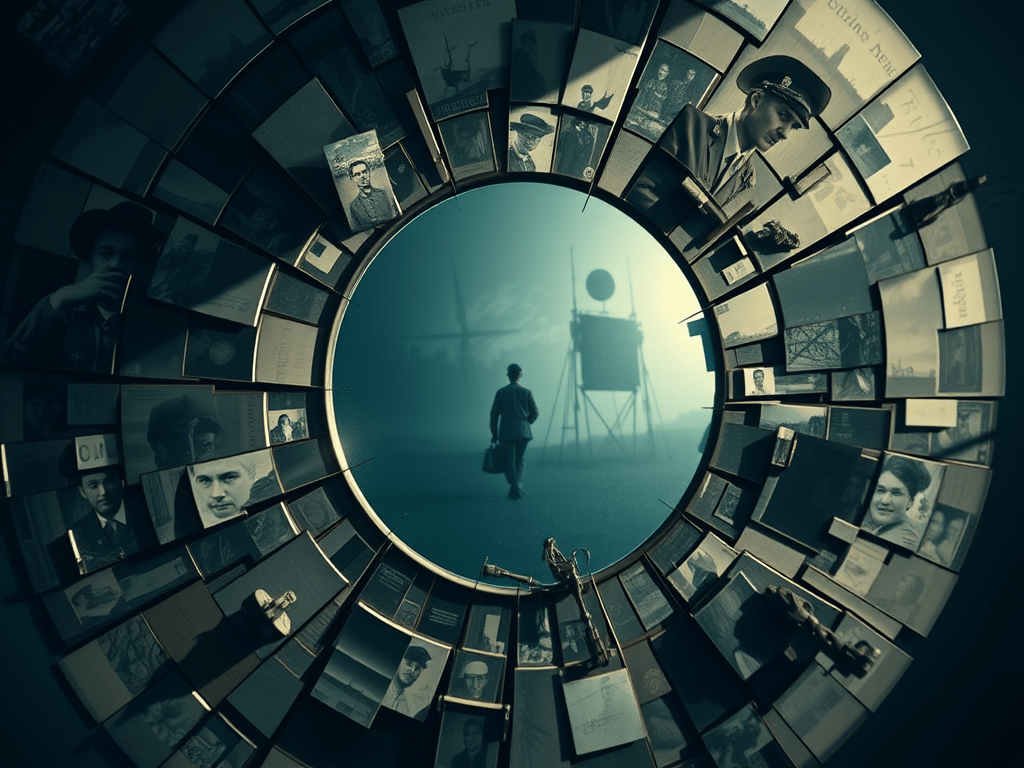
Memory, Propaganda, and the Broken Mirror
Memory and Power: The Will to Frame the Past
The past is not what happened, but what is remembered—and how.
Even the most honest account is never neutral: every narration decides what to include, what to omit, where to begin, and where to end. History always hovers between recounting and justifying, between preserving memory and legitimizing power.
In traditional societies, this ambiguity was contained within the sacred. Events found meaning not in causal sequence but in symbolic coherence; history reaffirmed what does not change. Modernity dissolved that frame. The sacred gave way to contingency, and truth became something to be produced. History turned into a tool of ideology—no longer describing what was, but shaping what must be believed.
The birth of modern historiography coincided with that of the nation-state. Peoples needed histories to bind them, narratives to define borders and values. But every such narrative served identity and power. Even liberation movements, though justified in reclaiming their voices, risked turning history into strategy rather than revelation. Thus memory, meant to recognize, became a battlefield—policed, weaponized, unstable.
Behind this struggle lies a forgotten question: why must we frame the past at all?
The urge to order memory arises from modernity’s deeper loss—the forgetting of Being. When the eternal structure is no longer recognized, the past becomes fluid, open to ownership and revision. History turns into a mirror, but the mirror is broken: the more we look into it, the less we see ourselves, or one another.
Ideology in the Guise of Remembrance
Modern history does not merely document—it positions. To claim the moral high ground, one must control memory. Suffering and triumph alike become sources of legitimacy. Memory becomes moral currency: we remember not to see, but to justify.
Victimhood turns into moral capital; heroism into redemptive myth. Guilt and innocence are instrumentalized. This is not accidental—it is the result of a history detached from truth. Once the eternal is forgotten, the past becomes construction, not revelation. Every side seeks narrative dominance, and when all see themselves as victims, dialogue collapses into opposing absolutes.
The symbols of memory—monuments, textbooks, commemorations—become instruments of belonging. To question them is to risk exile from the moral order. But the more memory is used to assign virtue or blame, the more brittle it grows. A people taught to remember only its wounds cannot see those of others; a nation that recalls only triumph becomes blind to its costs. Memory hardens into resentment, resentment into revisionism, and revisionism into denial.
True memory does not sanctify identity. It recognizes what is. It does not flatter the self or consolidate the group—it opens the gaze to what cannot be owned: the truth that appears, regardless of who looks.
The Mishearing of Civilizations
When history becomes a weapon, civilizations cease to hear one another. The West, in its global ascendancy, imposed not just power but meaning—assuming its categories were final. Enlightenment and empire carried the same hidden faith: that others would eventually become like us.
In response, the rest of the world oscillated between assimilation and resistance. Both remain trapped in the same dialectic: the frame set by the West. Even anti-colonial retellings often invert the hierarchy without transcending it—turning history into moral accusation rather than recognition.
But no civilization is “late” to Being, and none is “ahead.” Every worldview is a unique appearing of the eternal. True listening begins when we abandon the will to place the other on a timeline and recognize all cultures as necessary presences of what-is.
Without this, memory becomes manipulation, history becomes accusation, and difference turns to war.
Propaganda Without a Center
Propaganda once had a throne or pulpit. Now it has no center—only endless mirrors of influence. The internet has multiplied narratives, each claiming truth through feeling and belonging. Memory has become a marketplace.
This fragmentation reflects a deeper one: the loss of a shared recognition of Being. Without that light, every truth is provisional; coherence survives only as emotion or identity. Historical trauma becomes sacred and unquestionable. The past hardens into identity, and identity into moral absolutism.
The battlefield of memory now spans every screen and conversation. Propaganda no longer asks to be believed—only to be felt. But this reveals something profound: that the very idea of center has vanished. A civilization that forgets Being loses its axis and drowns in perspectives.
Only by turning to what-is can memory be freed of its weaponry. Only the eternal gives the past meaning beyond ideology.
The Forgotten Question: What Is?
Amid the noise of competing narratives, one question has vanished: what is? Not what happened, or who was right, but simply: what is?
History became a war of interpretations because Being was forgotten. Without that axis, truth dissolves into utility and identity. The Greeks once asked ti estin?—what is it?—to seek what remains through change. Modernity reversed that movement, enthroning becoming over being, fact over truth.
Yet the essence of what appears is not flux but necessity. Every being, every event, every suffering appears as part of the eternal structure. The denial of Being—what we call evil—has no substance of its own. Its defeat lies not in counter-power but in the inevitable unveiling of what is.
To ask what is? is to begin anew—not to rewrite the past, but to see its eternal necessity. Only then does history cease to be a battlefield and become what it always was: the manifestation of what cannot not be.
Closing Reflection: From Conflict to Clarity
Every struggle to reclaim or defend the past hides a deeper illusion: that truth must be won. As long as truth is sought in victory, remembrance will be bound to ideology.
But exhaustion reveals a threshold. When all stories fail to secure meaning, what appears is not chaos, but clarity—the recognition that no narrative can contain what-is. The task is no longer to “get history right,” but to see why we thought we could.
Coherence cannot be salvaged from chronology. It appears only in Being itself—the eternal light in which all stories unfold. To remember Being is not to forget history, but to see it as appearance: not as a field of winners and losers, but as the necessary unfolding of truth.
In this recognition, conflict yields to clarity—not the clarity of victory, but of peace.
The war of memory ends—not by silence, but by seeing.
 It Is What It Is
Leave a comment